

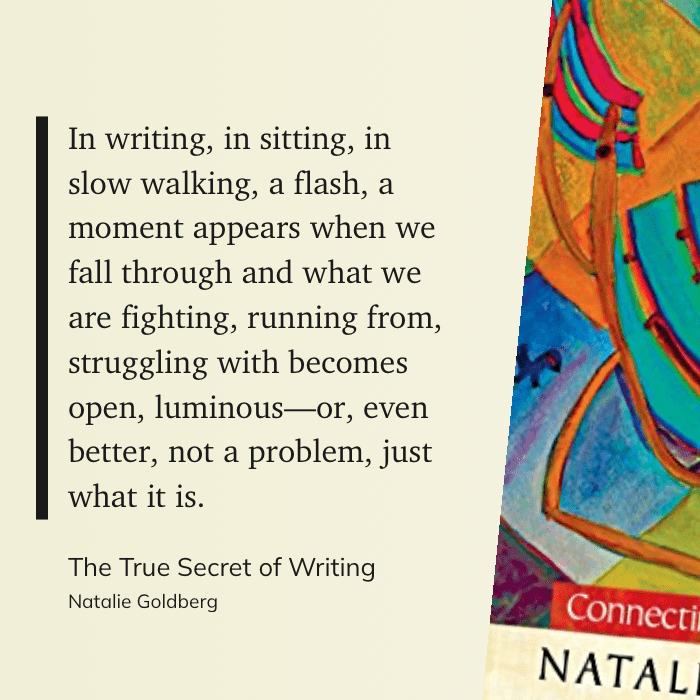
“In writing, in sitting, in slow walking, a flash, a moment appears when we fall through and what we are fighting, running from, struggling with becomes open, luminous—or, even better, not a problem, just what it is.” (Natalie Goldberg, The True Secret of Writing)
Goldberg treats this shift, where struggle becomes acceptance, as the foundation her whole approach to writing practice rests on. It suggests that our resistance to writing, to sitting, to any slow and deliberate act, is actually a signal of where we need to pay attention.
A regular practice builds what Goldberg calls a “spine of practice,” a kind of staying power that has little to do with whether the results are good. For Goldberg, this kind of work is a physical commitment. It happens in the body, in the act of showing up. It’s about letting the practice “enter your whole body,” whether or not the mind is on board.
The flash she describes is the moment a struggle loses its edges and settles into something plain and ordinary. As she points out, this opening can’t be forced. What we can do is “feed and fertilize the ground.”
That same flash shows up in her advice on meeting your own mind. Sitting down to write and meeting that initial resistance, the boredom, the “this is stupid,” the urge to check the news, shows you how your mind works under pressure. Move through it without judgment and you reach a quieter place, one where you can simply document your experience instead of fighting to change it.
What Goldberg calls the “secret” is really just presence, a willingness to meet whatever is arising. The struggle itself, when fully met, often becomes the material we need.
R.A.R.
If you would like to learn more about the craft behind storytelling, my articles on Ramos On Craft go deeper every Tuesday and Thursday. Subscribe here
 Rolando Andrés Ramos
Leave a comment