

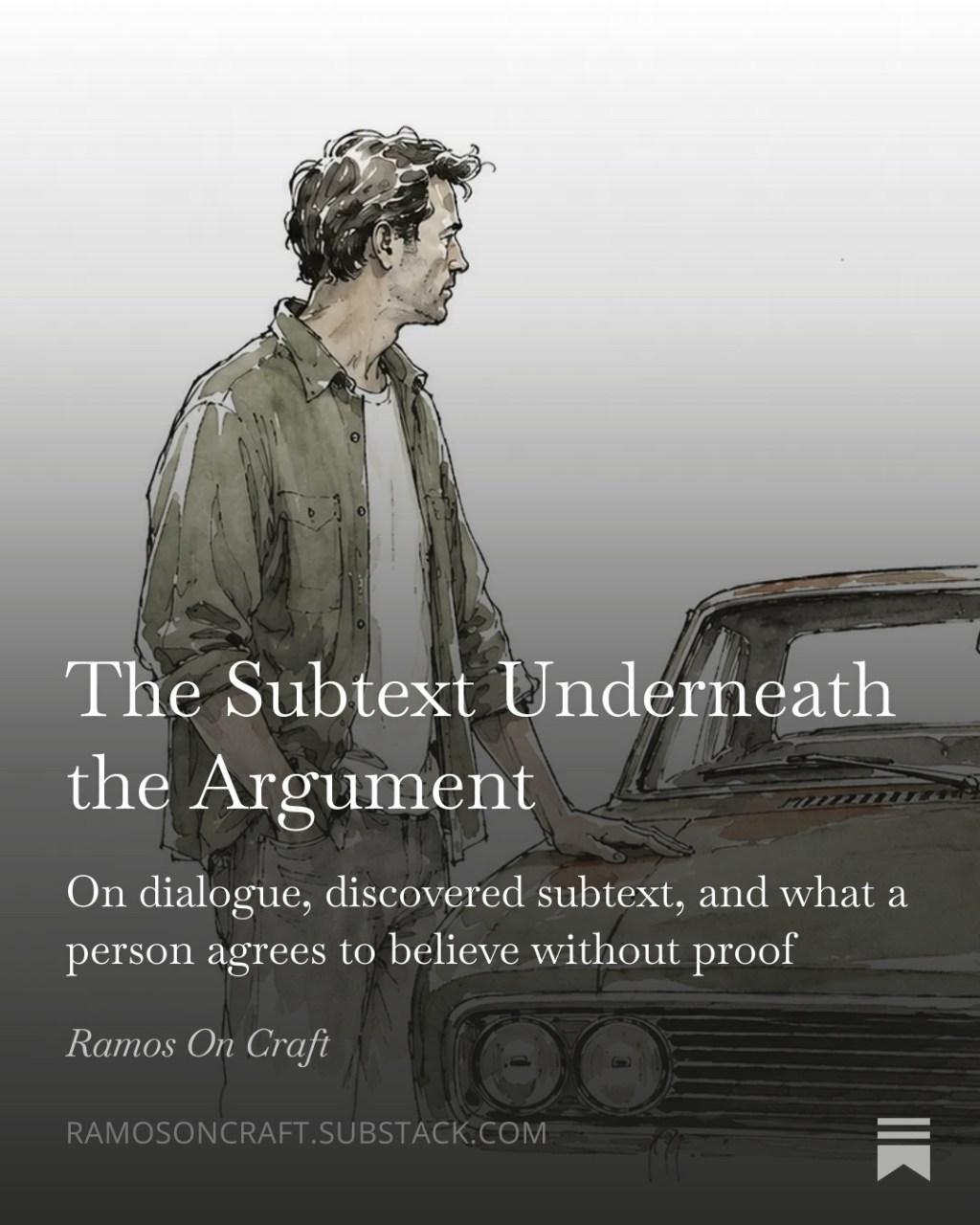
The gas cap was still warm under his hand when one of my characters stopped trusting the story his family’s business had been built on, or maybe he’d stopped trusting it years earlier and only said so now, his brother waiting, the hood of the car between them.
I had written three drafts of that scene believing the two men were arguing about whether to trespass onto a stranger’s property. They weren’t. One of them needed proof before he would risk anything for a story he couldn’t verify. The younger brother had already decided that some things become true the moment you act on them, provenance verified or family myth accepted without question.
Neither one said so directly. That’s the part that took me three drafts to hear.
A scene is almost never about what it claims to be about. The conversation actually moving a story forward usually happens somewhere underneath the one printed on the page, in what a character defends too hard, what gets answered with a question instead of an answer, what someone says with his hands while the other person watches his face for the answer his mouth won’t give.
Dialogue carries weight precisely because it can hold two arguments at once, the one the characters think they’re having and the one actually deciding something between them.
I didn’t plan any of this. I found it the way a writer usually finds the truest thing in a scene, later than expected, and only after the page had already decided what it was actually about. What that turned out to be is in the piece.
 Rolando Andrés Ramos
Leave a comment