

Hemingway cared about the sun and the gradation of light. Not the dramatic sky, not the storm, not the moment of spectacle. The quiet shift from dark to something almost gold. That attention, ordinary as it sounds, is what Natalie Goldberg had in mind when she wrote that in his best work so much is said by so little being said.
The principle of omission, which Hemingway carried like a private religion, holds that if a writer knows enough and writes truly, what is left out will be felt by the reader just as strongly as what is put in.
Most of us read that and nod. Fewer of us actually trust it.
The instinct when writing is to explain, to point, to make sure the reader does not miss what we are trying to say. But the writers worth studying do the opposite. Walter Mosley reminds us that only the important, the salient, the revealing details should be used, and that they cannot seem too important when we encounter them. George Saunders puts it simply. In a good story there is no waste. Even a brief description of a road is there for a reason. Colum McCann goes further and says the job is to find the one tiny atom that reveals the rest of the structure, and then to use it without pointing at it.
What this requires is not restraint exactly. It is selection. A sculptor does not add material. The writer who has learned this lesson does not describe everything in the room. She describes the one thing in the room that carries the weight of everything else.
I learned this gradually while writing my novel. The early notebook pages for Three Mangoes for Hemingway were full of everything, the smells of Key West, the texture of soil, the weight of a mango seedling in a character’s hands. I wrote it all down because I needed to know it. But what made it onto the final page was much less. A single detail about the earth. The way light fell at a particular hour. The silence between two characters who had too much to say to say any of it.
What I discovered is that the reader fills in the rest, and what they fill in is often more precise and more personal than anything I could have written outright. The omission is not an absence, it’s an invitation.
Style is part of this too, though it is often misunderstood. Brooks Landon makes a point that matters here. A writer of spare prose is every bit as engaged in creating a style as a writer of elaborate prose. Hemingway is not without style. He is all style, and the difference is that the style does not announce itself. Elmore Leonard put his version of this plainly. If it sounds like writing, he rewrites it. The goal is a prose that stays invisible long enough to pull the reader deep before they realize how far in they are.
George Orwell gave the same advice from a different angle. Get your meaning clear first through pictures and sensations, then choose your words. Natalie Goldberg adds that small plain words, fat, red, raw, dry, hot, old, do more to nail an impression than any elevated vocabulary. Big words let writers hide. Simple ones force us to search deeper.
The practice underneath all of this is the same practice. Sit with the ordinary moment. The butter melting and the coffee going cold. The way someone laughs before they cry. Write it plainly, then ask what you can take away without losing the feeling. What remains after that question is the thing the reader will carry.
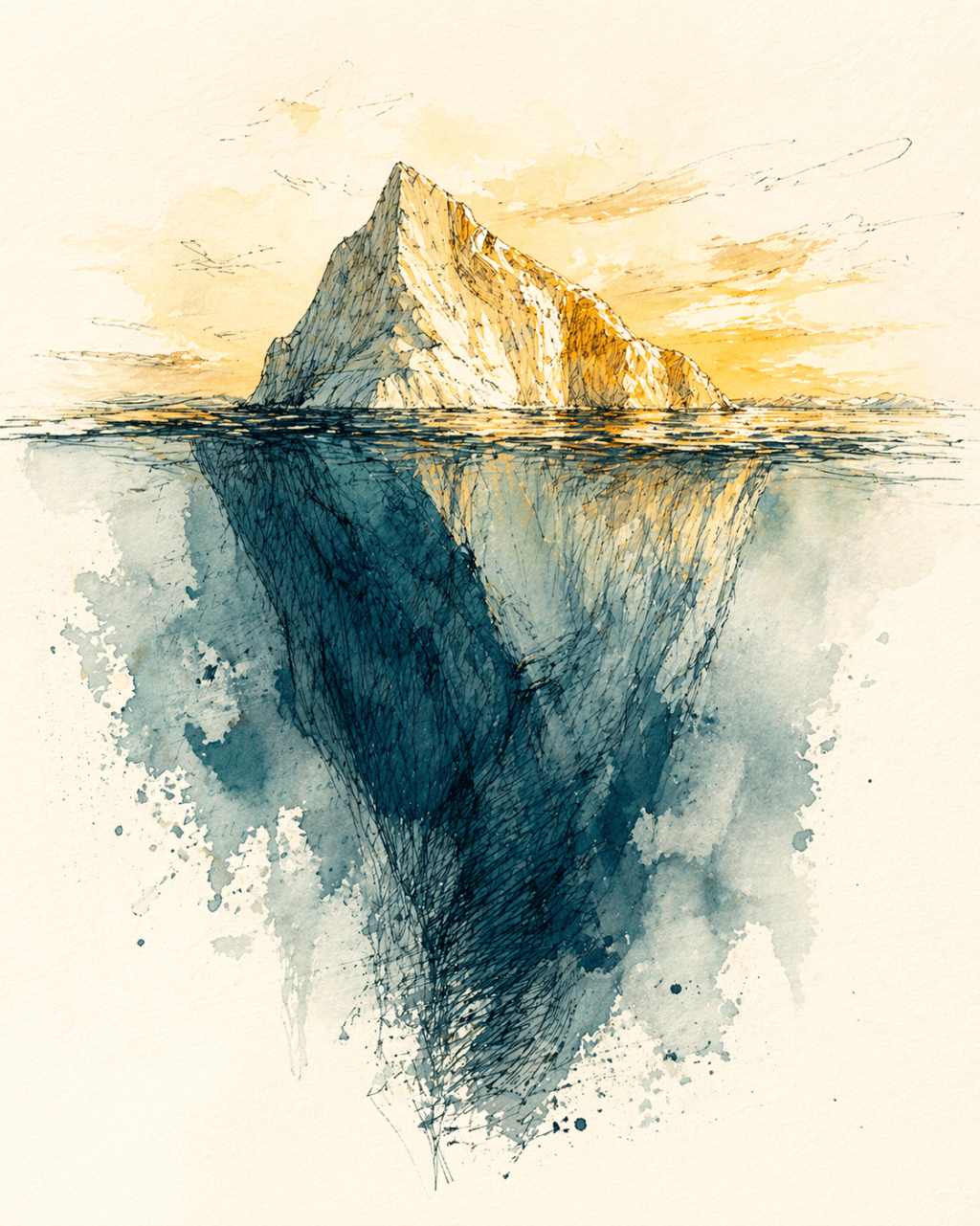
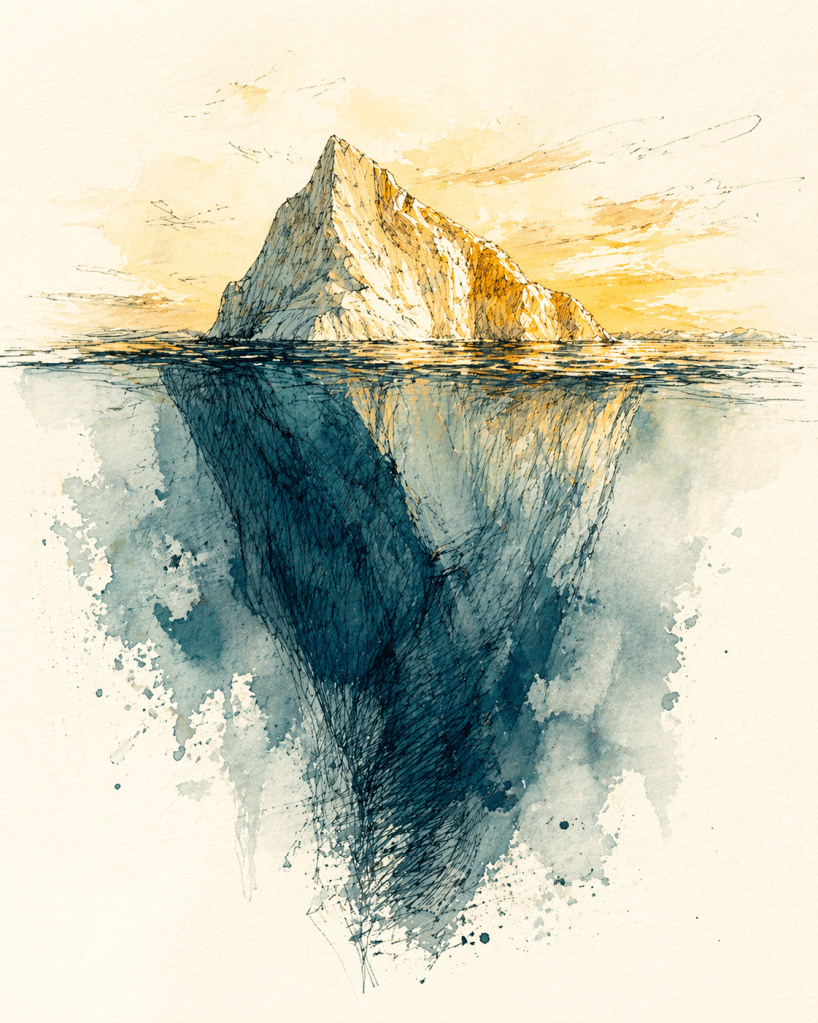
Hemingway said the dignity of movement of an iceberg is due to only one eighth of it being above water. The rest holds it up from below, invisible and essential. That is the work and not the spectacle. The structure underneath the surface that makes everything above it feel inevitable and true.
The writers you admire trust the reader enough to leave things out. The question worth sitting with today is whether you do too.
Three Mangoes for Hemingway, the novel that grew from those early notebook pages and that omission-shaped instinct, is available for preorder on Kindle and arrives May 1.
 Rolando Andrés Ramos
Leave a comment