

Most writers treat a notebook like a filing cabinet. A place to store finished thoughts, polished observations, lines that already know what they want to be. But the writers you admire most use notebooks differently. They use them to think.
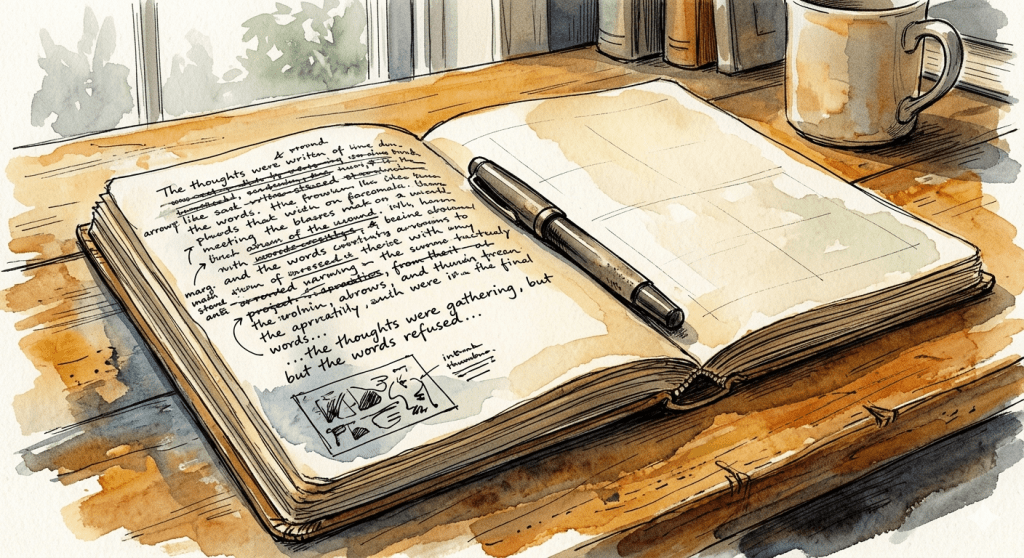
A quiet morning, a waiting page, and the fragile beginning of something that matters.
Robert Greene kept a scrapbook for decades. Not a curated collection of brilliant insights but a running mess of clippings, overheard phrases, drawings, and ideas so half-formed they barely qualified as ideas at all. He let everything in. The absurd, the contradictory, the not-yet-useful. He was not archiving his thinking. He was doing his thinking, on the page, in real time.
Austin Kleon carries a notebook everywhere for the same reason. Not to record what he already knows but to discover what he does not. Maggie Smith catches metaphors on the move before she understands what they are for. James Scott Bell has a rule for idea sessions that amounts to the same discipline from a different angle. Record everything. Judge nothing.
Julia Cameron calls this permission. Natalie Goldberg calls it practice. John Cleese calls it protecting fragile ideas from the part of your brain that kills them too early. The language differs. The instinct is identical.
They all understand something most of us take years to learn. The page is not a place to display thinking. It is a place to generate it. The notebook works not because you put good things in but because the act of writing moves something loose in the mind. Ideas that feel stuck in your head find their shape when they have somewhere to go.
This is not a romantic notion. It is cognitive. Externalizing thought gives you something to push against, something to revise, something to surprise you. Roland Allen put it plainly. He makes more progress in his thinking when he has tools to get his thoughts out of his head and into another place.
I know this from my own experience as a writer. When I began working on my novel, Three Mangoes for Hemingway, the notebook was where the story first breathed. Not on the screen. On paper. The early pages were a tangle of questions I could not answer yet. What did Key West smell like in that era at night? What would it feel like to press a mango seedling into earth that Hemingway himself had walked? What were my characters carrying that they had not told me about? I did not know. But the notebook let me not know out loud, which is different from not knowing in silence. The questions became sketches of scenes. The sketches became drafts. Some of those drafts collapsed and I was glad to let them go. Others surprised me by being closer to the truth of the story than anything I had planned. That is the part no outline can give you. The discovery that only comes when your hand is moving and your editor brain has not yet arrived to ruin things.
I used the notebook differently at different stages. In the beginning it held the world, the smells and textures and period details that would give the story its ground. Later it held the characters, their gestures and contradictions and the things they would never say aloud. Later still it held the scenes themselves, rough and alive in a way that a blinking cursor never quite invites. Each stage had its own kind of mess. Each mess turned out to be necessary.
There is something that happens in those early minutes, pen moving before the mind has decided anything, the page filling with half-thoughts and crossed-out lines and small drawings that mean nothing yet, the whole quiet act of it settling something in the chest that no amount of thinking in your head ever quite reaches.
The writers you admire think on paper. The question worth sitting with is whether you do too.
Three Mangoes for Hemingway, the novel that grew in part from those notebook pages, is available for preorder on Kindle and arrives May 1.

Leave a comment