

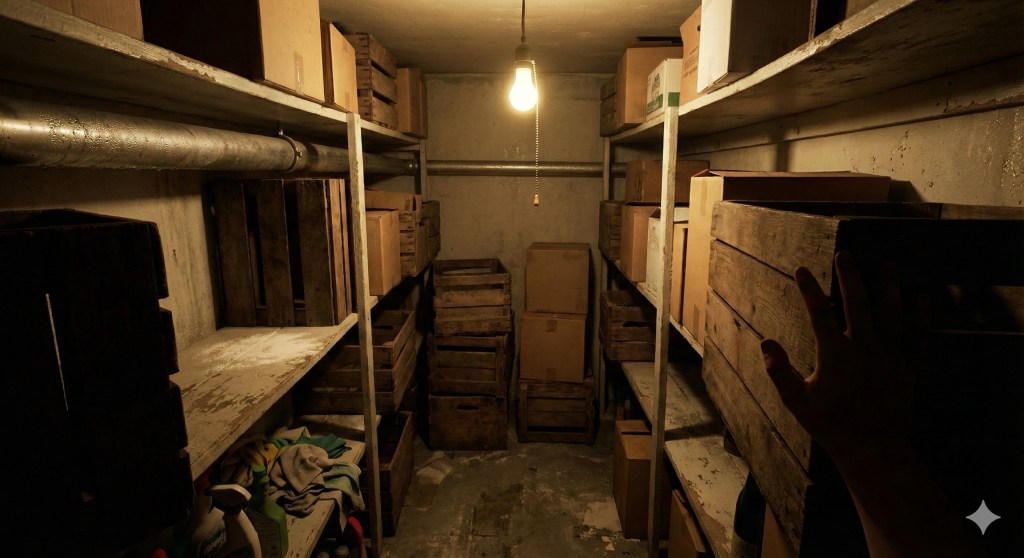
Caption: A realistic, atmospheric illustration of a cramped bar storage room, capturing the tension of a quiet moment before action with worn textures and specific sensory details. Image generated by Gemini.
Friday Catalyst: When a Single Detail Turns the Whole Scene Exercise
True attention does not soothe the character; it strips away their excuses and creates the very instability the scene needs.
BEGINNER LAYER
This exercise turns on three techniques: deliberate sensory focus, quick shifts in attention, and letting external detail expose internal tension. Strong work stays rooted in specific perception and lets each detail tilt the emotional field. Weak work summarizes, leans on adjectives, or treats detail as wallpaper.
INTERMEDIATE LAYER
The goal is to pause long enough for one observed detail to redirect the scene. The environment must trouble the protagonist’s intention. Strong work lets each sensory beat create forward movement. Weak work strings together impressions that never matter. Aim for a clean progression in which attention guides emotional change.
EXPERT LAYER
Sensory detail serves as disruption. Exact noticing pushes the protagonist toward meaning they would rather avoid. Strong work allows the environment to shape the character’s thinking. Weak work flattens the world into background. Let selective detail apply pressure and create a shift that could not happen any other way.
WRITING PROMPT (500 words)
Write a scene set in a place the protagonist knows with complete familiarity. Think of a room, corridor, or outdoor space that lives in their body: the narrow storage area behind the bar where they worked, the patch of ground behind their childhood home, or the small area between a desk and a window they adjust every morning. They begin with a simple private intention. Have them pause before acting. During that pause, let them take in three sensory impressions in a precise order. Each impression must alter what they meant to do. The first should awaken a memory they did not plan to revisit. The second should reveal something present and physical they normally overlook. The third should introduce new information they have resisted acknowledging. Let the body register these impressions through touch, sound, scent, or subtle shifts in temperature. Keep the point of view close and consistent. Allow each perception to push the protagonist into a new emotional position. Guide the scene through intention, pause, observation, disruption, and decision. Let the environment drive the change rather than serve as backdrop. End the scene at the moment the protagonist recognizes a new intention shaped by what they have just noticed. Action is optional. What matters is the internal turn created by attention.
EVALUATION CRITERIA
The three sensory impressions must each redirect the protagonist’s intention.
The environment must exert pressure that alters the emotional trajectory.
The protagonist’s internal shift must arise from concrete perception.
The final beat must feel earned and surprising.
Language must remain specific, lean, and purposeful.
FOLLOW-UP QUESTIONS
Which of the three impressions steered the scene the most, and why?
Where did the character resist what they perceived?
Which detail surprised you and forced the scene into new territory?
What tension now exists that did not exist at the start?
RECOMMENDED EXAMPLE
Consider the opening of Lauren Groff’s The Vaster Wilds, which uses sensory precision as a source of propulsion within a plot-driven narrative.
AI Disclosure Statement:
This writing prompt was created in collaboration with ChatGPT, an AI model by OpenAI, to support creative practice. ChatGPT assisted with idea generation and drafting; the final text was edited by the author. The illustration was created using Google Gemini.
 Rolando Andrés Ramos
Leave a comment