
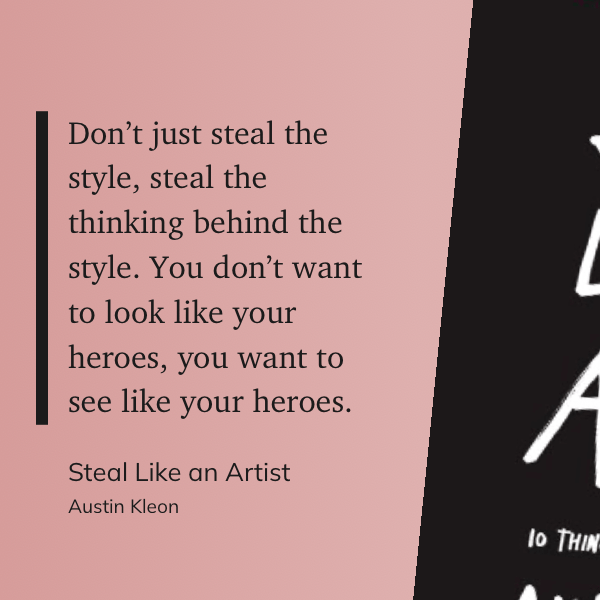
“Don’t just steal the style, steal the thinking behind the style. You don’t want to look like your heroes, you want to see like your heroes.” (Austin Kleon, Steal Like an Artist)
Writing Exercise: “Steal the Wiring, Not the Wallpaper”
Key Techniques Illustrated:
Structural Echoing — studying how admired writers organize narrative momentum, pivots, and reveals rather than mimicking their voice or aesthetics Thematic Transfer — transplanting the underlying tension, contradiction, or intellectual argument of a piece into new content Narrative Rhythm Mapping — mimicking the pacing of beats, pauses, and shifts without replicating style or tone
Prompt (500 words):
Choose a short story or novel excerpt by a writer you admire not for their voice but for their architecture—the way the story unfolds, escalates, and resolves. Outline the “wiring” of their scene or story in five moves (e.g., Opening Image → Disruption → Complication → Emotional Pivot → Resolution). Now, using different content, setting, and tone, draft your own 500-word story that follows this same scaffolding. Your goal is not to replicate plot or style, but to steal the thinking behind the movement—how tension is built and broken, how meaning shifts.
This is not pastiche. This is strategic mimicry of construction, not decoration.
Evaluation Criteria for a Strong Response:
Structural Integrity: The story adheres to the borrowed framework, with clear turning points and emotional logic. Weak: The story meanders or hinges on coincidence instead of pressure and reveal. Strong: The five narrative moves echo the original’s tension curve with new stakes. Thematic Adaptation: The emotional or philosophical engine of the original is adapted, not copied—reborn in a new narrative body. Weak: The story mirrors plot events or conflicts without reframing them. Strong: A story about romantic betrayal becomes a story about scientific fraud—but the emotional terrain is analogous. Rhythmic Control: Paragraph length, pacing of revelation, and escalation mirror the energy of the source without imitating the syntax. Weak: Flat tempo or jarring shifts that break the implied rhythm. Strong: A sense of build, suspense, or unraveling that mirrors the beat structure of the original.
Follow-Up Questions for Workshopping/Revision:
Where does your narrative diverge in emotional or thematic tone from the source—and should it? How does your opening image set the terms of expectation, and does your ending reframe them? Are there any moments where you leaned too much on mimicry instead of transformation? Could the same skeleton be used for a different story? Why does this one fit?
Recommended Reading:
Excerpt from The Largesse of the Sea Maiden by Denis Johnson — particularly the title story. Study how seemingly disconnected vignettes accrue thematic and emotional resonance through recursive beats and structural echoes. The writing isn’t in the sentences. It’s in the wiring.
This exercise fits in a two-hour session: 30 minutes to outline the structure of your chosen piece, 60 minutes to write, and 30 minutes to revise and reflect on how you internalized the thinking behind the style.


Leave a reply to Caleb Cheruiyot Cancel reply