
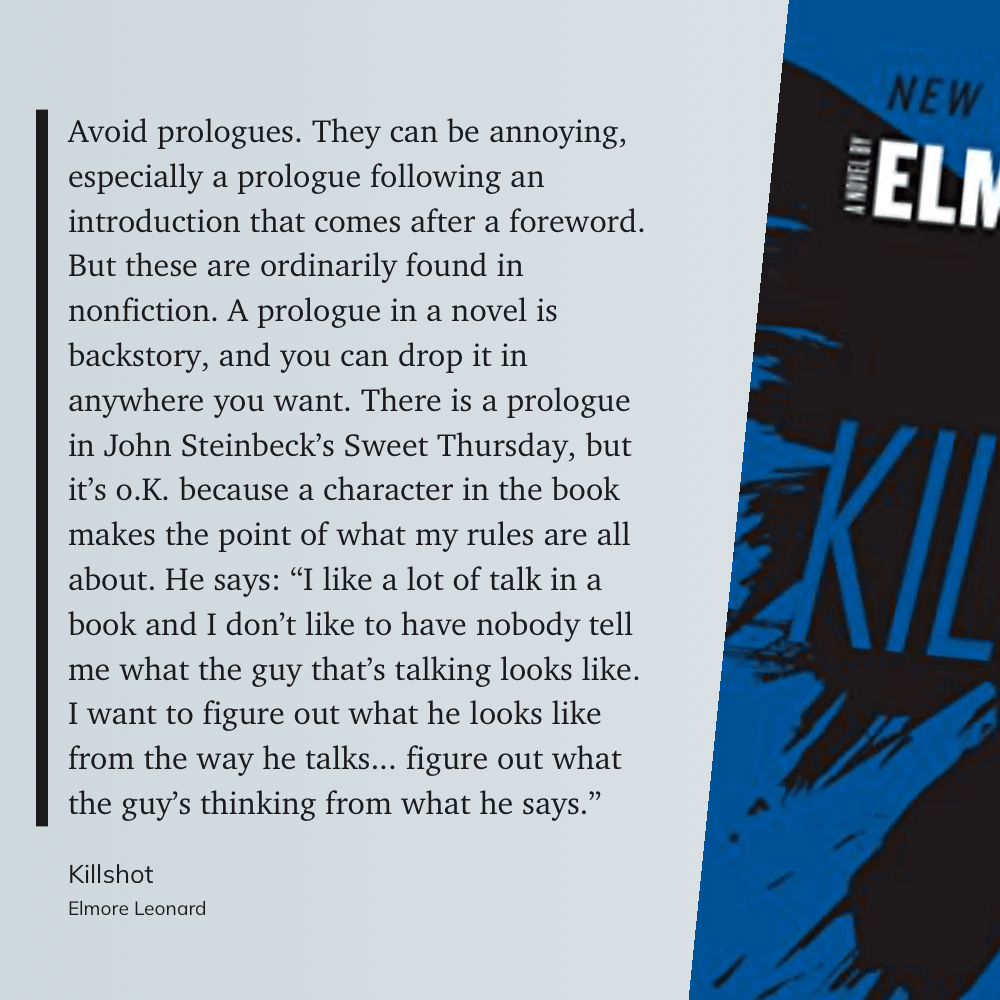
Avoid prologues. They can be annoying, especially a prologue following an introduction that comes after a foreword.
But these are ordinarily found in nonfiction. A prologue in a novel is backstory, and you can drop it in anywhere you want. There is a prologue in John Steinbeck’s Sweet Thursday, but it’s o.K. because a character in the book makes the point of what my rules are all about. He says: “I like a lot of talk in a book and I don’t like to have nobody tell me what the guy that’s talking looks like.
I want to figure out what he looks like from the way he talks… figure out what the guy’s thinking from what he says.” Killshot, Elmore Leonard
Writing Exercise: Character Revelation Through Dialogue and Action
Key Techniques:
1. Implicit Characterization – Instead of explicitly describing a character’s appearance, personality, or thoughts, reveal them through dialogue, action, and interaction.
2. Strategic Backstory Integration – Weave backstory naturally into the present action rather than frontloading it in a prologue or exposition.
3. Authentic Voice – Craft dialogue that conveys personality, subtext, and intention without feeling forced or overly explanatory.
500-Word Writing Prompt:
Write a scene in which two characters meet for the first time, but one of them has been waiting for this meeting for a long time. The other character, however, has no idea who they are or why this moment matters. The scene must reveal:
• Who each character is, their motivations, and their relationship dynamics without any direct exposition or internal monologue.
• Essential elements of backstory through the conversation, gestures, and setting.
• The emotional stakes beneath the surface, using subtext rather than direct statements.
For example, if Character A is a private investigator who has spent six months tracking Character B, this information should emerge naturally through what they say and do—not in a paragraph of summary.
Evaluation Criteria:
• Strong Response: The scene immerses the reader in the moment, allowing them to infer backstory, emotions, and motivations without being explicitly told. The dialogue feels natural and reveals personality through voice, rhythm, and word choice. Action and setting reinforce the mood and tension.
• Weak Response: The scene relies on direct exposition, such as “She had been searching for him for months” instead of showing desperation in her dialogue or actions. The dialogue feels forced or too explanatory, as in “I can’t believe I finally found you after all this time.” The characters’ emotions are stated rather than implied.
Follow-Up Questions for Workshopping/Revision:
1. What do we learn about each character in this scene? Are these revelations earned through dialogue and action, or are they told too explicitly?
2. How does the scene’s structure create tension? Does the conversation unfold in a way that keeps the reader engaged?
3. Is there subtext in the dialogue, or are characters saying exactly what they mean? Could anything be left unsaid for greater impact?
4. How does the setting contribute to characterization and emotional weight?
Recommended Reading:
• Elmore Leonard’s “Killshot” – Demonstrates how characters are revealed through speech and action rather than exposition.
• Raymond Carver’s “What We Talk About When We Talk About Love” – A masterclass in subtext-driven dialogue where emotions and relationships are revealed through speech patterns and pauses.
• Richard Price’s “Lush Life” – Captures distinct character voices and integrates backstory seamlessly into unfolding action.


Leave a reply to Caleb Cheruiyot Cancel reply