

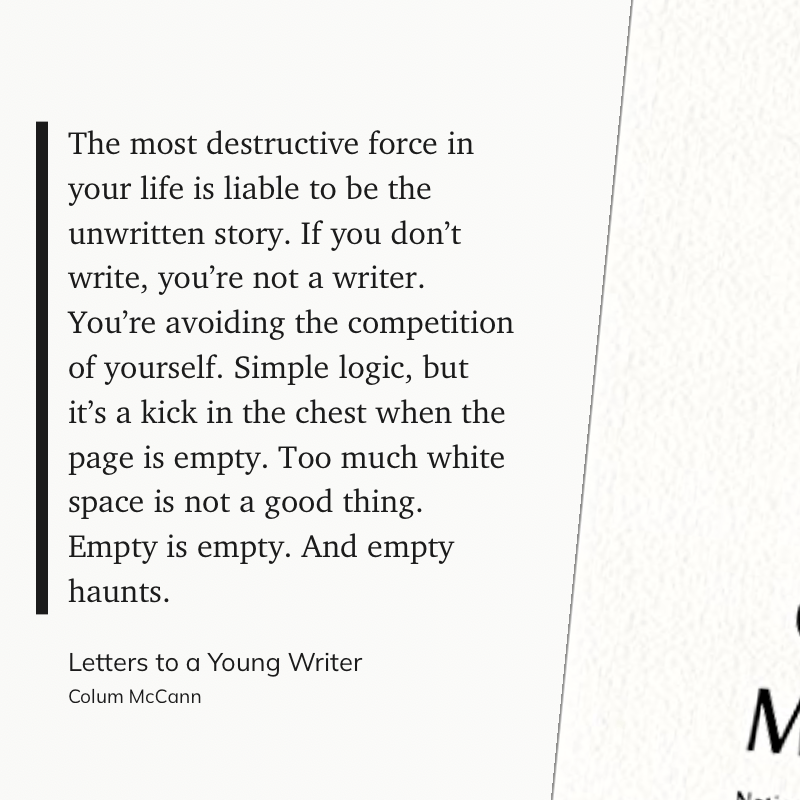
“The most destructive force in your life is liable to be the unwritten story. If you don’t write, you’re not a writer. You’re avoiding the competition of yourself. Simple logic, but it’s a kick in the chest when the page is empty. Too much white space is not a good thing. Empty is empty. And empty haunts.” (Colum McCann , Letters to a Young Writer)
Writing Exercise: Confronting the Unwritten Story
Key Techniques:
1. Character Urgency – A compelling character carries the weight of something unwritten, unspoken, or unresolved. Their internal conflict must be pressing, their need to act undeniable.
2. Tension Between Stasis and Action – A character’s reluctance to confront their story should clash against the forces that demand it. External events must force movement, even if the character resists.
3. Use of White Space and Subtext – The unsaid must loom over the narrative. Strong writing doesn’t just state absence; it makes it felt through sharp dialogue, evocative imagery, and carefully placed silence.
500-Word Writing Prompt:
Write a scene in which a character is confronted with a version of themselves they’ve spent years avoiding. This could be an old journal, an unpublished manuscript, a conversation with someone who remembers them differently, or an object tied to a past they refuse to acknowledge. The character must wrestle with the choice to either engage with this “unwritten story” or to let it continue haunting them.
The setting should be intimate yet charged—somewhere personal but no longer comfortable. Dialogue should be sparse but cutting. Actions should betray more than words reveal. The ending must leave the reader with a sense of weight, whether through resolution or continued evasion.
What Makes a Response Successful:
• The unwritten story is not just mentioned; it exerts force. The character’s relationship to it is felt in every choice, hesitation, or avoidance.
• Conflict plays out both externally and internally. The environment, dialogue, and physical sensations should all contribute to the tension.
• Silence and omission are intentional. What remains unsaid should feel as heavy as what is spoken.
Weak vs. Strong Examples:
Weak: A character finds an old letter, reads it, and feels nostalgic but unchanged. No struggle, no stakes, no consequence.
Strong: A character discovers an old novel they abandoned, only to have someone close read it aloud, forcing them to face the parts of themselves they had long buried. Their reaction is visceral—perhaps anger, perhaps deep denial—but their silence in the moment says more than their words ever could.
Follow-Up Questions for Revision:
• Does the “unwritten story” exert real pressure on the character, or does it merely exist in the background?
• Is the tension sustained throughout, or do moments of confrontation feel unearned?
• Are the silences and omissions doing intentional work, or do they simply leave gaps in the story?
• Could the setting or physical details better reflect the character’s emotional state?
Recommended Reading:
• “The Dead” by James Joyce – A masterclass in the weight of the unsaid and the confrontation with long-buried truths.
• “Emergency” by Denis Johnson – A stark, haunting example of tension between action and inaction, truth and avoidance.
• Never Let Me Go by Kazuo Ishiguro (excerpt) – How a character’s resistance to their own story builds a quiet, devastating power.


Leave a reply to Caleb Cheruiyot Cancel reply