

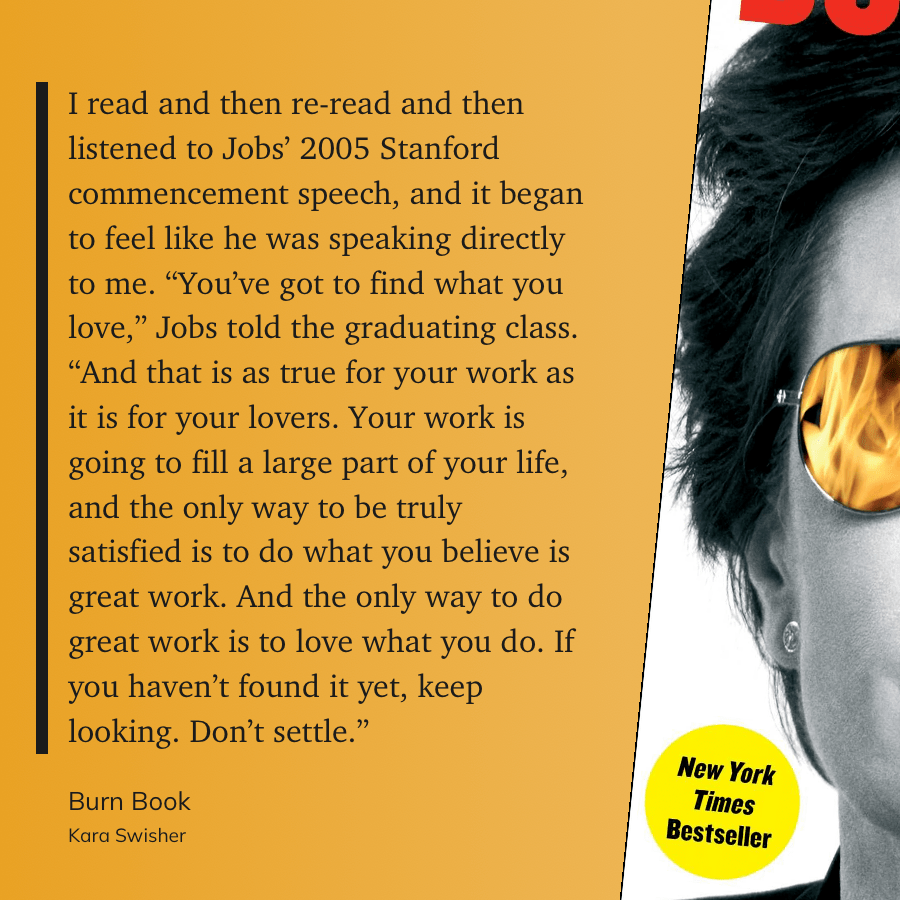
“I read and then re-read and then listened to Jobs’ 2005 Stanford commencement speech, and it began to feel like he was speaking directly to me. “You’ve got to find what you love,” Jobs told the graduating class. “And that is as true for your work as it is for your lovers. Your work is going to fill a large part of your life, and the only way to be truly satisfied is to do what you believe is great work. And the only way to do great work is to love what you do. If you haven’t found it yet, keep looking. Don’t settle.”” (Kara Swisher, Burn Book)
KEY TECHNIQUES FROM THE QUOTATION:
- Resonant Voice Connection – Understanding how external voices/influences catalyze personal revelation
- Transformative Moment Mining – Identifying pivotal moments when advice or wisdom shifts from abstract to personally meaningful
- Multi-Perspective Processing – Exploring how repeated exposure to the same message (reading, re-reading, listening) deepens understanding
WRITING PROMPT (2-hour exercise):
Write a 500-word scene where a character encounters a piece of advice, wisdom, or inspiration that initially seems like a cliché but becomes deeply meaningful to them through specific circumstances. Show this transformation through three distinct moments of exposure to the message, similar to how Swisher read, re-read, and listened to Jobs’ speech.
Your scene should capture how the same words take on new meaning as your character’s context changes. Perhaps it’s a quote they’ve seen on Instagram a hundred times, a parent’s repeated advice, or even song lyrics – but something in their current situation suddenly makes these familiar words strike home with new force.
EVALUATION CRITERIA:
Strong responses will:
- Establish the character’s initial skepticism or indifference to the message
- Create specific, concrete situations that force new interpretation of the words
- Show gradual deepening of understanding through external actions and circumstances
- Avoid melodrama while maintaining emotional authenticity
- Demonstrate how the character’s relationship with the message evolves through multiple encounters
Weak responses typically:
- Rely on sudden epiphanies without building context
- Tell rather than show the character’s changing understanding
- Use generic or overly dramatic situations
- Fall into inspirational poster territory without genuine complexity
- Rush through the stages of understanding without earning the shifts
WORKSHOP QUESTIONS:
- What makes the initial encounter with the message different from the final one?
- How does the physical setting or circumstance of each encounter affect its impact?
- What specific details show the character’s evolving relationship with the message?
- Where do we see resistance to the message, and how is it overcome?
- How does the character’s behavior or decision-making change as their understanding deepens?
RECOMMENDED READING:
“The Third and Final Continent” by Jhumpa Lahiri – This story masterfully demonstrates how repeated encounters with similar situations/phrases gain deeper meaning over time. Pay particular attention to how the narrator’s understanding of “splendid” evolves throughout the story, moving from simple acknowledgment to profound emotional resonance.
Alternative: “Letter from a Birmingham Jail” by Martin Luther King Jr., focusing specifically on how he transforms common religious and philosophical concepts into urgent, personally meaningful calls to action through concrete context and repeated examination.
Regards,
RAR
 Rolando Andrés Ramos
Leave a comment