
Monday Ignition: Writing Toward an Ending You Do Not Control Prompt
Discipline does not come from control or consistency of outcome; it comes from repeatedly entering the draft knowing you will lose your footing and choosing not to stabilize yourself when that happens.
This two-hour exercise prioritizes daily writing discipline over character depth, polish, or narrative assurance. The work values momentum, exposure, and intelligent risk.
1. Writing practice techniques at work
Destination-first drafting. Decide where the piece will end before you begin. The ending acts as gravity rather than instruction.
Productive instability. Keep the middle deliberately unsettled. Permit missteps, tonal shifts, and imperfect thinking without correction.
Time-bound continuity. Write forward for a fixed duration. Forward motion becomes the primary craft choice.
2. The 500-word writing prompt
Before you write, choose a final image or realization for the piece. Write it down privately in one sentence. Do not revise it. Do not look at it again.
Write a 500-word prose piece that moves toward this ending.
Begin in an ordinary physical situation: a desk, a parked car, a kitchen at dawn, a hallway outside a closed door. Start with concrete presence, not reflection.
Write continuously. You may not delete sentences. You may only add new ones. If a sentence feels false, follow it with another sentence rather than fixing it.
Each paragraph must introduce a factual detail that did not previously exist in the piece. No paragraph may restate emotional or narrative information already given.
Stop at 500 words even if the piece feels unfinished. End as close as possible to the destination you chose, regardless of whether the route feels awkward, abrupt, or surprising.
Strong response example: the opening feels almost neutral, even dull, yet each paragraph subtly shifts direction. The writer allows confusion without explanation. The ending arrives with a sense of inevitability rather than cleverness, even if the path there feels uneven.
Weak response example: the writer protects the draft through preplanning. Paragraphs circle the same emotional point. The ending feels justified only because it has been explained into place.
3. Evaluation criteria
Sustained forward motion across the full word count.
Clear evidence of risk in the middle of the piece, including uncertainty, tonal friction, or temporary loss of control.
An ending that feels drawn toward rather than constructed.
Sentences that privilege movement and pressure over refinement.
4. Follow-up questions for workshopping and revision
Where did the writing begin to feel uncomfortable, and what impulse arose to regain control?
Which paragraph contains the most energy, and what made it resistant?
If the ending stays fixed, what opening would change the piece most radically?
What sentence would you remove if clarity were not allowed?
5. Recommended reading
Lucia Berlin, “Manual for Cleaning Women.” Study how direction emerges through accumulation rather than plan, and how momentum carries the piece more than explanation.
AI Disclosure Statement:
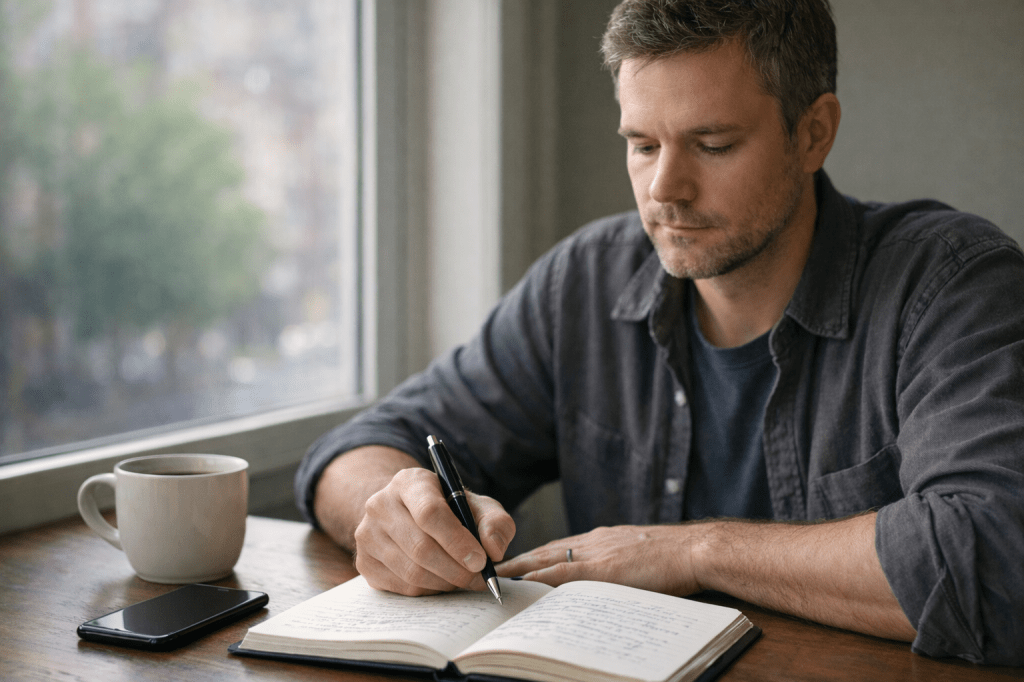
This writing prompt was created in collaboration with ChatGPT, an AI model by OpenAI, to support creative practice. ChatGPT assisted with idea generation and drafting; the final text was edited by the author. The illustration was created using ChatGPT.

Leave a comment