
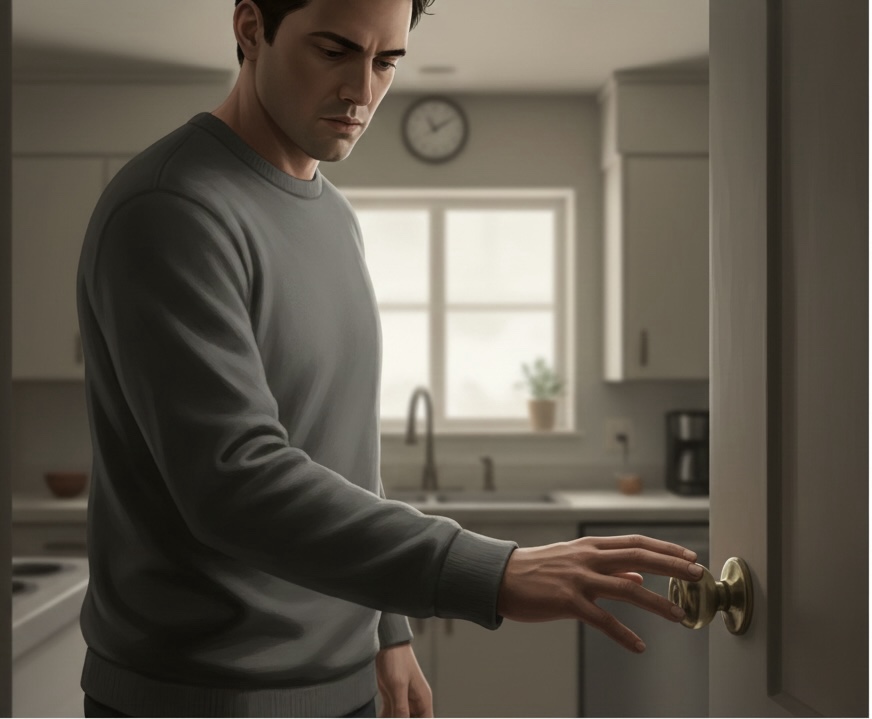
A realistic illustration of a man arrested mid-motion in an ordinary kitchen doorway, his hand hovering in hesitation under natural, non-dramatic lighting. Generated with Gemini.
Monday Ignition: When the Sentence Takes Control Prompt
Precision comes from surrendering to the sentence that arrives next, even when it narrows your options to one.
1. Key writing practice development techniques illustrated
a. Sentence pressure. Each line provokes the next through friction rather than plan.
b. Instinctive selection. Meaning forms through what the prose attends to, omits, or interrupts.
c. Revision as alertness. The work sharpens by obeying resistance, surprise, and acceleration.
2. 500-word writing prompt (for a single 2-hour session)
Write a 500-word scene that advances through reaction, not intention. Begin with a character encountering one ordinary stimulus: a remark overheard, a line in a note, a sound from another room, an object handled without care. Start inside the encounter. No setup.
Write one sentence at a time. Let each sentence force the next. When the prose presses to turn, turn. When a detail holds attention, remain with it. If a sentence resolves too cleanly, fracture it with a physical or sensory shift. No summary. No framing.
The scene must contain one moment where the character almost acts and stops, and one moment where the character acts without deciding to. Render both through movement, sensation, or syntax. Reflection is limited to a single sentence at a time. Do not name emotions. Do not use metaphor to clarify feeling.
At the midpoint, introduce a small disturbance: a presence, interruption, or piece of information that unsettles the scene. Do not heighten stakes openly. Let the disturbance register through rhythm, focus, or compression.
End without resolution. The final sentence should arrive before explanation. It should feel necessary, not conclusive.
Strong response: sentence length and verb choice shift after the disturbance; attention narrows; the ending lands quietly with force.
Weak response: the scene explains itself; emotions are labeled; the ending interprets events.
3. Evaluation criteria
a. Line momentum. Each sentence advances by answering the previous one.
b. Embodied choice. Decision appears through action, pause, or constraint in language.
c. Structural control. The midpoint disturbance alters texture without announcement.
d. Precision without commentary. The scene resists explanation while remaining deliberate.
4. Follow-up questions for workshop and revision
Which sentence forced the scene to change direction?
Where did explanation creep in, and what happens if that sentence is removed?
Which physical action carries the most weight, and how early does it appear?
What changes if the final sentence is cut in half?
5. Recommended published example
Lydia Davis, “Break It Down.” The piece advances through accumulated reactions, trusts omission, and gains force from instinctive sentence choice rather than plot movement.
AI Disclosure Statement:
This writing prompt was created in collaboration with ChatGPT, an AI model by OpenAI, to support creative practice. ChatGPT assisted with idea generation and drafting; the final text was edited by the author. The illustration was created using Google Gemini.

Leave a comment