
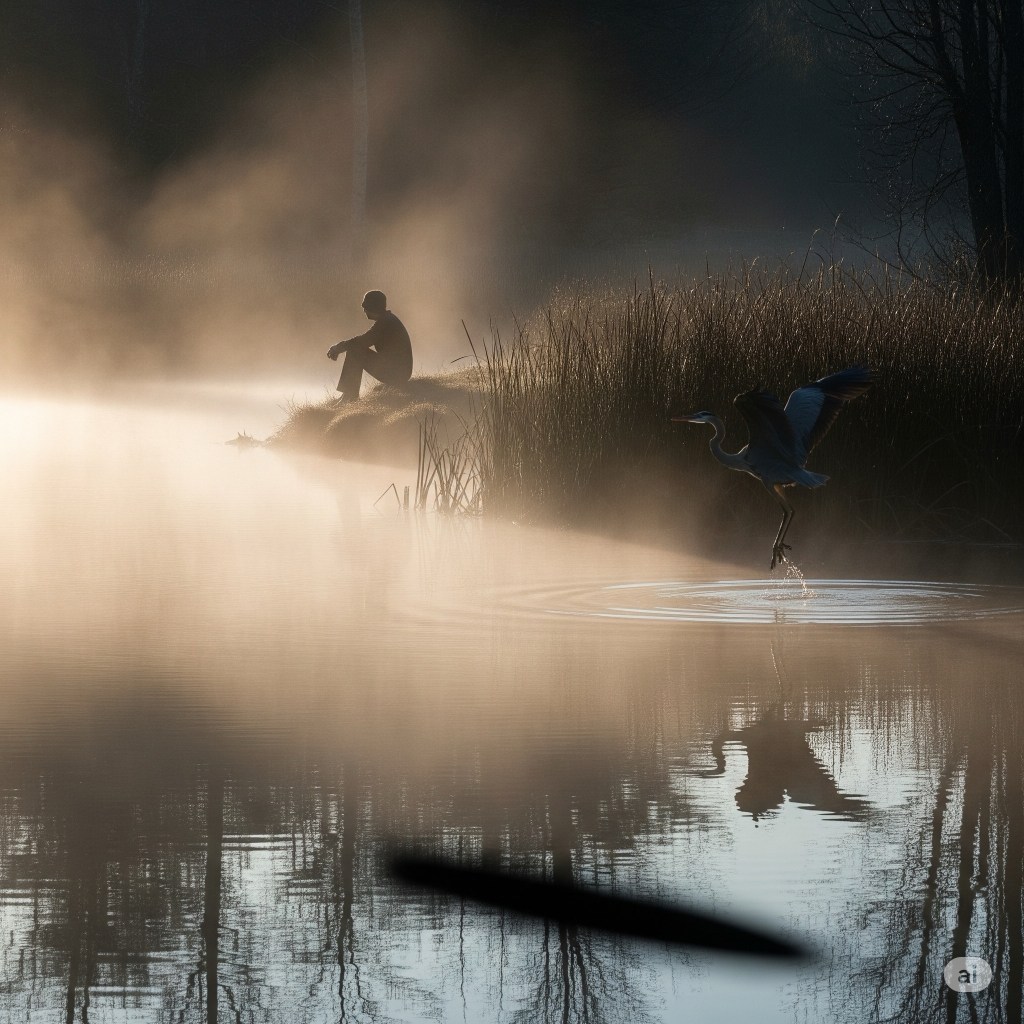
A character sits beside a misty pond at dawn as a heron takes flight, generated with Gemini.
Writing Exercise: The Stillness Before the Story
Key techniques illustrated by the quotation
1. Atmosphere-driven immersion: Building a setting that embodies stillness, openness, and heightened sensory presence.
2. Interior access: Revealing a character’s internal state through action, environment, and subtext rather than explicit commentary.
3. The slow-burn reveal: Letting meaning and narrative tension emerge gradually from observation and small shifts rather than overt plot events.
500-word writing prompt
Write a scene in which a character enters a space—either natural or human-made—where silence dominates. The setting should not be neutral; it should quietly alter the character’s perception, mood, or direction without any explicit conversation or dramatic action. The silence must not feel empty but charged, alive with unspoken possibility.
The scene must meet these conditions:
• No more than two characters present, and dialogue cannot exceed three short lines.
• The passage of time must be felt through changing sensory detail—light, air, sound, texture, or scent—rather than clocks or explicit time markers.
• The reader must be able to sense something unresolved in the character before the scene begins, and a subtle shift in that state by the end, even if nothing “happens” in the conventional plot sense.
• Your word count should be between 480 and 520 words, with no summarizing sentences like “It was peaceful” or “She felt calm.” All emotional or thematic weight must be embedded in the moment itself.
Evaluation criteria for a successful response
• Immersion: The reader can feel the setting as vividly as if they were there, without overloading on adjectives.
• Emotional resonance: The character’s inner movement is perceptible through external cues and subtext.
• Restraint: The writer resists explaining and instead trusts sensory and situational detail to carry meaning.
• Cohesion: Every sentence contributes to the tone and movement of the scene without filler or unnecessary description.
Follow-up questions for workshopping and revision
• Which specific images or sensory moments carried the most weight in shaping the emotional arc?
• Did the silence feel alive and charged, or empty and static? What choices led to that effect?
• Were there points where you explained instead of letting the environment and action suggest meaning?
• Could removing or compressing certain descriptions sharpen the emotional movement?
• Does the final sentence leave the reader with a sense of shift or possibility?
Recommended reading
The opening scene of “In the Cemetery Where Al Jolson is Buried” by Amy Hempel. It demonstrates stillness as tension, emotional undercurrents revealed through environment and sparse dialogue.
Strong response example
A character sits beside a pond at dawn, the mist curling like breath from the water. A heron lifts from the reeds without sound. The light thins, and a shadow moves across the surface. The character’s hand reaches for a stone, then lets it go. Without a single direct statement about grief, the reader understands something has lifted, however slightly.
Weak response example
A character sits on a bench and thinks about how peaceful it is. They describe how they are feeling in a list—calm, happy, content—and then leave. No sensory grounding, no progression in mood, and the silence functions as static background rather than a shaping force.
AI Disclosure Statement:
This writing prompt was created in collaboration with ChatGPT, an AI model by OpenAI, to support creative practice. ChatGPT assisted with idea generation and drafting; the final text was edited by the author. The illustration was created using Google Gemini.

Leave a comment