
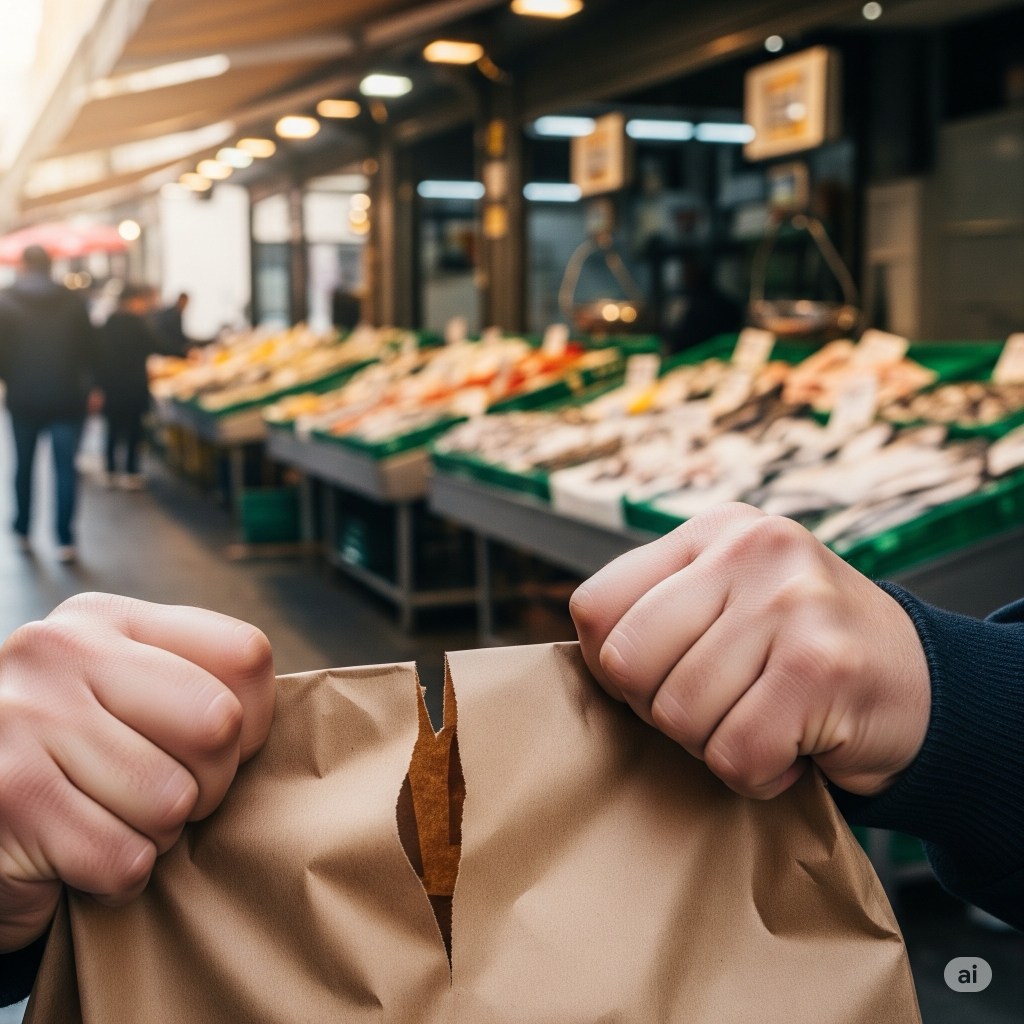
A person’s hands tighten on a paper bag until it splits, in a market with fish stalls nearby. This image was generated by Gemini.
Monday Ignition: Rotating Multi-Scene Immersion Challenge Prompt
Objective
Sustain deep point-of-view inhabitation and emotional immersion across multiple distinct scenes, each advancing a single irreversible decision without authorial intrusion, while shifting environments, pacing, and sensory emphasis.
Structure and Process
Write three connected scenes from the same protagonist’s perspective, occurring within a single day. The decision they will ultimately make is predetermined in your mind but never stated explicitly until the final scene. Each scene must be immersive, sensory-driven, and anchored entirely in the protagonist’s perceptions and interpretations.
Scene 1 (500 words)
Setting: A public space.
Focus: External sensory overload—crowds, ambient noise, shifting light, overlapping conversations.
Technique emphasis: Convey the protagonist’s internal state through what they notice and how they parse sensory chaos. Use at least one sensory detail that contradicts their conscious intention.
Scene 2 (400 words)
Setting: A private, enclosed space.
Focus: Constricted sensory input—fewer stimuli, heightened attention to micro-details.
Technique emphasis: Let pacing slow; use silence, texture, and small motions to deepen tension. Allow the protagonist’s unspoken conflict to surface in how they experience the space, not in what they tell themselves.
Scene 3 (500 words)
Setting: A transitional or liminal space (train station, hallway, shoreline, threshold).
Focus: The irreversible decision occurs here, but is revealed through action and sensory shifts rather than direct statement.
Technique emphasis: Vary sentence rhythm to match the protagonist’s final emotional surge. Sensory elements from earlier scenes should resurface, transformed by the new emotional state.
Evaluation Criteria
Immersion: Reader experiences each moment as the protagonist does, without stepping outside the POV.
Sensory Economy: Every detail serves double duty—building mood and revealing character.
Emotional Continuity: The arc of feeling builds naturally across scenes, with recurring sensory motifs evolving in meaning.
Decision Reveal: The final choice lands with inevitability and resonance without explicit signposting.
Follow-Up Questions for Workshopping/Revision
In which scenes did immersion weaken, and why?
Which sensory motifs carried through all three scenes? Did their meanings shift?
Did pacing between scenes support the emotional trajectory?
Where might you cut explanatory phrasing and let perception do the work?
How could the transitional scene intensify the inevitability of the decision?
Recommended Reading
Excerpt from “What We Talk About When We Talk About Love” by Raymond Carver — the layered conversations and sensory fragments immerse the reader in shifting emotional undercurrents without overtly telling us what the characters decide or feel, allowing meaning to emerge through rhythm, detail, and voice.
Strong Multi-Scene Response Example
Scene 1: In a market, the protagonist avoids the fish stalls, but the smell still threads through their breath. Their hands tighten on a paper bag until the seam splits.
Scene 2: In a dim kitchen, they run a finger over a knife’s worn wooden handle, the ticking of a clock seeming louder than the refrigerator’s hum.
Scene 3: Standing at a train platform, the wind carries the faint scent of fish again—this time they step forward, board, and the door closes behind them. No thoughts are stated, but the decision is clear.
Weak Multi-Scene Response Example
Scene 1: Protagonist describes the market and tells the reader they “don’t like fish” and “need to make a big choice.”
Scene 2: They explain their backstory in a monologue while sitting in the kitchen.
Scene 3: They think, “I finally decided to leave” and step on the train. Sensory links are missing, and the POV feels external.
AI Disclosure Statement:
This writing prompt was created in collaboration with ChatGPT, an AI model by OpenAI, to support creative practice. ChatGPT assisted with idea generation and drafting; the final text was edited by the author. The illustration was created using Google Gemini.

Leave a comment