
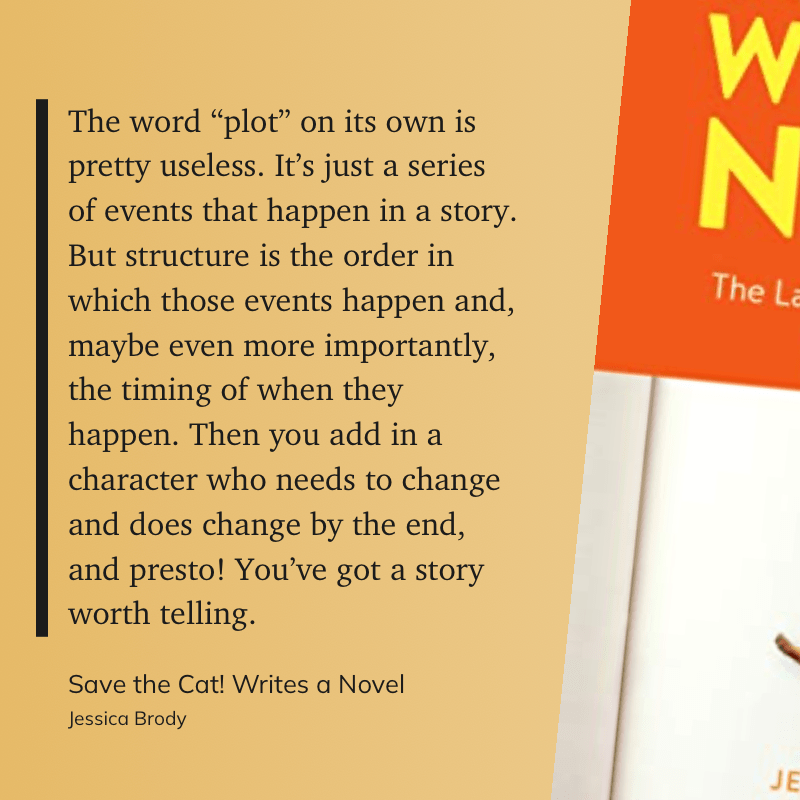
“The word “plot” on its own is pretty useless. It’s just a series of events that happen in a story. But structure is the order in which those events happen and, maybe even more importantly, the timing of when they happen. Then you add in a character who needs to change and does change by the end, and presto! You’ve got a story worth telling.” (Jessica Brody, Save the Cat! Writes a Novel)
Character Development and Narrative Structure Writing Exercise
This writing exercise uses Jessica Brody’s quotation to examine the intersection of plot, structure, and character transformation. Participants will explore three key techniques:
1. Crafting dynamic character arcs – emphasizing internal change over external events.
2. Experimenting with structure – exploring the effect of event timing on emotional impact.
3. Aligning character needs with plot events – ensuring every event advances both story and character development.
Writing Prompt (500 Words)
Write a scene where a character faces a significant decision that forces them to confront a long-standing flaw or fear. The scene should be structured with:
1. A brief opening (50–75 words) that establishes the stakes and setting.
2. A central moment (200–300 words) where the character is pushed to make their decision, with sensory details to heighten tension.
3. A closing (100–150 words) showing how the decision either reinforces or alters the character’s internal world.
Use nonlinear structure to disrupt chronological order. Begin in the middle or near the end of the scene, then backtrack to reveal earlier moments that illuminate the character’s internal conflict.
Evaluation Criteria with Strong vs. Weak Examples
1. Dynamic Character Arc
Strong Example:
A character, Jonah, who avoids confrontation, learns his sister plans to sell their childhood home. In the scene, he’s forced to decide whether to speak up or let the house go. At first, Jonah hesitates, recalling past failures. As he stands in the empty living room, a surge of anger at himself for being passive drives him to finally express his feelings to his sister. His speech is awkward but honest, showing growth in his willingness to take risks despite his fear of rejection.
Weak Example:
Jonah is informed about the house sale and becomes angry. He yells at his sister but offers no reflection or insight into his feelings. The scene ends with him storming out. While there’s action, his emotions feel superficial, and the reader doesn’t see any progression in his internal conflict.
2. Effective Use of Structure
Strong Example:
The scene opens with Jonah in the living room, shouting at his sister, “You don’t get to decide this alone!” Then it flashes back to earlier that day, showing his internal struggle as he walks through the house, recalling his parents’ love for it and his guilt for being distant. By looping back to the confrontation, the structure reveals Jonah’s motivation and vulnerability in a layered, emotionally resonant way.
Weak Example:
The scene starts with Jonah learning about the house sale, progresses to him feeling angry, and ends with him confronting his sister. The straightforward structure feels predictable, missing opportunities for tension or emotional depth.
3. Integration of Stakes
Strong Example:
The stakes are clear: if Jonah doesn’t act, he loses a connection to his parents and a chance to prove he’s capable of standing up for himself. Every detail in the scene reinforces this—his memories of the house, the sister’s frustration with his passivity, and the mounting pressure he feels. His ultimate decision carries weight because the stakes are emotionally and personally tied to his character arc.
Weak Example:
The stakes feel vague or disconnected. Jonah’s anger is presented without explanation, and the decision to confront his sister seems arbitrary. The scene lacks grounding in personal or emotional consequences, making the character’s transformation feel unearned.
Follow-Up Questions for Workshopping/Revision
1. Does the character’s decision feel inevitable and earned based on what we learn about them? Why or why not?
2. How does the structure (e.g., timing, nonlinear elements) affect your emotional engagement with the scene?
3. Are there sensory or emotional details that could be expanded to heighten tension or deepen the reader’s connection?
4. How effectively do the stakes in the scene reflect the character’s core flaw or fear?
Recommended Reading
Read the opening chapter of “A Visit from the Goon Squad” by Jennifer Egan. Egan’s use of nonlinear storytelling and character-driven scenes exemplifies how structure and internal transformation can deepen a narrative. In particular, Sasha’s initial theft and the subsequent backstory reveal her internal conflict and need for change, using structure to create resonance.
This integrated approach allows writers to connect techniques to their craft while producing layered, engaging work in a two-hour session.

Leave a comment