
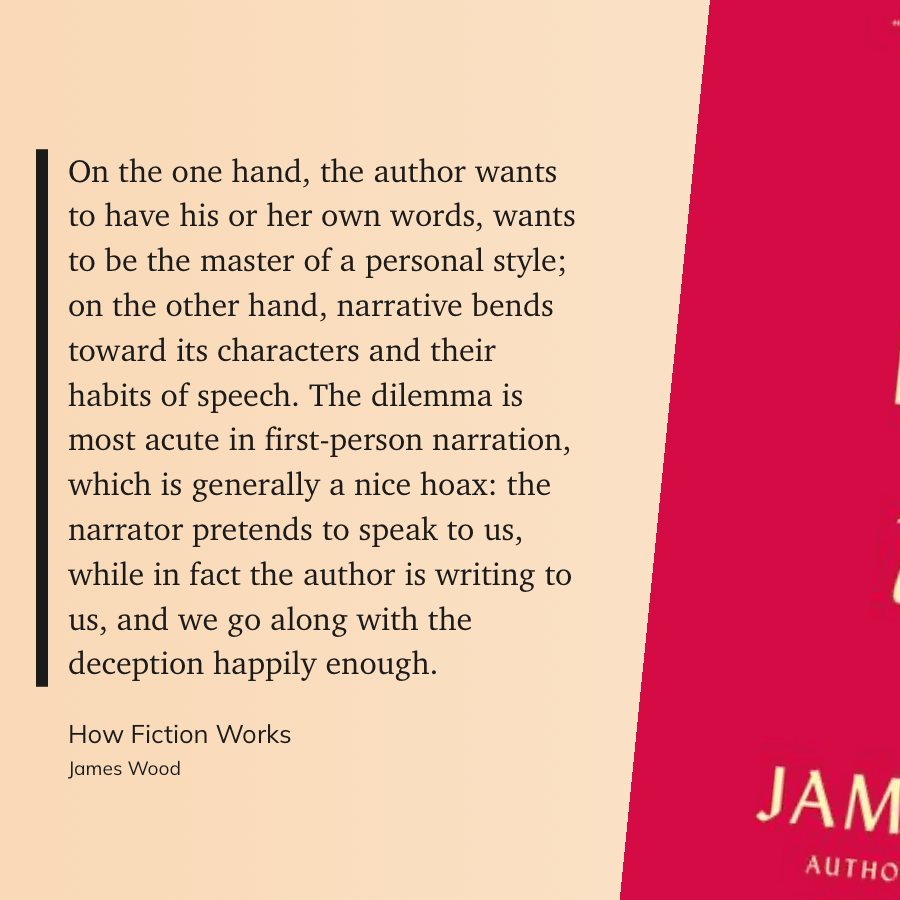
“On the one hand, the author wants to have his or her own words, wants to be the master of a personal style; on the other hand, narrative bends toward its characters and their habits of speech. The dilemma is most acute in first-person narration, which is generally a nice hoax: the narrator pretends to speak to us, while in fact the author is writing to us, and we go along with the deception happily enough.” (James Wood, How Fiction Works)
Writing Exercise: Mastering First-Person Voice and Perspective
1. Key Writing Techniques Illustrated by the Quotation
1. Character-Driven Voice: Creating a narrator whose speech patterns, tone, and worldview feel authentic to their personality, background, and experiences.
2. Authorial Control in Disguise: Balancing the author’s style with the illusion that the narrator is fully “in charge” of the story, even as the writer subtly steers the narrative.
3. Narrative Bias and Self-Revelation: Using the narrator’s perspective to reveal layers of self-awareness, self-deception, or internal conflict that enhance complexity.
2. Writing Prompt (500 Words)
Write a first-person narrative in which the narrator tells the story of an event that went wrong but insists it wasn’t their fault. As the narrator defends themselves, their voice should reveal unintentional truths about their character and perspective, leaving the reader to decide whether to trust or doubt them.
Specific Guidelines:
• Give the narrator a distinctive way of speaking (e.g., specific idioms, slang, or patterns of thought).
• Let the narrator’s bias color the events, but leave subtle clues that invite the reader to see beyond their version of the truth.
• Use tone to shape the narrator’s relationship with the audience (e.g., are they confiding, justifying, charming, or defensive?).
Possible Scenarios:
• A shopkeeper recalls a tense encounter with a difficult customer.
• A wedding guest recounts their disastrous toast, blaming everyone but themselves.
• A petty thief describes how they were “set up” during a failed heist.
3. Evaluation Criteria
1. Distinctiveness of Voice:
• Strong Example: The narrator’s personality shines through their phrasing and tone.
• “I told him straight out—‘Get off my back already, Mike’—but you know how people are. They don’t hear the words, just the tone. Like I’m the bad guy for raising my voice.”
• Weak Example: The voice is flat or generic, with no clear personality or background.
• “I told him to stop bothering me, but he didn’t listen. I don’t know why people act like that.”
2. Subtle Narrative Bias:
• Strong Example: The narrator’s perspective is colored by self-interest or insecurity, creating tension between their words and the implied reality.
• “The boss said I ‘lost control.’ Yeah, sure. Like anyone would stay calm with Barb breathing down their neck. Maybe I threw the wrench a little harder than I meant, but it didn’t hit anyone.”
• Weak Example: The narrator explains events without complexity or room for interpretation.
• “I lost my temper because Barb was mean. It wasn’t really my fault.”
3. Complexity of the Reader’s Experience:
• Strong Example: The narrator’s tone and details draw the reader into their mindset while also hinting at deeper truths.
• “She slammed the door on me, and I figured, fine, no big deal. But the way she looked at me? Like I was the problem? That stayed with me. Made me think maybe next time, I’ll let her explain herself first—if there’s a next time.”
• Weak Example: The scene lacks nuance, offering no opportunity for the reader to infer or analyze.
• “She slammed the door, so I left. I didn’t think about it much afterward.”
4. Follow-Up Questions for Workshopping/Revision
1. How well does the narrator’s voice reflect their personality and background?
2. Does the narrative feel as though the character is speaking directly to the audience?
3. Are there moments where the narrator unintentionally reveals something deeper about themselves?
4. How does the author balance their own style with the illusion of the narrator’s control?
5. Does the reader feel invited to question the narrator’s version of events, or does it feel too one-sided?
5. Recommended Reading
• “The Tell-Tale Heart” by Edgar Allan Poe: A classic example of a biased, unreliable first-person narrator whose voice is shaped by self-justification and paranoia.
• “Big Two-Hearted River” by Ernest Hemingway: Though third-person, this story exemplifies how narrative style can align closely with a character’s mental state.
• “We Have Always Lived in the Castle” by Shirley Jackson: First-person narration that masterfully blends character voice, authorial style, and layers of bias and unreliability.
This exercise should take 2 hours, with 45 minutes spent writing, 45 minutes revising, and 30 minutes reflecting on the follow-up questions or comparing your work to one of the recommended readings.

Leave a comment