
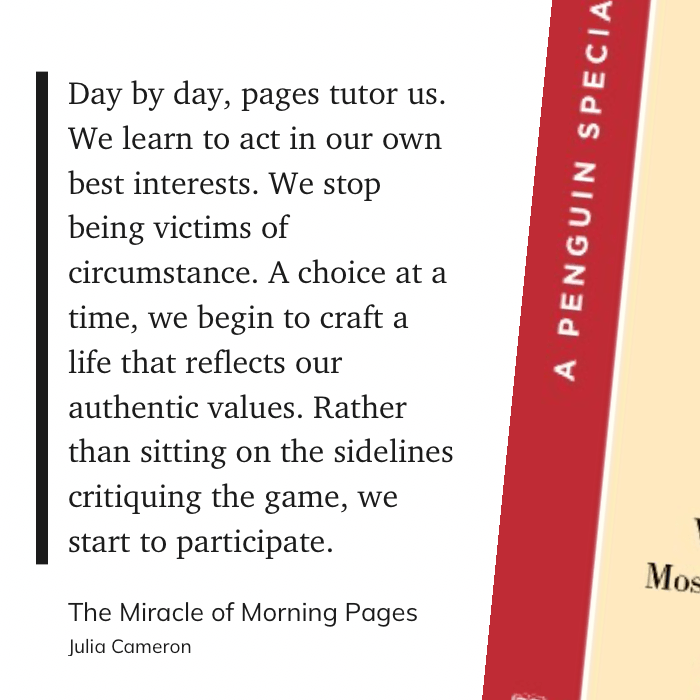
“Day by day, pages tutor us. We learn to act in our own best interests. We stop being victims of circumstance. A choice at a time, we begin to craft a life that reflects our authentic values. Rather than sitting on the sidelines critiquing the game, we start to participate.” (Julia Cameron, The Miracle of Morning Pages)
Writing Exercise: Crafting Authentic Characters Through Choice and Agency
Objective: This exercise uses Julia Cameron’s quotation to help writers explore how deliberate choices shape both a character’s internal world and their external circumstances. Writers will practice creating characters who take ownership of their lives, using specific moments of decision to reflect their values and deepen their development.
Key Writing Practice Development Techniques Illustrated by the Quotation
1. Character Agency: Focusing on how characters actively shape their own stories by making choices rather than being passive victims of circumstance.
2. Value-Driven Action: Highlighting the alignment (or tension) between a character’s decisions and their authentic values or internal desires.
3. Incremental Transformation: Demonstrating how small, deliberate choices accumulate to create significant character growth over time.
Writing Prompt
In 500 words, write a scene in which your protagonist is at a personal or moral crossroads. Begin with the character in a passive state, feeling trapped by external circumstances or internal doubt. Over the course of the scene, have them make a series of at least two decisions (small or large) that signal their movement toward greater agency. These choices should reveal their core values—whether aligned with or in tension with those values—and leave the reader with a sense of how the character’s arc might continue beyond the scene.
Scene Setting Options (choose one or invent your own):
1. Your character wakes up to find a crucial text message that demands an immediate decision.
2. Your character, while shopping, unexpectedly runs into someone from their past who they have unfinished business with.
3. Your character is asked to step into a leadership role they don’t feel ready for during a group crisis.
Evaluation Criteria
1. Strength of Character Agency:
• Strong Response: The protagonist demonstrates clear decision-making, moving the plot forward through their actions.
• Weak Response: The character remains reactive, with decisions driven by external forces or convenience.
2. Depth of Value-Driven Choices:
• Strong Response: The protagonist’s choices are complex and reveal their internal values or conflicts. The scene demonstrates how even small decisions reflect larger truths about the character.
• Weak Response: Choices feel superficial or disconnected from the character’s internal world, leaving the reader with little insight into their motivations.
3. Incremental Transformation:
• Strong Response: By the end of the scene, the character shows a shift in agency or perspective, even if subtle.
• Weak Response: The character remains stagnant, with no meaningful progress or change visible.
Follow-Up Questions for Reflection/Workshopping
1. How do the protagonist’s decisions reflect their internal values or conflicts?
2. Are there moments where the character could take greater initiative to drive the scene forward?
3. Does the pacing of the decisions feel natural and earned, or rushed and unmotivated?
4. How might you expand this moment to show more tension between the character’s internal values and their actions?
Recommended Published Work
Excerpt from Olive Kitteridge by Elizabeth Strout
In Strout’s novel-in-stories, characters are often caught in moments of quiet decision-making that reflect their inner lives. For example, in the story “Pharmacy,” the protagonist makes subtle yet revealing choices in how he interacts with others, demonstrating his inner values and small transformations over time.
Example Outcomes
Strong Response:
A protagonist receives a message from their estranged sibling asking for financial help. The character hesitates, haunted by past betrayals, but decides to respond. Instead of simply agreeing, they set firm boundaries, indicating a shift from their previous pattern of self-sacrifice.
Weak Response:
The character reads the message, debates briefly, and either agrees or declines without showing any internal struggle or growth. The decision feels perfunctory, offering little insight into their deeper motivations or values.
This exercise challenges writers to create characters who not only react but actively participate in their own stories, embodying the spirit of Cameron’s quotation.

Leave a comment