
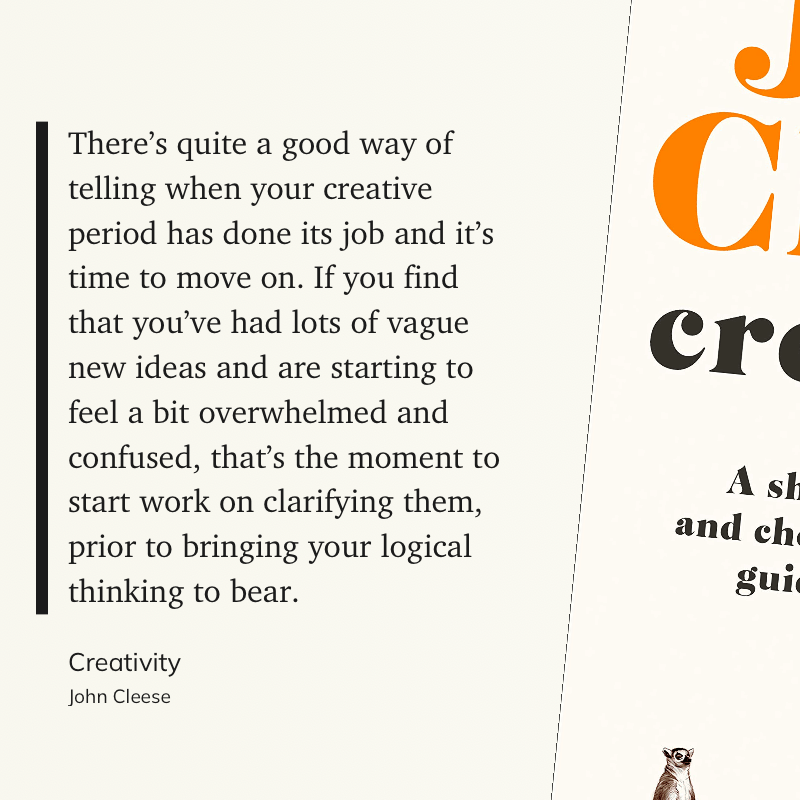
“There’s quite a good way of telling when your creative period has done its job and it’s time to move on. If you find that you’ve had lots of vague new ideas and are starting to feel a bit overwhelmed and confused, that’s the moment to start work on clarifying them, prior to bringing your logical thinking to bear.” (John Cleese, Creativity)
Writing Exercise: Clarifying Creative Ideas
Key Writing Practice Development Techniques:
Idea Clarification: The ability to sift through numerous creative ideas and identify the core elements that can be transformed into a coherent narrative.
Logical Structuring: Organizing and structuring those clarified ideas into a logical sequence that guides the reader.
Emotional Resonance: Ensuring the narrative maintains emotional depth and connectivity, even as it becomes more structured.
Writing Prompt:
In 500 words, write a scene where a character experiences an overwhelming rush of thoughts and emotions after discovering a life-altering secret. Begin with a stream-of-consciousness style to reflect their initial confusion and creativity explosion. Gradually, transition into a more structured narrative as the character clarifies their thoughts and decides on a course of action. Use dialogue, inner monologue, and sensory details to enhance emotional resonance.
Evaluation Criteria:
Clarity: The response should clearly show the shift from confusion to clarity, illustrating how the character organizes and prioritizes their thoughts.
Structure: The narrative should smoothly transition from a chaotic stream-of-consciousness to a logical and structured plot.
Emotional Engagement: The character’s internal conflict and resolution should evoke empathy or emotional engagement from the reader.
Consistency: The character’s voice and personality should remain consistent throughout, even as their thoughts become clearer.
Follow-Up Questions for Workshopping/Revision:
How effectively does the initial chaotic mind state transform into clarity?
Are the character’s motivations and decisions believable and impactful?
Does the writing maintain emotional depth throughout the transition?
What additional sensory details or inner dialogue could enhance the clarity and depth of the narrative?
Recommended Reading:
“Mrs. Dalloway” by Virginia Woolf – This novel exemplifies the transition from stream-of-consciousness to structured narrative, with a focus on clarifying complex emotions and thoughts.
Examples of Strong vs. Weak Responses:
Strong Response: A passage that begins with disjointed thoughts and vivid imagery, seamlessly transitioning into a clear and logical sequence of actions and decisions, with a character whose emotional journey is palpable and relatable.
Weak Response: A response that remains static, either in confusion or structure, without showing a believable progression or depth in the character’s emotional journey.
Regards,
RAR

Leave a comment