
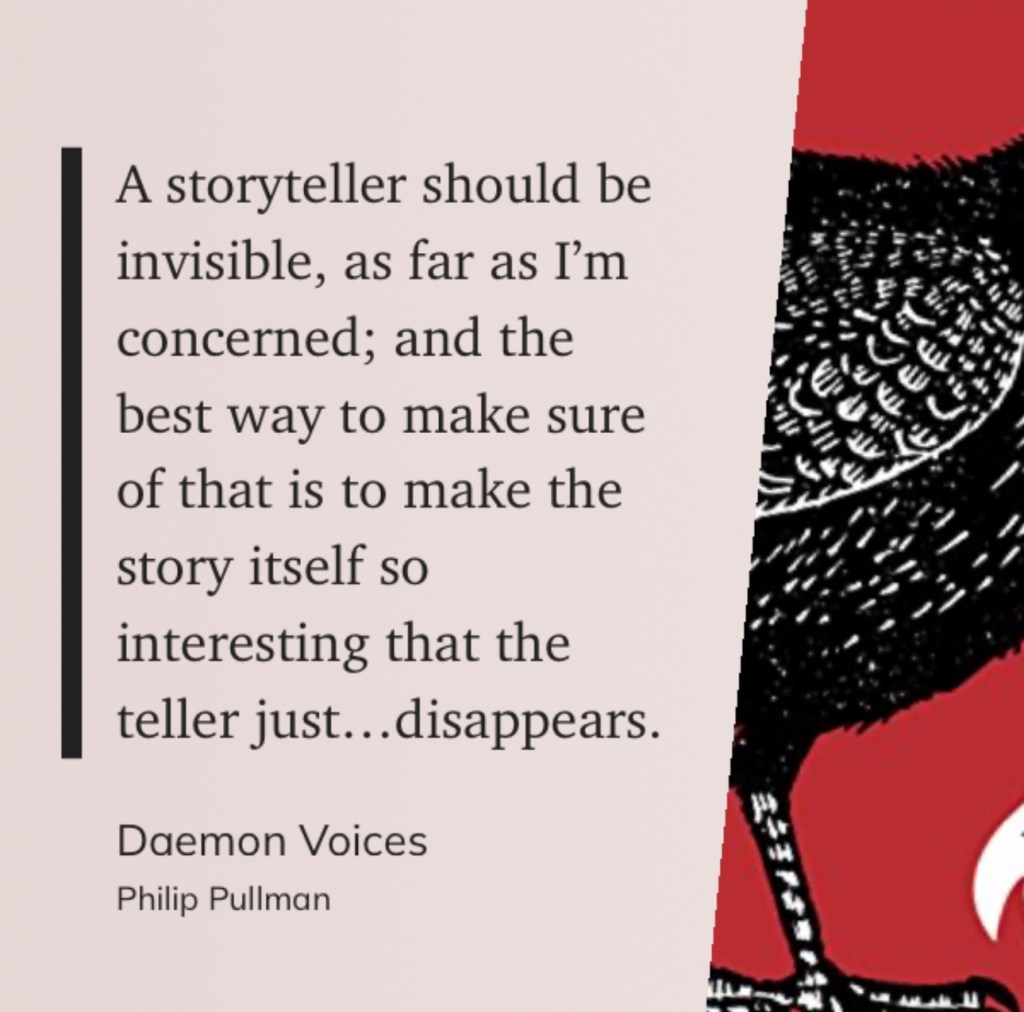
“A storyteller should be invisible, as far as I’m concerned; and the best way to make sure of that is to make the story itself so interesting that the teller just…disappears.” (Philip Pullman, Daemon Voices)
Writing Exercise: Vanishing into the Story
Key Writing Practice Development Techniques:
1. Immersive Narrative Flow – The prose should engage the reader so completely that they forget about the author’s presence. This means avoiding self-conscious writing, unnecessary flourishes, or narrative intrusions.
2. Character-Driven Engagement – A strong story captivates through the characters’ experiences, thoughts, and actions rather than through overt authorial commentary.
3. Seamless Worldbuilding – Every detail should feel organic, revealed through action and interaction rather than exposition or heavy-handed description.
500-Word Writing Prompt:
Write a scene in which a character is on the verge of making a life-changing decision, but instead of explicitly stating their thought process, reveal their struggle through their actions, environment, and interactions. The challenge is to keep the reader fully absorbed in the moment without relying on internal monologue or overt authorial guidance.
For example, if the character is deciding whether to leave their spouse, show them lingering over an old photograph, hesitating before dialing a phone number, or flinching at the sound of their partner’s voice. Let the setting reflect their inner turmoil—a flickering streetlamp outside, a radio playing a song that carries an old memory, the subtle tension in the way they grip their fork at dinner.
Evaluation Criteria:
• Engagement: The scene should fully absorb the reader without drawing attention to the author’s craft.
• Subtext: The character’s internal struggle should be conveyed without direct explanation.
• Integration of Setting: Every sensory detail should deepen the reader’s understanding of the character’s emotional state.
• Natural Dialogue and Action: If dialogue is used, it should advance the tension organically rather than explicitly stating the conflict.
Strong vs. Weak Responses:
• Strong: A character packs a suitcase but keeps removing items, their movements precise but hesitant. The room is silent except for the rhythmic drip of a faucet, which they finally fix—a quiet act of control amid uncertainty. Dialogue is clipped, loaded with unspoken weight.
• Weak: The character sits on the bed thinking, “I don’t know if I should leave.” They recount past memories in a long block of internal monologue, and the narration explains their conflict rather than letting it unfold naturally. The setting feels generic, with no atmospheric tension.
Follow-Up Questions for Workshopping/Revision:
• Where does the story pull the reader in most effectively? Are there moments where the writer’s presence becomes too noticeable?
• Does the scene rely on direct exposition rather than letting details and action carry the weight?
• How does the setting contribute to the emotional undercurrent? Could it be heightened or made more specific?
• Are there any lines of dialogue or actions that feel too on-the-nose?
Recommended Reading:
• “Runaway” by Alice Munro – A masterclass in invisible storytelling where tension builds through subtle details and restrained narration.
• “The Husband Stitch” by Carmen Maria Machado – Uses immersive storytelling to pull the reader into a character’s emotional reality without intrusive authorial presence.


Leave a comment