
Writing Exercise: Precision of Point of View and Movement
Key Craft Techniques
1. Point of View as Camera Placement: Choosing where the reader “stands” in a scene shapes emotional tone, intimacy, and narrative focus.
2. Dramatic Movement through Staged Action: Constructing a scene as if framing a shot—what enters the frame, where it lands, how long it lingers—dictates tension and meaning.
3. Descriptive Intentionality: Every sensory detail must push character, reveal stakes, or heighten conflict. No background noise. Every pixel matters.
500-Word Prompt
Write a scene in which a character discovers something that changes their understanding of someone they trust. Do not summarize or reflect on the past. Focus entirely on the moment of discovery, unfolding in real time. Use one physical setting. Limit yourself to a single point of view—one camera. No omniscient flourishes, no info dumps. Begin with the character entering the space. End before they act on what they’ve learned. Let the moment hang.
As you write, decide: Where is the camera? Hovering above? Close on the character’s hands? Watching through a cracked door? Try several before committing. Avoid default placement (e.g., eye-level, front-and-center). Use the chosen angle to regulate what the reader knows and when. Think like a cinematographer: tight framing for claustrophobia, wide shots for alienation, silence for dread.
Evaluation Criteria
Strong responses will:
– Use precise POV to sculpt emotional distance and shape reader knowledge
– Create rising tension through what’s seen, not told
– Allow gesture, environment, and timing to do the work of revelation
– Build to a meaningful pause, not a summary or emotional label
Weak responses explain too much, choose neutral POV angles, and rely on interior monologue or exposition to express what should be shown. Strong responses stay grounded in the body, the room, the visual field—what the camera sees.
Follow-Up Workshop Questions
– What would shift if the scene were shot from a different angle—closer, farther, obscured?
– Is the tension driven by what’s revealed or by what remains hidden?
– Which details build pressure? Are they revealed in the right order?
– Could one sentence be cut to increase tension or ambiguity?
Recommended Reading
The End of Firpo in the World by George Saunders (Tenth of December). Saunders shows exactly how camera-like POV decisions drive emotional stakes. He restricts what the reader can see or understand in order to simulate the confusion, pain, and insight of a single moment. His framing choices are ruthlessly intentional, often placing us inside a character’s fragmented perception, forcing us to read between the action to discover what’s at risk.
Strong Example Snapshot
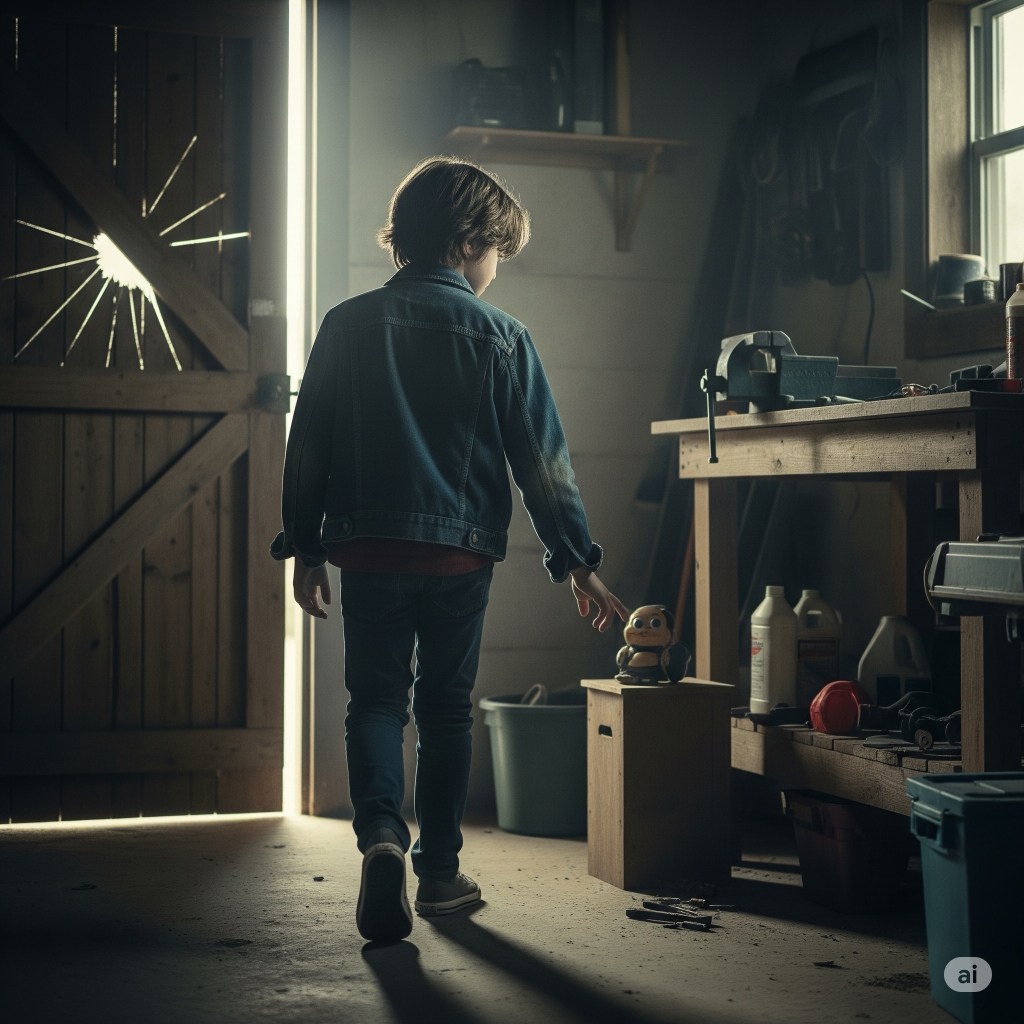
A boy steps into the garage. Light slices in from a cracked door. The camera stays on his back as he crosses to the workbench. His hand pauses above a small, out-of-place object. He doesn’t pick it up. He recognizes it. His shoulders still. In the silence, the distant sound of a running shower. He turns, but the scene ends before his face is seen.
Weak Example Snapshot
He found something that proved she’d been lying all along. Memories of what she’d said came flooding back. It made him sick. He felt betrayed. He sat down, trying to decide what to do. Everything had changed, and he didn’t know how to handle it.
AI Disclosure Statement:
This writing prompt was created in collaboration with ChatGPT, an AI model by OpenAI, to support creative practice. ChatGPT assisted with idea generation and drafting; the final text was edited by the author. The illustration was created using Google Gemini.

Leave a comment