
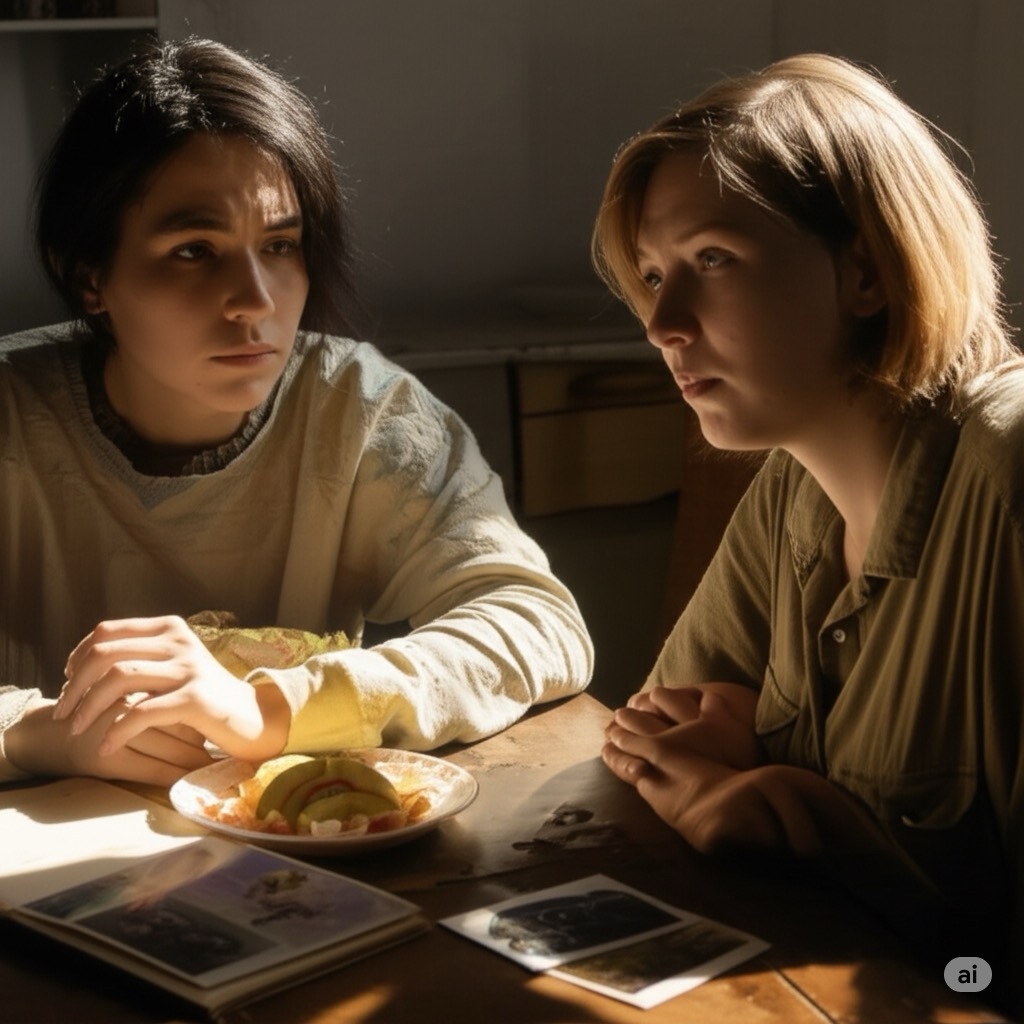
A friend’s silence and a forgotten photo album spark misinterpretation in this photorealistic illustration, generated by Gemini for a writing prompt.
Writing Exercise: “The Voice That Knows Prompt”
Key Techniques Developed:
Use of a high-authority third-person omniscient narrator Contrast between character confusion and narrator clarity Sentence-level control through declarative rhythm and precise diction
500-Word Prompt:
Write a 500-word scene in third-person omniscient narration in which a character misinterprets an ordinary event—something subtle but emotionally loaded: a friend’s silence, a forgotten object, an unexpected gesture. The narrator must not echo the character’s confusion. The narrator knows what happened, why it matters, and what the character cannot or will not admit. The event should unfold in real time—no flashbacks, no drifting into abstraction. Let the narrative voice stay grounded, clear-eyed, and fully in control.
Avoid softening words: “maybe,” “somehow,” “it seemed,” “perhaps.” Replace them with clear observations. The narrator’s tone should feel unshakable—lean, deliberate, confident. This isn’t a story told while thinking aloud. It’s a verdict delivered without apology.
Strong Response:
A strong response reveals layered emotional truth through confident narration:
“Leo thought the half-smile meant forgiveness. It didn’t. Clara smiled because it was finished—because nothing else needed to be said. He would replay that moment for years, but he was already wrong.”
This delivers character misunderstanding without narrative uncertainty. The narrator is clear, concise, unblinking.
Weak Response:
A weak response lacks commitment to voice and leans on hedging:
“Clara might have meant something by the way she smiled, or maybe she didn’t. Leo wasn’t sure, and maybe she wasn’t either.”
This forfeits control to vagueness. The narrator floats rather than drives the story. Insight dissolves into speculation.
Evaluation Criteria:
The narrator never speculates or mimics the character’s uncertainty Sentences are clear, confident, and carry a steady rhythm The scene centers on a small but emotionally significant event Character misinterpretation is rendered without narrator ambiguity Word choices support the authority of the voice—no padding, no qualifiers
Workshopping/Revision Questions:
Where is the narrator unsure? Can that moment be sharpened or cut? Are any words softening the impact (e.g., “a little,” “somewhat,” “as if”)? Does the narrator reveal something the character fails to grasp? Are the strongest sentences driven by action, perception, or judgment? Would the tone still feel authoritative if one sentence were read aloud in isolation?
Recommended Reading:
Claire Keegan’s “Foster”—narrative restraint with underlying control, even when the child narrator doesn’t understand what’s happening.
Edward P. Jones’ “Old Boys, Old Girls”—omniscient voice delivers memory and fate with stark clarity and emotional precision.
Time Allotment:
Draft: 60 minutes
Self-edit: 45 minutes
Workshop prep: 15 minutes
AI Disclosure Statement:
This writing prompt was created in collaboration with ChatGPT, an AI model by OpenAI, to support creative practice. ChatGPT assisted with idea generation and drafting; the final text was edited by the author. The illustration was created using Google Gemini.

Leave a comment