
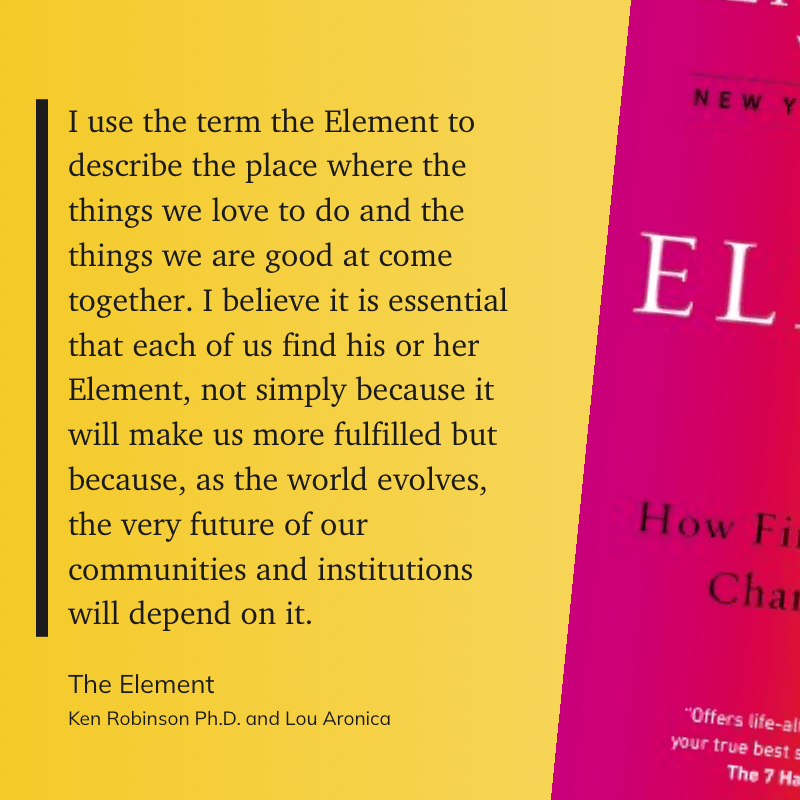
“I use the term the Element to describe the place where the things we love to do and the things we are good at come together. I believe it is essential that each of us find his or her Element, not simply because it will make us more fulfilled but because, as the world evolves, the very future of our communities and institutions will depend on it.” (Ken Robinson Ph.D. and Lou Aronica, The Element)
Where Love Meets Labor: A Practice in Writing Toward the Element
Writing Practice Techniques Illustrated
Creative Alignment: Daily writing becomes sustainable and generative when it lives at the intersection of what the writer loves and what they’re uniquely skilled at. Purpose-Driven Process: Writing is not only a personal act but one that can shape culture, institutions, and shared meaning. Friction as Fertile Ground: The most productive writing habits emerge not from ease, but from tension—between desire and discipline, passion and precision, self and audience.
Writing Prompt (500 words)
Write a scene or reflection where you explore a moment in your writing life when what you love to write and what you are good at writing diverged—or converged. Begin with a real or imagined moment: the draft that felt thrilling but fell flat, the project that earned praise but bored you, the genre that called to you but defied your voice. Without narrating from a distance, recreate this moment in visceral detail—location, time of day, sounds, posture, tension in your body. Show us the push-pull: the part of you that wants to write freely vs. the part that knows what “works.” Avoid abstraction. Let the friction emerge through physical choices, gesture, hesitation, tone.
The scene must move toward a moment of shift—a decision or reframing in your writing practice that implicates not just your craft but your purpose. This decision should expand the scene beyond your own mind. Who or what depends on your voice? Where does your writing matter outside of the page? Let the Element emerge, not as epiphany but as something inconvenient, clarifying, even destabilizing.
Evaluation Criteria
Strong responses:
– Render the writing life as lived experience, not abstract commentary
– Ground the tension between love and skill in a specific, concrete moment
– Make the writing act itself dramatic and alive on the page
– Extend the scene beyond self-expression toward social or relational meaning
– Resist clean resolutions; honor ambivalence or contradiction
Weak responses:
– Generalize fulfillment or frustration without a scene
– Frame writing practice as solely personal, disconnected from broader impact
– Lean on clichés about creativity or writer’s block
– Explain rather than dramatize the struggle between passion and discipline
– Settle for tidy resolutions or didactic tone
Follow-up Workshop Questions
– Where in the piece do you feel the real friction in your practice? Could it be more embodied?
– How clearly do you distinguish between what you want to write and what you can write well?
– Is there a moment of risk or choice? What makes it costly or consequential?
– What wider context—reader, community, institution—emerges as implicated in your writing?
– Does the piece respect the complexity of the writer’s life, or tidy it up too quickly?
Recommended Reading
Why I Write by Joan Didion – especially the way she connects language, observation, and control to her deeper compulsions as a writer. Notice how Didion doesn’t romanticize the writing life but makes it bodily, psychological, and culturally engaged. Her clarity emerges not from resolution but from relentless attention to what drives her—and what it costs.

Leave a comment