
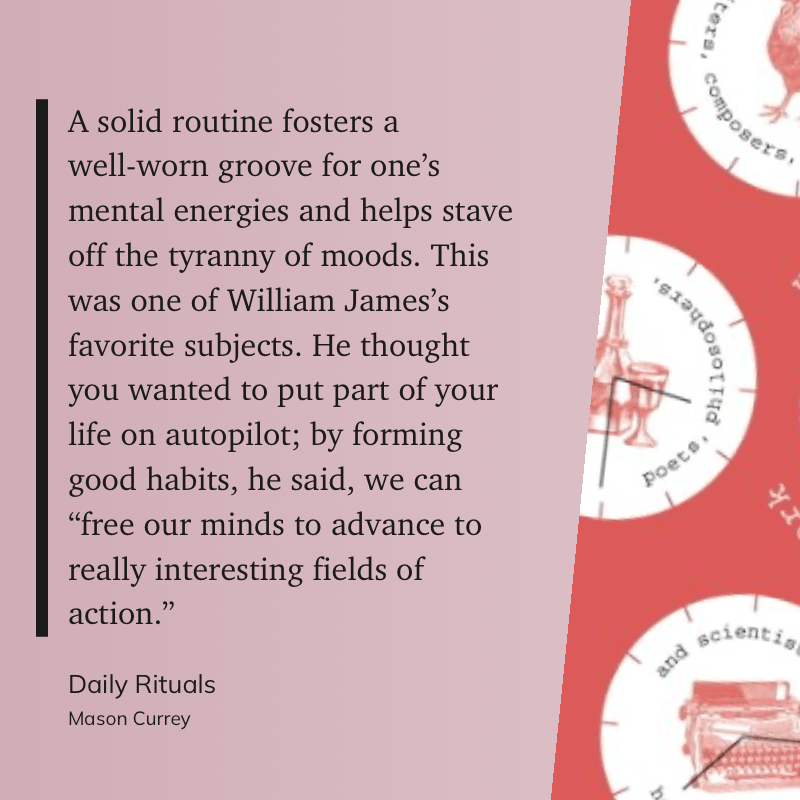
“A solid routine fosters a well-worn groove for one’s mental energies and helps stave off the tyranny of moods. This was one of William James’s favorite subjects. He had thought you wanted to put part of your life on autopilot; by forming good habits, he said, we can “free our minds to advance to really interesting fields of action.”” (Mason Currey, Daily Rituals)
Writing Exercise: “Grooves Before Genius”
Techniques to Practice
Externalizing Inner Resistance – Transforming internal struggles into concrete actions, obstacles, and sensory details Time-Boxed Psychological Realism – Rendering the mental terrain of a constrained writing window (e.g., 90 minutes) with emotional precision Behavioral Structure as Narrative Frame – Using the structure of a repeated activity (writing practice) to shape the scene’s rhythm, tension, and stakes
Writing Prompt (500 words)
Write a scene in which a writer tries to begin their daily writing practice but can’t. Set the timer for a 90-minute window. The story takes place entirely inside this space: the desk, the screen, the chair, the coffee. Begin with the writer’s familiar routine—how they prepare their space, the objects they touch, the noises around them. Then shift into the psychological friction: the distractions they invent, the memories that surface, the bargaining, the small shames. Use action and physicality to show their inner state (posture, pacing, rituals, repeated gestures). Let the writing itself become the antagonist—not because it’s absent, but because its presence is unbearable. Do not let them write. End the piece as the 90-minute timer ends.
Avoid flashbacks unless they surface involuntarily. Avoid first-person reflection. Anchor the story in physical and temporal detail. You are dramatizing the prelude to a practice, not the fruits of it.
Evaluation Criteria
Strong responses will:
– Make time and space feel shaped by psychological pressure
– Render resistance in sensory and behavioral terms, not abstract reflection
– Establish a rhythmic structure that mimics a writer’s halting internal pacing
– Avoid sentimentality or romanticized suffering—keep the friction grounded and embodied
– Let every object or action carry weight beyond function (a cold mug, a blinking cursor, an unopened notebook)
Weak responses will:
– Overexplain the character’s mental state without dramatizing it
– Default to clichés about “writer’s block” without specificity
– Include flashbacks or memories as narrative crutches
– Allow the character to give in and start writing, resolving the conflict
– Ignore sensory detail in favor of internal monologue or commentary
Workshopping/Revision Questions
– Where in the scene does time feel most distorted—dragging or collapsing? Why?
– Are the physical actions aligned with the emotional stakes of the scene?
– What’s the real fear or resistance hiding beneath the behavior?
– Is there too much interior narration and not enough dramatized tension?
– Could the writing space itself be used more effectively as a container or mirror of struggle?
Recommended Reading
Deborah Eisenberg’s “Transactions in a Foreign Currency” — The opening pages focus on small, repeated gestures and spatial discomfort to render a character’s internal paralysis. Eisenberg captures mental friction without ever naming it directly, allowing sensory detail and timing to carry emotional weight.
Strong vs. Weak Response Comparison
Strong: A writer clears the desk at 6:00 a.m. sharp. Pours coffee, aligns two pens beside the notebook. Opens the window to hear traffic, then closes it. Types one word, deletes it. Stares at a knuckle scar. Reorganizes a drawer. Sits back down. Starts to cry but doesn’t know why. With one minute left on the timer, she closes the laptop, wipes the table, and walks away. She never wrote a word.
Weak: A writer sits and immediately thinks, “Why can’t I write?” Then recounts a childhood trauma in internal monologue, skips from thought to thought without anchoring in place or time. The piece ends with them typing out a sentence and feeling relieved. The routine feels generic. The resistance feels stated, not dramatized. The ending resolves the tension too easily.

Leave a comment