
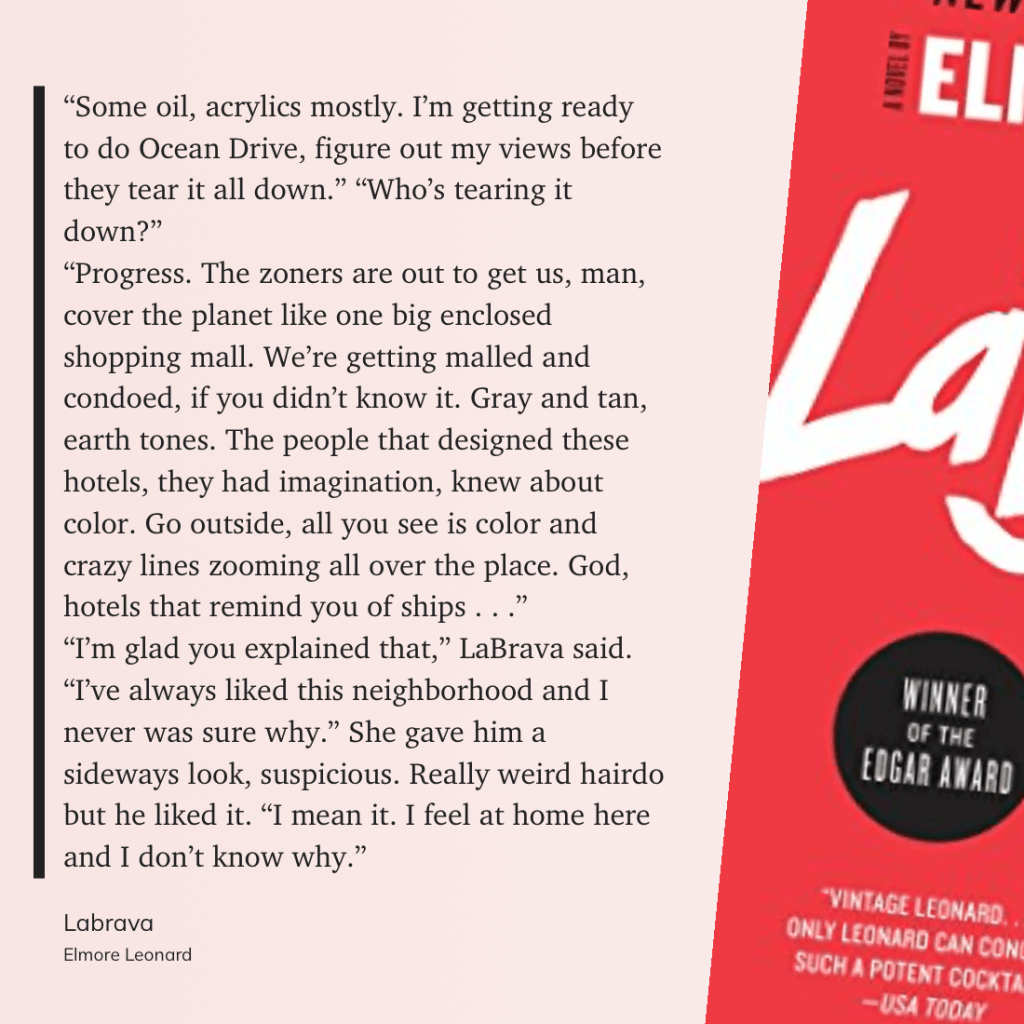
““Some oil, acrylics mostly. I’m getting ready to do Ocean Drive, figure out my views before they tear it all down.” “Who’s tearing it down?”
“Progress. The zoners are out to get us, man, cover the planet like one big enclosed shopping mall. We’re getting malled and condoed, if you didn’t know it. Gray and tan, earth tones. The people that designed these hotels, they had imagination, knew about color. Go outside, all you see is color and crazy lines zooming all over the place. God, hotels that remind you of ships . . .”
“I’m glad you explained that,” LaBrava said. “I’ve always liked this neighborhood and I never was sure why.” She gave him a sideways look, suspicious. Really weird hairdo but he liked it. “I mean it. I feel at home here and I don’t know why.”” (Elmore Leonard, Labrava)
CHARACTER THROUGH DIALOGUE: A Two-Hour Exercise Inspired by Elmore Leonard
Techniques Highlighted
Revealing Character Through Dialogue – The speaker’s views on urban development expose not only aesthetic tastes but values, worldview, and a sense of loss. Subtext in Interaction – The sideways glance, the unspoken judgments, the defensive tone—characters’ true feelings emerge between the lines. Concrete Sensory Detail as Emotional Language – “Gray and tan,” “crazy lines,” and “hotels that remind you of ships” provide external imagery that reflects internal states.
Writing Prompt (500 words)
Write a two-person scene set in a place threatened by change—a diner about to close, a bus route being shut down, a park slated for condos. One character is deeply invested in the space and feels the loss personally. The other is either indifferent or only vaguely aware of the change. Through their conversation, reveal each character’s inner life, values, and personal history without using exposition or direct description. Let the setting speak. Let the dialogue carry emotion, friction, and insight. At least one character should surprise the reader by the end—not through plot, but through a shift in tone, attitude, or emotional vulnerability.
No internal monologue. No narration. Only action, setting, and dialogue. The goal is to let what’s said and how it’s said do the heavy lifting.
Evaluation Criteria
Strong Responses:
Dialogue is layered, sounding real while also carrying emotional and thematic weight. Setting details evoke memory, mood, or cultural shifts without overt commentary. Characters reveal themselves through interaction—how they listen, interrupt, contradict, or evade. There is a tonal or emotional turn in the scene that deepens understanding of one or both characters.
Weak Responses:
Dialogue is too on-the-nose, with characters stating exactly what they mean or feel. Setting is generic or described without emotional relevance. Characters remain static, with no shift in tone or vulnerability. Interpersonal dynamics lack subtext—too much explanation, not enough implication.
Follow-Up Workshop Questions
Where does the scene imply something deeper than what is said aloud? What does each character want from this conversation—and do they get it? How does the setting reflect or clash with the emotional stakes? Does the dialogue have rhythm and variation, or does it feel flat? Where could you introduce a tonal turn, a surprise, or an emotional pivot?
Recommended Reading
“Runaway” by Alice Munro (from Runaway) – Watch how Munro uses dialogue and setting (a woman returning to a changed home) to expose past trauma, present conflict, and unspoken longing.
Strong Example (Excerpt)
“I used to sit at this counter after school. Same stool, same jukebox. You remember jukeboxes?”
“I remember the noise,” he said. “Glad they’re gone.”
She laughed, but not kindly. “You’d rather silence?”
“Silence doesn’t lie to you.”
“Neither did the Supremes.”
Weak Example (Excerpt)
“This diner means a lot to me. I’ve been coming here since I was a kid.”
“Okay. But it’s just a diner.”
“You don’t understand. It’s special.”
“Why is it special?”
“I told you, because I came here as a kid. Lots of memories.”
“Okay.”
The strong version reveals character through contrast, tone, and implication. The weak version explains without evoking.
Use the full two hours. First hour: free-write, keeping your fingers moving, trusting the voices. Second hour: revise with the evaluation criteria. Trim anything expository. Turn summary into implication. Listen for surprise in your own lines.

Leave a comment