
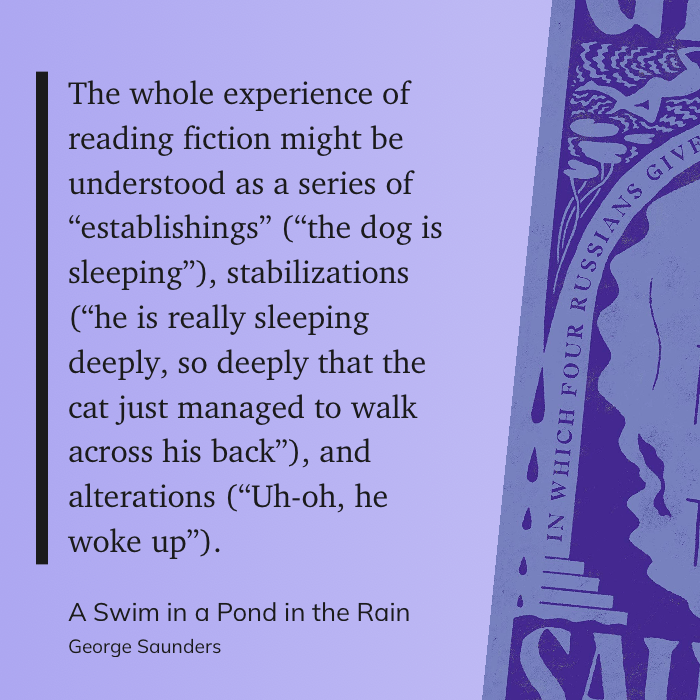
“The whole experience of reading fiction might be understood as a series of “establishings” (“the dog is sleeping”), stabilizations (“he is really sleeping deeply, so deeply that the cat just managed to walk across his back”), and alterations (“Uh-oh, he woke up”).” (George Saunders, A Swim in a Pond in the Rain)
Writing Exercise: “Instability in Stillness”
Techniques Illustrated:
Establishing character reality through specific observation: Creating an initial baseline that anchors the reader in a believable, tangible moment. Gradual destabilization to build tension and deepen character: Using subtle changes in action or perception to shift the emotional stakes. Altering a character’s status quo through a meaningful event: Introducing disruption that reveals character psychology through their reaction.
Writing Prompt (500 words):
Write a scene in which your protagonist is engaged in a quiet, repetitive action—something solitary, even meditative. This could be mending a net, folding laundry, watching a neighbor, cutting vegetables. Begin by establishing the physical setting and the protagonist’s mindset through sensory detail and interiority. Use precise description to root the reader in stillness.
Then, stabilize the moment by reinforcing the character’s rhythm or ritual. Let time pass—show the repetition deepening, the thoughts expanding or narrowing. The stability should feel deliberate, slightly too perfect.
Finally, introduce an alteration: a knock, a discovery, an unplanned phone call, a shift in weather, an overheard word. The change must be external and small, but significant enough to force an internal crack or reevaluation. Let the protagonist’s reaction show us something previously hidden about them.
Evaluation Criteria:
Does the piece establish a believable, sensory-rich world in its opening? Does the stabilization deepen tension rather than stall it? Is the alteration subtle but resonant, revealing something unexpected about the protagonist? Does the emotional shift feel earned, not sudden or melodramatic? Does the language reflect tonal control across the three movements (establish, stabilize, alter)?
Strong Response Example:
A widower irons his late wife’s blouses every Tuesday, though she died four years ago. He hums as he smooths the fabric, the heat rising into his face. He hangs each shirt by color. The ritual is intact. Then the iron sputters. The power’s gone. He goes to the breaker—finds her wedding ring tucked behind a pipe. He didn’t know it was missing. The room goes still. He doesn’t turn the power back on.
Weak Response Example:
A man is watching TV. A friend comes over. They talk about something bad that happened at work. The man gets upset and throws the remote. The scene starts in chaos, never stabilizes, and the change is not earned—just explosive.
Workshopping/Revision Questions:
What exactly has been disrupted, and why does it matter to this character? Could the alteration be made more subtle but still deepen the emotional stakes? Does the protagonist change internally as a result, or only react externally? Are the “establish” and “stabilize” moments carrying emotional weight, or just filling time?
Recommended Reading:
The Half-Skinned Steer by Annie Proulx. The story exemplifies gradual destabilization through memory, environment, and physical vulnerability, with an alteration at the end that resonates long after. The opening’s steadiness makes the shift haunting.


Leave a comment