
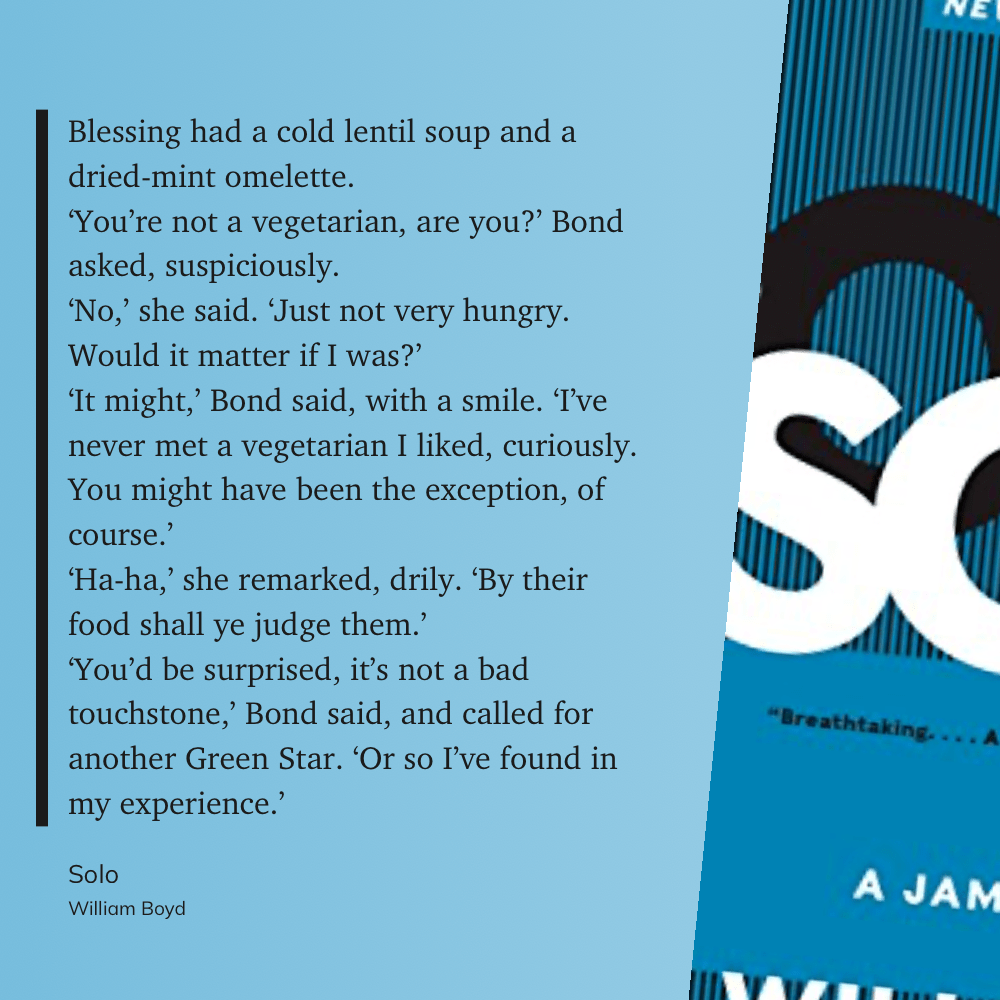
“Blessing had a cold lentil soup and a dried-mint omelette.
‘You’re not a vegetarian, are you?’ Bond asked, suspiciously.
‘No,’ she said. ‘Just not very hungry. Would it matter if I was?’
‘It might,’ Bond said, with a smile. ‘I’ve never met a vegetarian I liked, curiously. You might have been the exception, of course.’
‘Ha-ha,’ she remarked, drily. ‘By their food shall ye judge them.’
‘You’d be surprised, it’s not a bad touchstone,’ Bond said, and called for another Green Star. ‘Or so I’ve found in my experience.’” (William Boyd, Solo)
Character Development Writing Exercise: By Their Food Shall Ye Judge Them
Key Writing Practice Techniques Illustrated by the Quotation
Dialogue as Subtext: The exchange reveals subtle power dynamics, judgment, and flirtation beneath the surface of a mundane conversation about food. Each character’s line gestures toward more than what’s said aloud. Characterization Through Sensory Detail and Preference: The mention of cold lentil soup and dried-mint omelette instantly signals restraint, cultural texture, and possibly mood. Bond’s reaction reveals more about him than it does about Blessing. Tension in Banter: The flirtation is laced with challenge, skepticism, and coded personal judgments. The tone flickers between charm and discomfort.
500-Word Writing Prompt
Write a 500-word scene in which two characters meet over a shared meal, and their differing relationships to the food reveal deeper tensions, judgments, or desires. One character should make an offhand comment about the other’s food choice that exposes something about their worldview. Avoid having them state their emotions or backstories outright. Instead, use how they speak about (or refuse to speak about) the food to indicate attraction, distrust, resentment, or admiration.
Set the scene in a real-world setting: a late-night diner, a family’s cramped kitchen, a breakroom during a double shift. Let the food and dialogue do the heavy lifting. No inner monologues or expository flashbacks—build the characters entirely through what they say and how they behave during the meal.
Evaluation Criteria
Strong Responses:
Dialogue contains layered subtext, where what’s unsaid carries as much weight as what’s spoken. The characters’ food choices function symbolically and concretely (e.g., one character’s abstention or indulgence has narrative weight). Tonal shifts (warmth/defensiveness, flirtation/hostility) create emotional texture without overexplaining. Scene ends with a subtle change—an emotional or psychological shift—without overt resolution.
Weak Responses:
Dialogue is too on-the-nose or expository (“I’m vegan because of my childhood trauma”). Food is described generically or only for atmosphere without character insight. Characters remain static, or the scene ends without any narrative movement or emotional charge. Tone is flat or inconsistent, lacking the emotional layering that tension-in-banter requires.
Follow-up Questions for Workshopping/Revision
What does each character want from the other in this scene, and how is that expressed indirectly? Where does the power shift in the dialogue? Who ends up exposed? If a stranger read only the characters’ food orders and dialogue, what would they infer? Does the setting support or undercut the emotional temperature of the exchange?
Recommended Reading
Read the dinner party scene between Marian and Mark in The Driver’s Seat by Muriel Spark. Spark uses food, clipped dialogue, and emotional withholding to construct sharp, often unsettling power dynamics. The scene exemplifies how every bite, pause, and remark carries psychological weight.

Leave a comment