
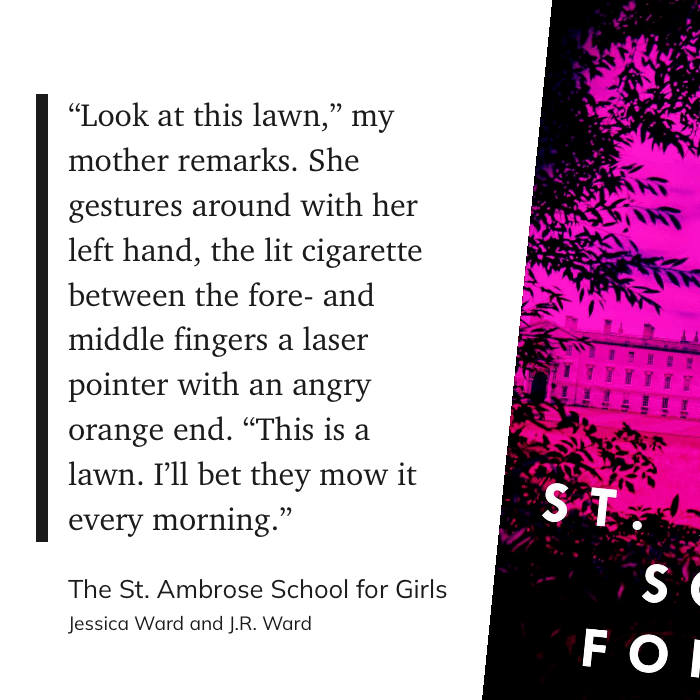
““Look at this lawn,” my mother remarks. She gestures around with her left hand, the lit cigarette between the fore- and middle fingers a laser pointer with an angry orange end. “This is a lawn. I’ll bet they mow it every morning.”” (Jessica Ward and J.R. Ward, The St. Ambrose School for Girls)
CHARACTER THROUGH GESTURE, VOICE, AND ENVY
Key Writing Practice Development Techniques
Characterization through Gesture: The cigarette acting as a “laser pointer” transforms a mundane habit into a loaded gesture, projecting disdain and precision. Voice-Infused Dialogue: The mother’s line drips with sarcasm and barely concealed envy. Her speech reveals class tension, judgment, and dissatisfaction without overt exposition. Emotional Subtext through Observation: The lawn isn’t just a lawn—it’s a symbol of affluence, order, and privilege. The mother’s remark refracts personal insecurity through a physical setting.
500-Word Writing Prompt: “The Envy Scene”
Write a 500-word scene in which one character, in the presence of another, reacts to a symbol of someone else’s perceived success. This symbol could be a new car, a family heirloom, a backyard pool, a freshly remodeled kitchen, or even a perfect report card. Use a single, telling gesture to externalize envy. Embed subtext in the dialogue—what’s said must carry weight, but what’s not said should carry more. Your challenge is to create emotional tension not through confrontation, but through tone, gesture, and the manipulation of an object or space.
Strong Response Example
A brother flicks invisible lint off a designer blazer hanging on a coat rack, calling it “slick,” his tone brittle. He says, “Bet it cost more than my rent.” The gesture reveals resentment, the phrasing carries bite, and the silence after lands heavy. The envy is unspoken but palpable.
Weak Response Example
A character says, “I’m jealous of her kitchen. I wish I had money like that.” The envy is direct, but flat. There’s no tonal complexity, no action to support it, no layered emotional truth.
Evaluation Criteria for a Successful Response
– Gesture externalizes a deeper emotional state
– Dialogue reveals voice and internal tension without directly naming the emotion
– Symbol is specific, grounded, and thematically rich
– Subtext carries emotional weight beyond the surface of the scene
– Avoids exposition in favor of dramatization
Follow-Up Questions for Workshopping or Revision
– Does the character’s gesture imply more than it states?
– Is the object of envy specific and symbolically loaded, or generic?
– What deeper insecurity or unmet need does the envy hint at?
– Could you remove the dialogue entirely and still understand the tension through action and tone?
– Where does silence or omission do emotional work?
Recommended Reading
Excerpt from The Great Gatsby by F. Scott Fitzgerald (Chapter 5): Gatsby’s nervous preparation for Daisy’s arrival, including the meticulous arrangement of flowers and shirts, shows longing, class aspiration, and fragile masculinity—all through gesture, tone, and physical detail.

Leave a comment