
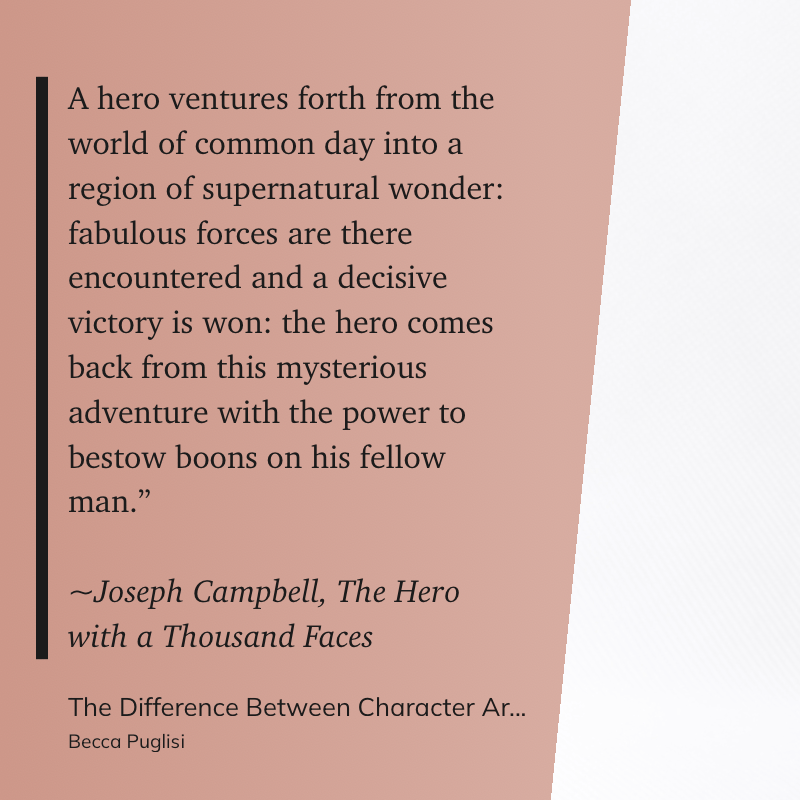
“A hero ventures forth from the world of common day into a region of supernatural wonder: fabulous forces are there encountered and a decisive victory is won: the hero comes back from this mysterious adventure with the power to bestow boons on his fellow man.” — Joseph Campbell, The Hero with a Thousand Faces (Becca Puglisi, The Difference Between Character Archetypes and Tropes)
Crossing Into the Unknown: Character Arc and Inner Boon
Quotation: “A hero ventures forth from the world of common day into a region of supernatural wonder: fabulous forces are there encountered and a decisive victory is won: the hero comes back from this mysterious adventure with the power to bestow boons on his fellow man.” — Joseph Campbell, The Hero with a Thousand Faces (quoted in Becca Puglisi, The Difference Between Character Archetypes and Tropes)
Techniques to Practice:
Dynamic Character Transformation: Show internal change triggered by external forces, not just action or plot shifts. Deep Stakes Through Symbolism: Frame challenges and victories in symbolic terms that reveal the character’s core fear or desire. Meaningful Return: Illustrate how the character’s personal transformation translates into a gift, insight, or burden they bring back to their world.
Writing Prompt (500 Words):
Write a scene in which a character crosses into an unfamiliar, unsettling environment — physical, emotional, or fantastical — and confronts a symbolic obstacle that embodies their deepest internal flaw or fear. The character must achieve a decisive but costly victory that grants them a new awareness or ability. End the scene with the character returning (literally or figuratively) to their starting point, changed in a way that could benefit others, even if they themselves are conflicted about their new role. Keep the scene between 450-550 words. Avoid heavy exposition; focus on action, sensory detail, and the shift in the character’s internal landscape.
Evaluation Criteria for Success:
Character’s inner transformation must be vividly dramatized, not told or summarized. Symbolism must be integrated naturally into the obstacle or challenge, enhancing emotional stakes. The character’s return must clearly convey a shift that suggests they are no longer who they were — without relying on overt explanation. Scene must maintain tension and momentum; no long internal monologues or static reflection.
Strong Response Example:
A teenage graffiti artist falls into an abandoned subway tunnel filled with distorted echoes of her own past mistakes. She must tag a wall in total darkness to find her way back up, discovering through this act that her creativity is both her rebellion and her redemption. She emerges onto a city street she no longer despises, carrying a spray can that now leaves shimmering, invisible marks only revealed in moonlight — a secret gift she doesn’t yet understand how to use.
Weak Response Example:
A businessman falls asleep at his desk, dreams of fighting a dragon that tells him to be kinder, and wakes up deciding to donate to charity. The symbolism is literal, the transformation is stated rather than dramatized, and the “return” offers no vivid change beyond a generic moral.
Follow-up Workshopping/Revision Questions:
Where can the scene show more resistance or struggle before the character wins? Is the environment’s strangeness externalizing the character’s internal conflict effectively? Does the final moment suggest unresolved tension that hints at further consequences of the transformation?
Recommended Published Example:
Excerpt from The Ocean at the End of the Lane by Neil Gaiman (Chapter where the protagonist crosses into the supernatural realm with Lettie Hempstock). Gaiman demonstrates seamless symbolic world-building, inner change through external challenge, and a layered return that leaves emotional resonance.

Leave a comment