
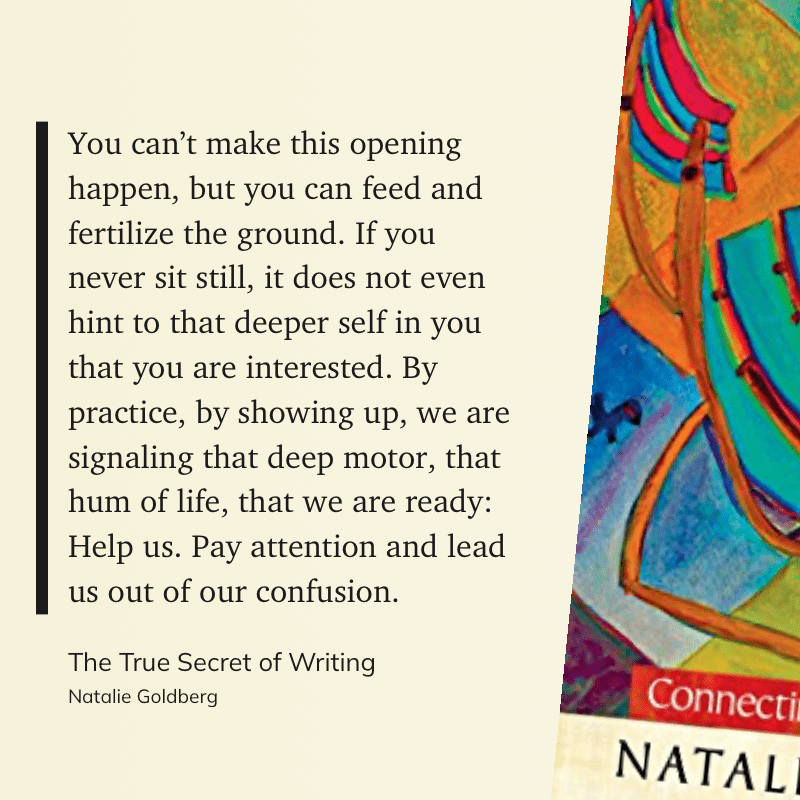
“You can’t make this opening happen, but you can feed and fertilize the ground. If you never sit still, it does not even hint to that deeper self in you that you are interested. By practice, by showing up, we are signaling that deep motor, that hum of life, that we are ready: Help us. Pay attention and lead us out of our confusion.” (Natalie Goldberg, The True Secret of Writing)
The Hum Beneath the Silence: Probing Character Depth
Key Techniques:
Stillness as Character Catalyst – holding a fixed space or mood until character depth begins to emerge Emotional Grounding through Repetition – returning to an image, gesture, or thought until it transforms Subconscious Access via Restriction – narrowing the scene’s possibilities to force deeper interior discovery
500-Word Writing Prompt:
Write a scene in which your character is alone in a confined space for 30 uninterrupted minutes. No phone, no books, no distractions. They must stay seated or still—on a train platform, in a bathtub, on a church pew, on a closed balcony, at the end of a long hallway. The scene should unfold entirely from their interior experience: memory fragments, bodily sensations, stray thoughts, forgotten fears.
Let one small object or detail in the environment act as an emotional anchor. A chipped mug, a ceiling fan, a stain on the floor. Return to it repeatedly. Allow it to evolve in meaning.
Something must shift in the character’s emotional or psychological state by the end of the scene. Not resolution—direction. A quiet opening. An internal tilt. No epiphany, no plot twist, no sudden action. Just the deeper self surfacing.
Evaluation Criteria:
Strong responses:
– Stay committed to the restriction: no movement, no external action, no other characters
– Let the emotional terrain emerge slowly, through repetition and sensory layering
– Avoid forced revelations or dramatic turns—let discovery arise from patience
– Use detail with emotional specificity (not “the mug reminded her of her mother” but “the mug’s handle, glued back on, curved like her mother’s broken finger”)
Weak responses:
– Break the container with action or dialogue
– Depend on exposition instead of interior experience
– Conclude with tidy emotional summaries or plot-driven insight
– Offer general or cliché sensory descriptions
Follow-Up Workshop Questions:
What changes in the character’s emotional state from beginning to end?
Where does the repetition become transformative? Where does it stall?
Does the confined setting feed tension or feel decorative?
What’s the “deep motor” moment—the image or sentence that reveals the hum beneath?
Which details feel earned, and which feel ornamental?
Recommended Reading:
Excerpt from Housekeeping by Marilynne Robinson (Ruth’s meditations while alone in the house)
or
“Letter to a Funeral Parlor” by Lydia Davis – a stillness that disturbs and reveals
2-Hour Session Plan:
– 15 minutes: freewrite on one sensory memory tied to stillness
– 60 minutes: write the scene, aiming for 500 words
– 15 minutes: read aloud and mark the sentence where the hum surfaces
– 30 minutes: workshop in pairs using the follow-up questions
Strong Example:
A woman sits in her late father’s shed, staring at his old fishing hat. She touches the brim but doesn’t wear it. The dust reminds her of the flour on his hands. She returns three times to the hat. By the end, she notices she’s pulled the stool closer without realizing.
Weak Example:
A man sits on a dock thinking about his divorce. He stands up, throws his wedding ring in the lake, and walks off.
The first reveals slow movement from interior quiet. The second skips the stillness and goes straight for the plot beat.

Leave a comment