
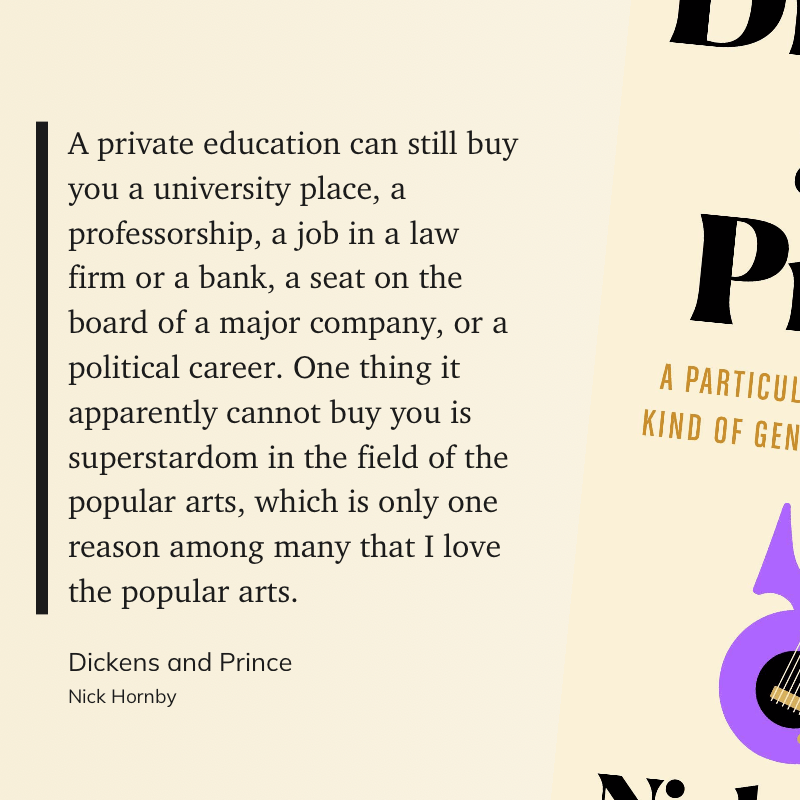
“A private education can still buy you a university place, a professorship, a job in a law firm or a bank, a seat on the board of a major company, or a political career. One thing it apparently cannot buy you is superstardom in the field of the popular arts, which is only one reason among many that I love the popular arts.” (Nick Hornby, Dickens and Prince)
Writing Exercise: Character, Status, and the Illusion of Merit
Key Techniques Illustrated by the Quotation
1. Status Signaling Through Detail: The quotation shows how institutions confer power and access, but not necessarily admiration or cultural influence. The contrast between elite status and popular resonance is key to layered character construction.
2. Implicit Judgment Through Voice: Hornby’s tone conveys admiration and critique simultaneously. The voice walks the line between observational detachment and personal allegiance, which invites complex emotional shading in narration.
3. Value Inversion as Character Insight: The value system is flipped—what should confer ultimate prestige (elite education) is positioned as irrelevant in a world that values authentic connection. This reversal is rich ground for internal conflict or social commentary.
Writing Prompt (500 words)
Write a scene in which a character from an elite background attempts to enter a creative or populist space where their inherited advantages hold no currency. They must attempt to gain recognition, connection, or validation—but the rules of this new world are unfamiliar, and their usual strategies fail. Let their background show subtly: through speech patterns, assumptions, body language, or attempts at control. Focus the scene on a single moment of friction or realization. Avoid caricature or satire unless fully earned. The tone can range from dry comedy to quiet devastation, but must reveal something true about the character’s self-conception and the environment they’re trying to penetrate.
Evaluation Criteria for a Successful Response
• Does the scene embed status and class dynamics through indirect cues (dialogue, action, subtext) rather than exposition?
• Does the character’s internal conflict emerge through interaction, not explanation?
• Is the voice consistent and emotionally resonant—does it guide the reader’s attention and judgment without overt moralizing?
• Does the piece engage with the tension between institutional legitimacy and populist credibility in a fresh or specific way?
Strong Response Example
A privately educated lawyer walks into an open-mic poetry night in an industrial neighborhood. He tries to bond with the crowd by referencing Auden but mispronounces “Funeral Blues.” He offers unsolicited line edits to a teenage girl’s poem. The host thanks him politely, then turns back to the crowd with, “Okay, now that Dad’s had his turn, let’s get back to the real work.” The lawyer smiles too widely. His next poem is a quiet, awkward piece about wanting to be heard without credentials.
Weak Response Example
A rich guy goes to a rap battle and gets humiliated. Everyone laughs at him. He feels sad and leaves. The narration mocks him overtly and explains all the reasons he’s out of touch. The tone is smug and the characters flat.
Workshopping and Revision Questions
• Where does the character reveal more than they intend? Can you amplify that through behavior or dialogue?
• Is the setting doing enough to challenge or reflect the character’s values?
• What assumptions does the character hold at the start of the scene—and how have they been cracked, if not broken, by the end?
• Could the narrative voice guide us more deeply into the emotional implications without stating them outright?
Recommended Reading
Zadie Smith, “The Embassy of Cambodia” — quietly indicts privilege while maintaining psychological intimacy.
Excerpt from White Teeth also models how to render class contrast and voice without flattening characters.

Leave a comment