
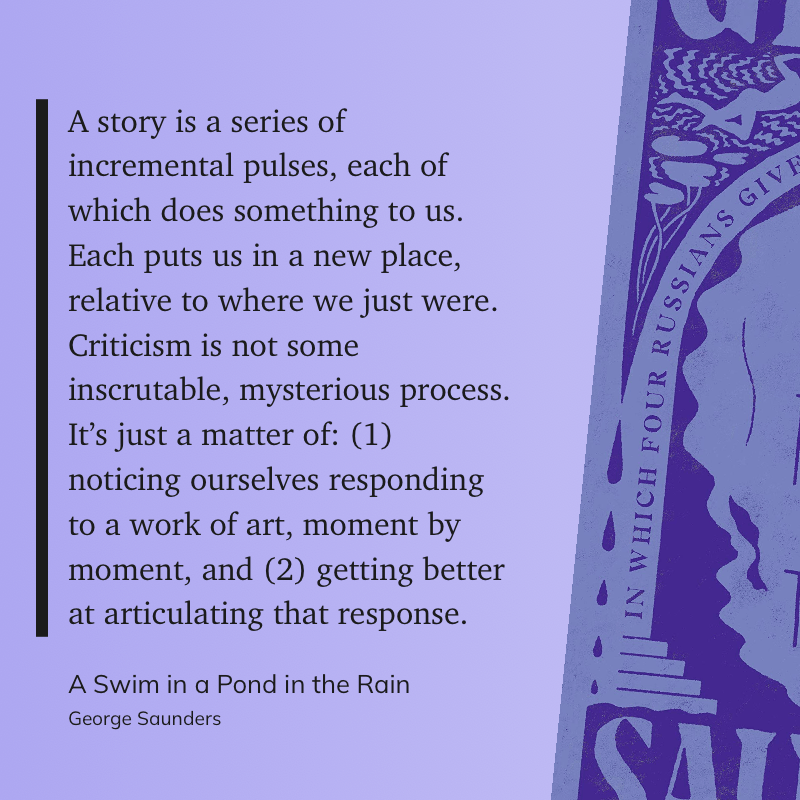
“A story is a series of incremental pulses, each of which does something to us. Each puts us in a new place, relative to where we just were. Criticism is not always some inscrutable, mysterious process. It’s just a matter of: (1) noticing ourselves responding to a work of art, moment by moment, and (2) getting better at articulating that response.” (George Saunders, A Swim in a Pond in the Rain)
Writing Exercise: Pulse-by-Pulse Character Movement
Key Techniques Illustrated by the Quotation:
1. Moment-to-moment emotional progression: Track how each beat or pulse shifts the character’s emotional state or perception.
2. Incremental revelation: Reveal character through successive, small changes rather than dramatic exposition.
3. Responsive storytelling: Build scenes that cause the reader to shift position with each new sentence, mirroring the character’s internal recalibration.
500-Word Writing Prompt:
Write a scene set in real time—no more than five minutes pass from beginning to end. A character receives a piece of unexpected information that is not life-altering but personally significant (e.g., an offhand comment, a minor betrayal, an accidental confession). Use this moment to explore how the character’s inner world evolves pulse by pulse. Track at least five emotional or perceptual shifts within the scene. Keep the character in one location and resist external action. Focus entirely on how internal states morph in response to new micro-inputs: words, silences, gestures, memories triggered by small cues. Let each sentence reorient the character—and the reader.
Evaluation Criteria:
Strong Responses:
• Track a clear, specific emotional arc using small, precise shifts (e.g., irritation turning to guilt turning to resolve).
• Show responsiveness to each moment without heavy exposition; let tone, syntax, and internal monologue carry the change.
• Maintain narrative momentum through emotional friction rather than plot escalation.
• Achieve character revelation through subtext and contradiction (what the character says vs. what they feel).
Weak Responses:
• Include static emotional tone or flat reaction to stimuli (e.g., stays angry or confused without change).
• Rely on overt summary or cliché to express feeling (“She was shocked” without embodied detail).
• Let plot override internal experience (e.g., character leaves the room, takes a call, etc.).
• Use declarative emotional statements without showing the shift (e.g., “He changed his mind” instead of demonstrating the process).
Follow-up Workshopping/Revision Questions:
• Where do we feel the character shift in response to something? Can we mark five distinct moments of change?
• Does the progression feel earned and specific, or generalized and vague?
• What’s the emotional rhythm—does it accelerate, contract, surprise? Can any pulse be made sharper or more ambiguous?
• Does the character end somewhere emotionally different than where they started? How visible is that movement?
Recommended Reading:
Excerpt from The Half-Skinned Steer by Annie Proulx
Proulx masterfully constructs internal shifts with incremental beats: small gestures, remembered images, and physical sensations that build an emotional and perceptual transformation in real time.
Strong Response Example (excerpt):
She watches him stir sugar into his coffee, twice clockwise, then taps the spoon against the rim like her father used to. Something catches in her throat—not grief, not quite—but a grainy nostalgia that sharpens into irritation when he speaks without looking up. She smiles. Too wide. She hadn’t meant to smile.
Weak Response Example (excerpt):
She sat across from him and thought about how much he had changed. She felt confused, and then she got angry. Finally, she realized she didn’t care anymore.
This exercise can be completed in a focused two-hour writing block: 30 minutes of planning and tracking the five pulse shifts, 60 minutes of writing, 30 minutes of reflection using the revision questions.

Leave a comment