
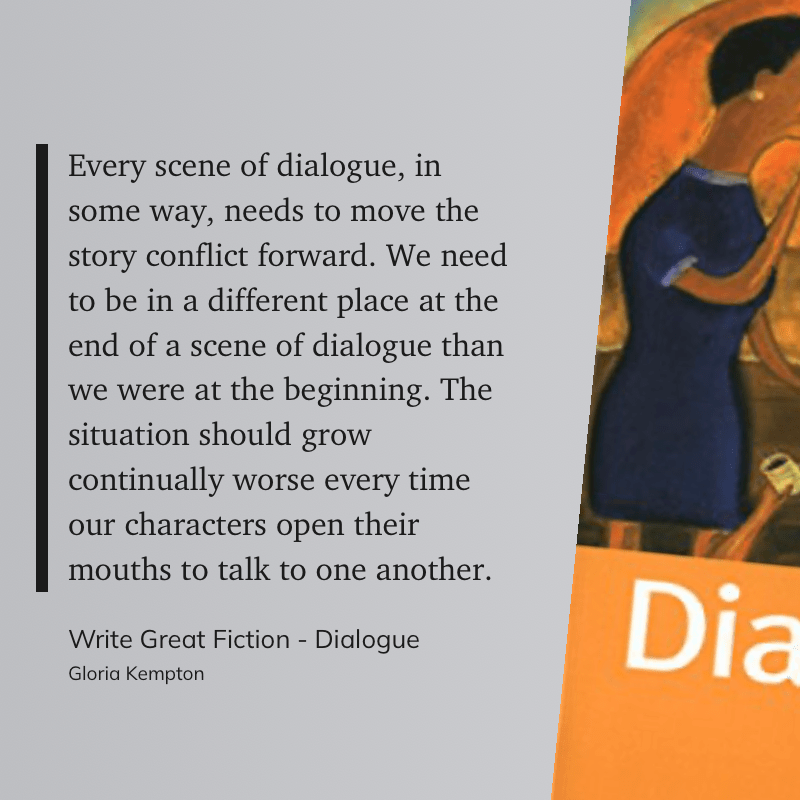
“Every scene of dialogue, in some way, needs to move the story conflict forward. We need to be in a different place at the end of a scene of dialogue than we were at in a the beginning. The situation should grow continually worse every time our characters open their mouths to talk to one another.” (Gloria Kempton, Write Great Fiction – Dialogue)
Dialogue Under Pressure: A Character Development Exercise
Key Techniques Illustrated by the Quotation
1. Progressive Complication Through Dialogue: Dialogue must escalate tension, not merely convey information or reveal backstory. Every line should sharpen the central conflict.
2. Dynamic Status Shifts: Power, control, or emotional ground must shift between characters by the end of the scene.
3. Subtext-Driven Exchanges: Characters rarely say exactly what they mean. The unsaid should drive the emotional truth.
Writing Prompt (500 words max)
Write a single scene in which two characters confront a shared decision—one wants to act, the other resists. The setting is tight, inescapable: a parked car outside a hospital, a cramped kitchen at 3 a.m., a stalled elevator. Neither can leave. Use only dialogue (and brief beats or action lines) to escalate the emotional tension. By the final line, their relationship must be fundamentally altered. One of them should lose something—a sense of control, a delusion, a belief about the other.
Avoid exposition dumps or overly explanatory lines. Focus instead on the pressure cooker effect: let the constraints of the space and the emotional stakes force the truth out.
Evaluation Criteria for Success
– Escalation: The dialogue must increase the tension steadily. The stakes should rise or shift by the end.
– Transformation: Both characters must not be in the same emotional or relational place at the end as they were at the start.
– Subtext: Strong responses rely on implication, tone, pacing, and word choice to convey what the characters won’t say aloud. Weak responses explain too much or rely on melodrama.
– Economy: Every line should do double duty—revealing character and pushing the conflict forward. Flabby dialogue signals a lack of narrative tension.
Strong Response Example (Excerpt)
“She’s not even cold yet, and you’re packing up her clothes?”
“I can’t breathe with them still here.”
“That’s not why. You think if you fold her sweaters, it means it didn’t happen. That she wasn’t real.”
“You don’t get to talk about real. You left.”
Notice: No line restates the same emotion. The tension jumps with each beat. The characters wound each other by degrees, revealing deeper fractures.
Weak Response Example (Excerpt)
“I’m sad that she died.”
“Me too. It’s hard.”
“But we have to move on.”
“You’re right.”
This dialogue lacks conflict, transformation, or emotional layering. It flattens instead of builds.
Follow-Up Questions for Workshop/Revision
– Where in the scene does the tension shift? Does it escalate or plateau?
– Are both characters active, or is one only reacting?
– What’s not being said? Can you tighten the dialogue so the subtext carries the weight?
– Does the final beat feel earned? What changed?
– Could you remove 10% of the dialogue and lose nothing important?
Recommended Reading
Excerpt: “Emergency” by Denis Johnson (from Jesus’ Son)
In the scene where Fuckhead and Georgie drive through the night after a chaotic shift at the hospital, the dialogue pulses with disorientation, escalating stakes, and strange tenderness. Nothing is resolved, but everything changes. The conflict isn’t overt, but it evolves with each line, reflecting internal chaos and shifting relational dynamics.

Leave a comment