
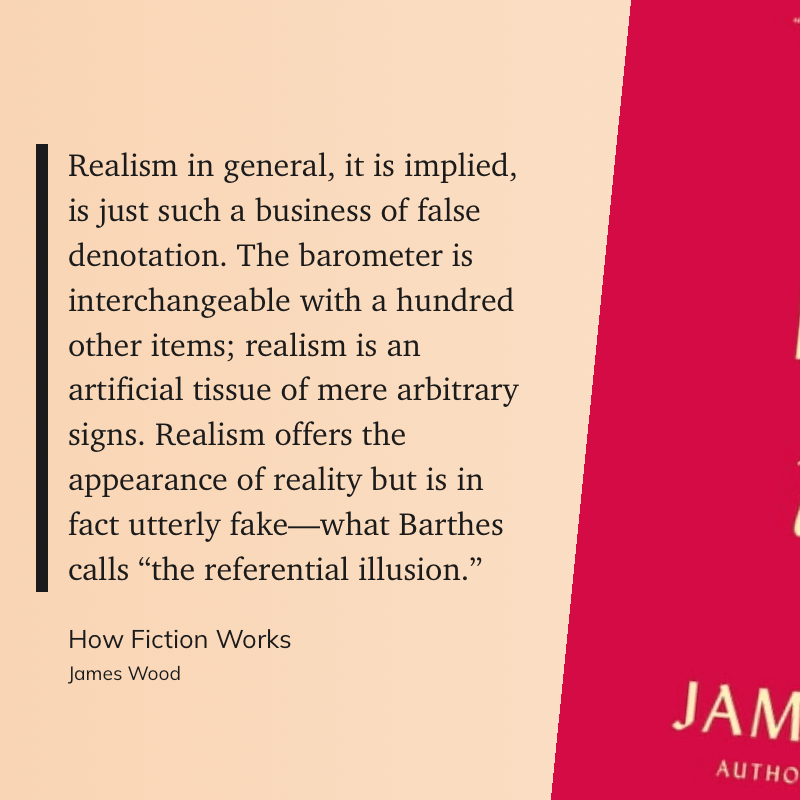
“Realism in general, it is implied, is just such a business of false denotation. The barometer is interchangeable with a hundred other items; the realism is an artificial tissue of mere arbitrary signs. Realism offers the appearance of reality but is in fact utterly fake—what Barthes calls “the referential illusion.”” (James Wood, How Fiction Works)
Writing Exercise: The Illusion of Realism
Key Techniques:
1. Specificity vs. Arbitrary Detail – Strong writing selects details that reveal character, theme, or conflict rather than merely filling space.
2. Symbolic Weight of Objects – A well-chosen object can resonate beyond its surface meaning, anchoring emotion and subtext.
3. Strategic Misdirection – Effective realism sometimes relies on the illusion of verisimilitude, guiding the reader’s attention while embedding deeper meaning.
Writing Prompt:
A character arrives home to find an object out of place—something small, seemingly insignificant, but utterly wrong. This object does not belong, yet it is not overtly dramatic (no bloodstains, weapons, or overt threats). The discovery unsettles them, but they do not immediately understand why. Over the course of 500 words, allow the object to take on layered meaning—does it reveal something about their past? Their relationships? Their own denial? Maintain the surface of realism while ensuring that the object’s presence ultimately serves a deeper narrative purpose.
Evaluation Criteria:
• Strong Response: The object is specific and imbued with narrative weight, subtly revealing conflict or interiority. Description is deliberate—every detail matters. The scene builds tension organically, leading the reader toward realization rather than forcing it. The prose avoids generic realism in favor of layered, intentional meaning.
• Weak Response: The object is arbitrary, its presence serving only to create artificial intrigue. Description is cluttered or unfocused, with unnecessary sensory details that do not contribute to the story’s emotional arc. The scene lacks subtext, leaving the reader with only surface-level meaning.
Follow-Up Questions for Workshopping:
• What does the object reveal about the character beyond the immediate moment?
• Could another object create the same effect? If so, is this one the best choice?
• How does the description of the object shape the reader’s emotional response?
• Does the narrative earn its sense of realism, or does it merely simulate it?
Recommended Reading:
• “The Overcoat” by Nikolai Gogol – Examines how an object (the coat) transcends its material reality to embody deep personal and social meaning.
• “The Swimmer” by John Cheever – Demonstrates how realism can mask deeper surrealism and emotional dissonance.
• “Pet Milk” by Stuart Dybek – A short piece where mundane details (a can of condensed milk, a train ride) carry immense emotional and nostalgic weight.

Leave a comment