
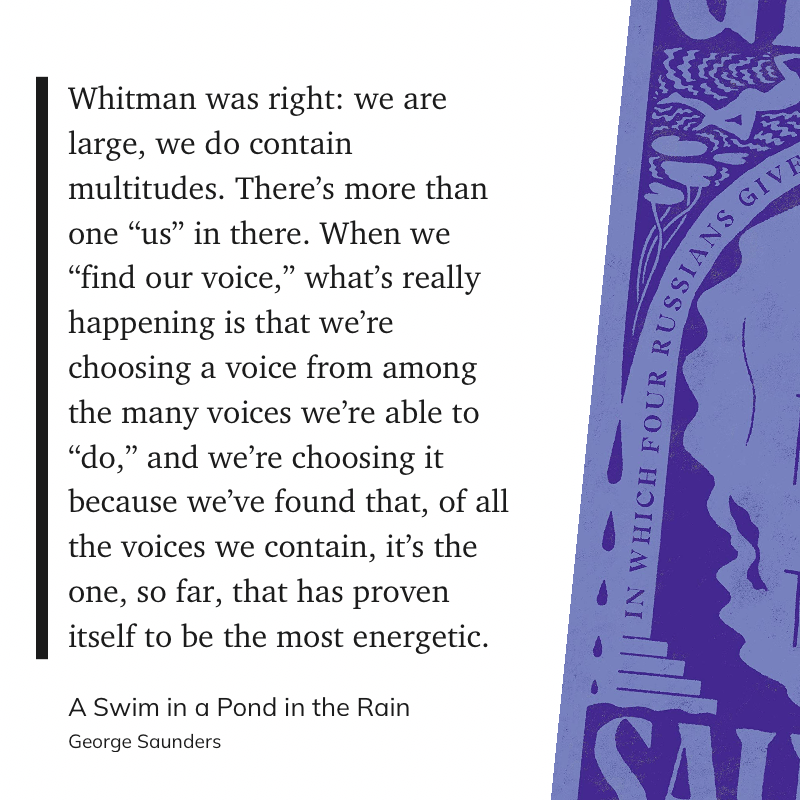
“Whitman was right: we are large, we do contain multitudes. There’s more than one “us” in there. When we “find our voice,” what’s really happening is that we’re choosing a voice from among the many voices we’re able to “do,” and we’re choosing it because we’ve found that, of all the voices we contain, it’s the one, so far, that has proven itself to be the most energetic.” (George Saunders, A Swim in a Pond in the Rain)
Writing Exercise: The Multitudes Within – Harnessing Voice Through Choice
Key Techniques:
1. Voice as a Deliberate Choice – Writers don’t discover a single, innate voice; they shape it through selection. The strongest choices emerge from energy, specificity, and alignment with character or narrative tone.
2. Multiplicity of Self – Characters, like writers, contain multitudes. Effective writing captures the tensions, contradictions, and layered perspectives within a single character’s voice.
3. Energy as the Guiding Principle – A compelling voice isn’t necessarily the most polished or “literary” but the one that generates momentum, surprise, and vitality on the page.
500-Word Writing Prompt:
Write a first-person monologue from a character struggling to reconcile two conflicting aspects of their identity. The voice should shift dynamically to reflect these internal contradictions, but the piece must maintain cohesion and energy.
Choose a scenario:
• A doctor who is also a compulsive gambler, rationalizing their actions.
• A politician delivering a speech while internally battling self-doubt.
• A retired hitman trying to convince themselves they were never really violent.
• A parent on the brink of a major life decision, arguing both sides internally.
The piece must be written in a single continuous flow, without explicit signaling (“he thought” or “on the other hand”) when shifting between perspectives. Let rhythm, syntax, and diction do the work of conveying the shifts.
Evaluation Criteria:
• Strength of Voice – Is the character’s voice distinct, memorable, and energetic? A strong response demonstrates a voice that commands attention, even in its contradictions. A weak response sounds generic, safe, or overly polished at the expense of authenticity.
• Multiplicity Without Chaos – Does the piece successfully hold multiple tones or perspectives without losing coherence? Strong writing allows contradictions to build complexity. Weak writing either flattens the character into a single mode or becomes confusingly erratic.
• Use of Language to Reflect Internal Conflict – Do sentence structures, rhythms, and word choices shift naturally to reflect different facets of the character’s identity? Strong responses use syntax and pacing to create a dynamic internal landscape, while weak responses rely on explicit signposting or unnatural transitions.
Follow-Up Questions for Workshopping/Revising:
• Where does the voice feel most alive? Where does it feel less authentic or more generic?
• Does the language shift in a way that feels organic, or does it feel too abrupt or forced?
• If you had to push one aspect of the voice further, what would it be?
• Are the contradictions clear enough to create tension but not so stark that they feel artificial?
• What does this voice reveal about the character beyond what they explicitly state?
Recommended Reading:
• “Good Country People” by Flannery O’Connor – Captures voice-driven storytelling with layered contradictions in character perspective.
• “Emergency” by Denis Johnson – Showcases voice as raw energy, balancing humor and dread.
• An excerpt from Jesus’ Son by Denis Johnson – A masterclass in how voice emerges through rhythm, syntax, and the collision of disparate emotions.
This exercise forces writers to embrace the multiplicity within their characters and themselves, selecting a voice not because it is the most refined, but because it is the most electric.


Leave a comment