
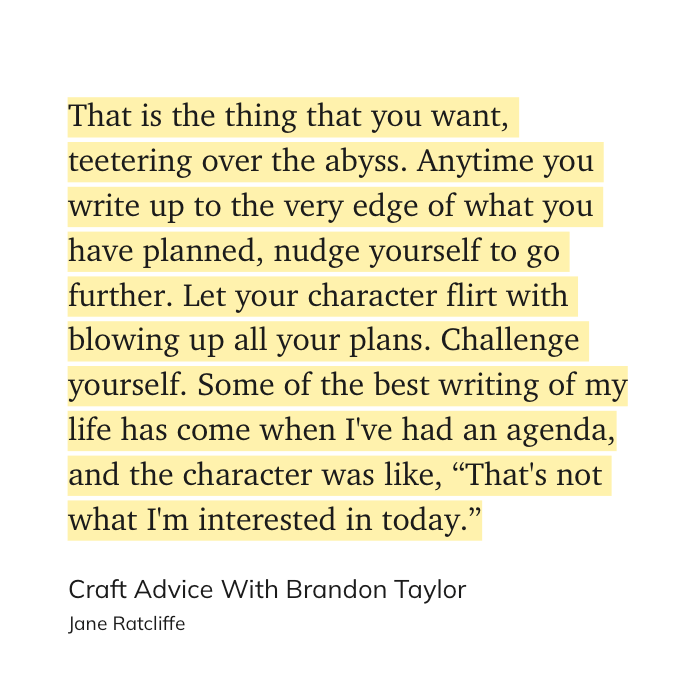
“That is the thing that you want, teetering over the abyss. Anytime you write up to the very edge of what you have planned, nudge yourself to go further. Let your character flirt with blowing up all your plans. Challenge yourself. Some of the best writing of my life has come when I’ve had an agenda, and the character was like, “That’s not what I’m interested in today.”” (Jane Ratcliffe, Craft Advice With Brandon Taylor)
Writing Exercise: The Edge of the Abyss
Key Writing Practice Development Techniques:
1. Character-Driven Narrative Disruption – Instead of rigidly following pre-planned plot points, allow characters to dictate direction, even if it means dismantling the original framework.
2. Narrative Risk-Taking – Push beyond safe storytelling choices. Force characters into decisions that complicate or derail expectations.
3. Authenticity in Character Reactions – Ensure that character actions stem from organic emotional truth rather than mere plot necessity.
Writing Prompt:
Write a scene where a character, on the verge of making a predictable or expected decision, does the opposite—either by impulse, a sudden realization, or an external provocation. This choice should unravel their original plan, forcing them into an uncharted emotional or physical space.
Start with a character who has a clear goal—something they believe is the logical or necessary path forward. This could be a marriage proposal, quitting a job, seeking revenge, confessing a secret, or making a final goodbye. Establish the setup in the first few paragraphs, leading the reader to expect a particular outcome. At the critical moment, let the character rebel. Maybe their anger burns out instead of igniting; maybe their desire shifts. Maybe fear wins. Maybe love does.
Do not pre-plan the twist. Write until you reach the decisive moment, then push yourself to choose the option you didn’t intend. What are the immediate consequences? What emotions follow? How does this affect the character’s relationship with themselves and others?
Evaluation Criteria:
• Strength of Character Agency: The shift should feel like an internal necessity rather than an arbitrary plot device.
• Emotional Credibility: The character’s unexpected choice must be believable within their psychological framework.
• Narrative Tension: The reader should feel the weight of the choice, experiencing the stakes alongside the character.
• Risk and Surprise: The scene should subvert expectations without feeling forced or gimmicky.
Examples of Strong vs. Weak Responses:
• Strong Response: A woman at her engagement dinner, fully prepared to say yes, sees her fiancé adjusting his cufflinks—an utterly normal gesture. But something about the movement shatters her resolve. Instead of accepting, she laughs—not cruelly, but uncontrollably—realizing she doesn’t want to be here at all. The moment turns quiet. Everyone watches. She doesn’t know what she’ll say next, but it won’t be “yes.”
• Weak Response: A man about to quit his job suddenly decides not to, but the reversal lacks emotional or psychological weight. The change happens because the prompt demands it, not because something in the moment forces the shift. The scene unfolds predictably, with minor consequences, and the character remains largely unchanged.
Follow-Up Questions for Workshopping/Revision:
• Does the character’s decision feel like an authentic breaking point, or does it feel externally imposed?
• How does the unexpected choice deepen or complicate the character’s internal struggle?
• What consequences ripple out from this decision? Are they given enough weight in the scene?
• Would the scene still be compelling if the initial plan had played out as expected? If not, what does that reveal about the strength of the original setup?
Recommended Reading:
• Emergency by Denis Johnson – A short story that masterfully veers into unexpected, character-driven chaos.
• The Virgin Suicides (excerpt) by Jeffrey Eugenides – Lush internal landscapes where character emotions resist predictable resolution.

Leave a comment