
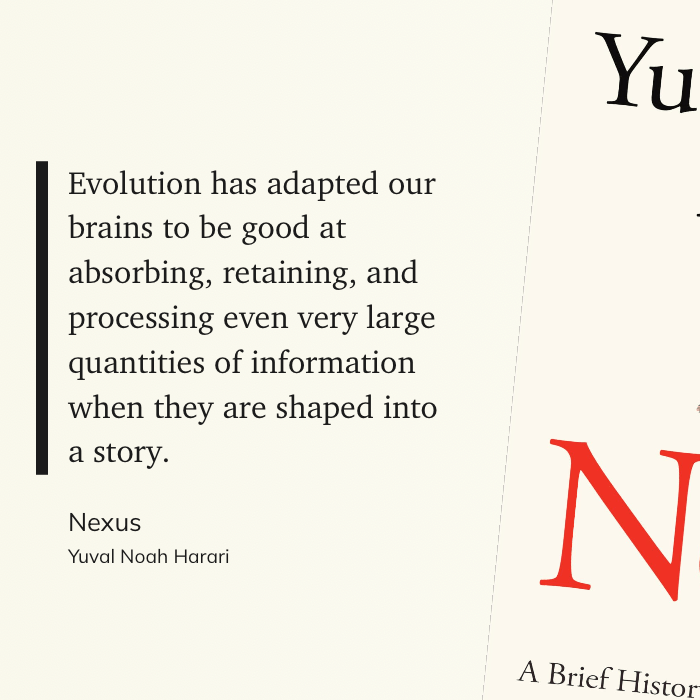
“Evolution has adapted our brains to be good at absorbing, retaining, and processing even very large quantities of information when they are shaped into a story.” (Yuval Noah Harari, Nexus)
Writing Exercise: Narrative as Cognitive Architecture
Key Writing Techniques:
1. Information Integration Through Storytelling – Embedding complex ideas, histories, or technical details within character-driven narratives to enhance reader retention and engagement.
2. Character as a Vessel for Knowledge – Using a character’s perspective, emotions, and stakes to naturally deliver information rather than through exposition.
3. Tension as a Retention Mechanism – Structuring information release through conflict, mystery, or emotional weight to make it more compelling and memorable.
500-Word Writing Prompt:
A character possesses a crucial but intricate piece of knowledge that could change their world—scientific, historical, personal, or philosophical. However, the only way to convey it effectively is through a story. The stakes are high: they must convince someone who is skeptical, in danger, or emotionally closed off.
Write a scene where the character weaves this knowledge into a story, ensuring that it is not presented as raw information but absorbed naturally by the listener. The listener’s reaction should reveal whether the storytelling method succeeds or fails.
What Makes a Response Successful:
• Seamless Information Integration: The knowledge should unfold within the story rather than be delivered as a dry explanation. The reader should feel drawn to the information because of how it affects the characters.
• Strong Narrative Stakes: There must be a reason the story matters—whether to persuade, warn, or connect. A weak response will lack urgency or emotional depth.
• Character Dynamics: The storyteller and the listener should have a defined relationship, with clear emotional or intellectual resistance that the story must overcome.
• Tension in the Delivery: The knowledge must not only be conveyed but must also change something—perception, action, belief. A strong response will show the moment when understanding clicks (or fails to).
Weak Example:
A professor explains quantum mechanics to a student, describing concepts in a straightforward lecture format. The student listens passively, and there is no personal or narrative tension. The information, though accurate, feels separate from the characters.
Strong Example:
A woman visits her estranged mother, who refuses to discuss the past. Instead of confronting her directly, the daughter tells a childhood memory about the day a neighbor’s house burned down—the strange silence in their own home, the missing photo albums, the way her mother’s hands shook when she locked the doors. She never states outright what she knows: that they changed their names, fled a country they no longer speak of. But the way her mother listens, the way she finally says, “That fire wasn’t an accident,” reveals the power of a story told the right way.
Follow-Up Questions for Workshopping/Revision:
• Does the embedded information feel natural within the story, or does it feel inserted?
• How does the listener’s response shape the scene’s emotional impact?
• Would the scene’s tension change if the story were told differently (e.g., a myth instead of a memory, a joke instead of a parable)?
• Is there a moment where the stakes or urgency could be heightened?
Recommended Reading:
• Einstein’s Dreams by Alan Lightman (selected passages) – Fictionalized thought experiments that embed complex scientific ideas into evocative narratives.
• The Ghosts of the Tsunami by Richard Lloyd Parry (opening chapters) – A nonfiction example where deeply personal narratives make historical and geological knowledge hauntingly unforgettable.

Leave a comment