
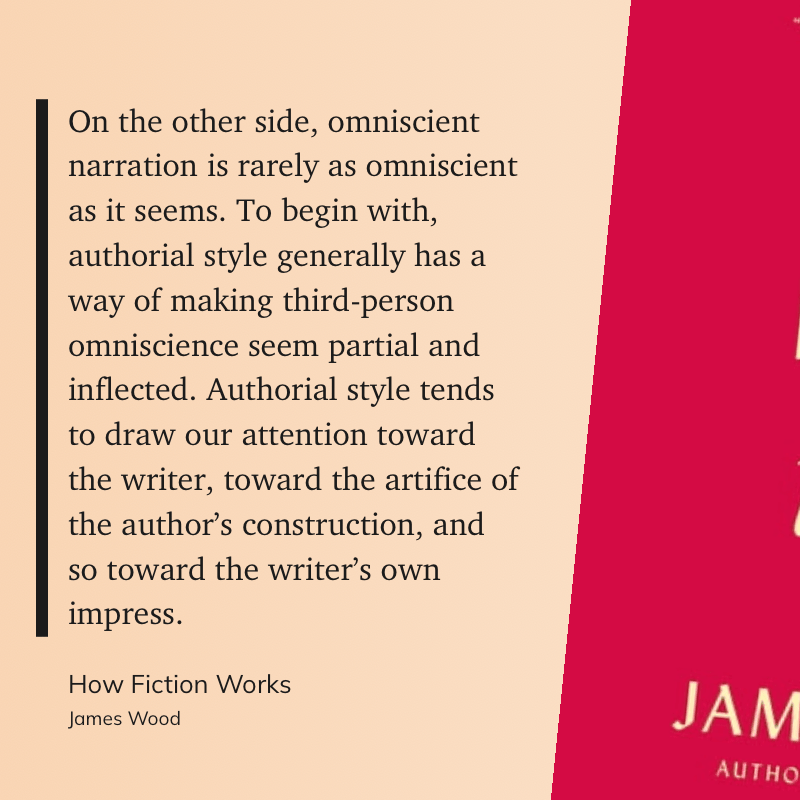
“On the other side, omniscient narration is rarely as omniscient as it seems. To begin with, authorial style generally has a way of making third-person omniscience seem partial and inflected. Authorial style has tends to draw our attention toward the writer, toward the artifice of the author’s construction, and so toward the writer’s own impress.” (James Wood, How Fiction Works)
Writing Exercise: The Artifice of Omniscience
Key Techniques:
1. Selective Omniscience – Third-person omniscience is rarely absolute; it bends toward the author’s stylistic choices, favoring certain details, rhythms, or character perspectives while omitting others.
2. Authorial Presence – The writer’s voice subtly shapes the narrative, influencing the reader’s perception without breaking immersion.
3. Inflected Perspective – Even in omniscience, the narrator’s gaze can carry implicit bias, tone, or judgment, shaping the reader’s understanding of the world and characters.
Writing Prompt:
Write a 500-word scene set in a bustling train station, narrated from a third-person omniscient perspective. The narrator has access to multiple characters’ thoughts but exhibits a distinct style that reveals an underlying viewpoint or bias. The scene should focus on a moment of small but charged human interaction—an argument between strangers, a missed connection, or a quiet act of kindness. The omniscience should feel expansive yet deliberate, with the narrator’s choices subtly influencing what the reader sees and feels.
Strong Response:
A well-crafted response carefully modulates access to different characters’ thoughts while maintaining a cohesive, slightly inflected voice. The narrator’s tone and word choice shape how we interpret the scene without overt editorializing. If one character is described in lush, poetic language while another is rendered in clipped, practical sentences, the narrator’s partiality is subtly felt rather than stated outright. The prose should demonstrate controlled omniscience—moving between interiority and exteriority without losing momentum or clarity.
Weak Response:
A weak response either flattens omniscience into mechanical head-hopping, offering an indiscriminate flood of character thoughts, or remains too neutral, failing to shape the scene with a distinct authorial presence. A lack of intentional style leads to disjointed or lifeless narration, while over-explanation makes the omniscience feel clumsy or intrusive.
Evaluation Criteria:
• Narrative Control: Omniscience is used purposefully, not indiscriminately; perspective shifts feel intentional rather than chaotic.
• Authorial Style: The narrator’s voice leaves an imprint on the storytelling, shaping the reader’s perception without overshadowing the story itself.
• Character Depth: The omniscience enriches rather than flattens characterization, revealing depth through careful selection of thoughts and observations.
• Seamless Transitions: The movement between characters’ thoughts and external action is fluid, avoiding abrupt shifts or excessive interiority.
Follow-Up Workshopping Questions:
• How does the narrator’s style influence the reader’s perception of the characters?
• Where does the narration feel most effective in balancing omniscience with control? Where does it feel too detached or too involved?
• How might subtle shifts in word choice or syntax deepen the narrator’s implicit bias without making it overt?
• Would the scene feel different if rewritten with a more neutral or less present narrator? What changes would be necessary?
Recommended Reading:
• Virginia Woolf, Mrs. Dalloway (for fluid omniscience that inflects subtly through style)
• James Baldwin, Giovanni’s Room (for an omniscient but deeply personal voice that shapes perception)
• John Fowles, The French Lieutenant’s Woman (for direct engagement with the artifice of omniscience)

Leave a comment