
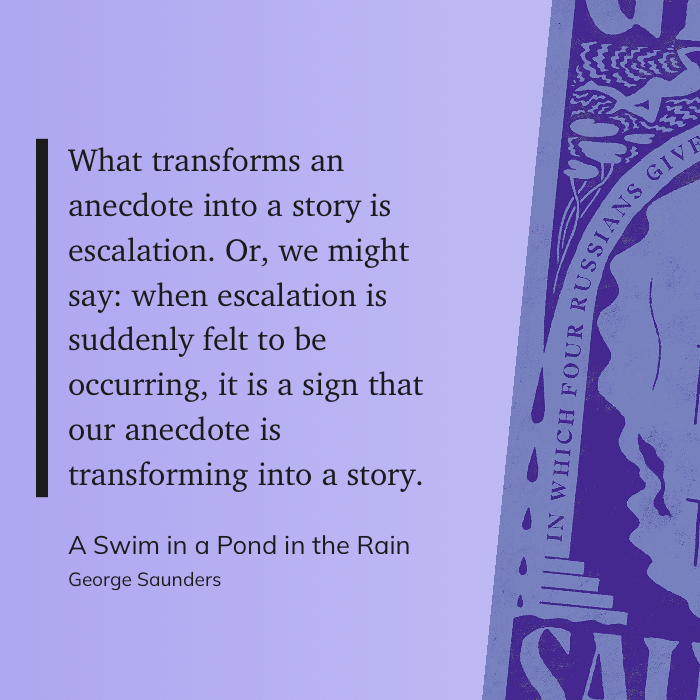
“What transforms an anecdote into a story is escalation. Or, we might say: when escalation is suddenly felt to be occurring, it is a sign that our anecdote is transforming into a story.” (George Saunders, A Swim in a Pond in the Rain)
Writing Exercise: The Tipping Point—Escalation as Story Engine
Key Techniques Illustrated by the Quotation:
1. Escalation as Narrative Momentum – A story is not just a series of events; something must intensify, shift, or gain weight. An anecdote remains flat unless tension builds in an organic but undeniable way.
2. Emotional Acceleration – Escalation is not just about external events but also about deepening internal stakes. A character’s emotions should shift in tandem with the rising action, creating a sense of inevitability or compulsion.
3. Structural Transformation – The moment when a reader feels escalation is often when the story takes on a new shape, breaking out of its initial setup and becoming something more urgent. This can be done through pacing, language, or a sudden shift in tone or perspective.
Writing Prompt (500 words):
Write a scene in which a character is engaged in a seemingly mundane interaction—buying groceries, making a phone call, attending a meeting—but something happens that forces the situation to escalate rapidly. The shift must be subtle at first, almost imperceptible, but by the end, the scene should feel dramatically different from how it began. The cause of the escalation can be internal (a realization, suppressed emotion breaking through) or external (a revelation, an unexpected provocation), but the change should be felt before it is overtly recognized.
What makes a response successful?
• Escalation is organic yet surprising. The shift does not feel forced or arbitrary but rather emerges naturally from what precedes it.
• Emotional intensity builds in tandem with the external events. The reader must sense an increasing charge in the character’s internal state, even if it remains unspoken.
• The scene transforms in a meaningful way. By the end, the character or situation must have changed—either subtly or dramatically—so that returning to the status quo feels impossible.
Weak vs. Strong Examples of Escalation:
• Weak: A character argues with a cashier over incorrect change, gets frustrated, and storms out. The emotion is static, and the conflict is predictable.
• Strong: A character quietly accepts the wrong change, but something about the interaction—a tone of voice, a glance exchanged—triggers a buried memory or fear. They walk away, but their internal tension builds until they impulsively turn back, leading to a moment of unexpected confrontation or revelation.
Follow-up Workshopping/Revision Questions:
• Where does the first sign of escalation occur? Does it happen soon enough?
• Does the escalation feel inevitable in hindsight, or does it seem forced?
• How does the character’s emotional state shift alongside the action?
• Does the final moment of the scene feel like a true transformation? If not, what’s missing?
Recommended Reading:
• Emergency by Denis Johnson – A masterclass in escalation, where absurdity and danger mount until the story moves into a surreal, almost mythic register.
• A Small, Good Thing by Raymond Carver – A quiet but devastating example of emotional escalation, where tension builds subtly through seemingly ordinary interactions.
• Where Are You Going, Where Have You Been? by Joyce Carol Oates – A chilling, slow-burn escalation where a seemingly mundane conversation turns into something terrifying and irreversible.

Leave a comment