
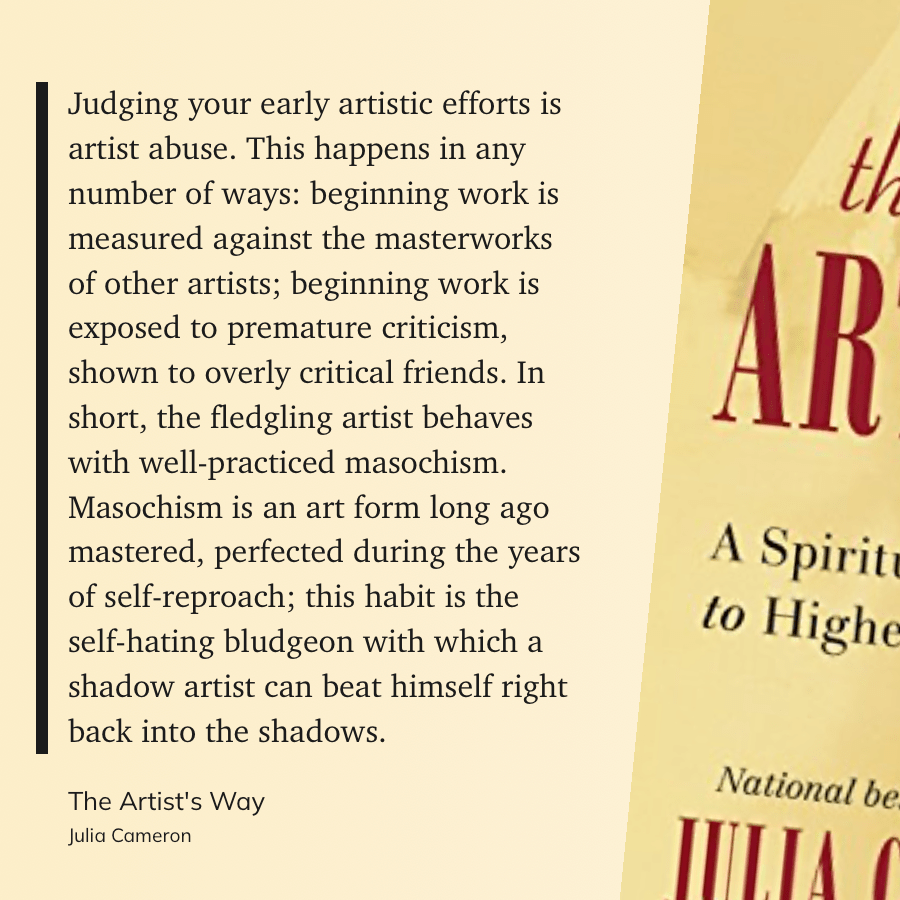
“Judging your early artistic efforts is artist abuse. This happens in any number of ways: beginning work is measured against the masterworks of other artists; beginning work is exposed to premature criticism, shown to overly critical friends. In short, the fledgling artist behaves with well-practiced masochism. Masochism is an art form long ago mastered, perfected during the years of self-reproach; this habit is the self-hating bludgeon with which a shadow artist can beat himself right back into the shadows.” (Julia Cameron, The Artist’s Way)
CHARACTER CRUCIBLE: EMBRACING IMPERFECTION
CORE TECHNIQUES
- Silencing the Inner Critic – Recognizing and neutralizing self-judgment that prevents authentic character development
- Shadow Work Integration – Transforming personal limitations into character depth through acceptance rather than masochism
THE CHALLENGE
Write a 500-word scene featuring a character who:
- Faces a moment of creative vulnerability (artistic performance, presentation, personal revelation)
- Experiences their internal critic as a separate entity/voice/character
- Navigates toward an unexpected resolution that neither fully embraces nor rejects their limitations
Your character must reveal themselves through:
- Physical sensations of self-consciousness
- Precise, concrete details of their environment (minimum three sensory elements)
- At least one moment where they misinterpret another’s reaction through their own filter
WRITING PROMPT
Your character stands at the threshold of revealing something they’ve created. This could be literal (an artist showing work) or metaphorical (revealing a truth about themselves). The stakes must feel personally significant.
Begin in the moment just before exposure. Show us their physical state. Then introduce the “voice” of their inner critic—not as an abstract concept but as a presence with specific traits. This voice should echo something from their past.
As the scene unfolds, have your character attempt to navigate between two impulses: the desire to retreat into safety versus the pull toward vulnerability. The resolution should contain an element of surprise—something neither you nor your character anticipated when you began writing.
EVALUATION CRITERIA
Strong responses will:
- Create a tangible inner critic with specific voice, vocabulary, and possibly physical traits
- Use concrete sensory details rather than abstractions to convey emotion
- Show the character’s transformation through action rather than explanation
- Maintain tension between opposing desires without simplistic resolution
- Reveal character through specific, unexpected choices
Weak responses typically:
- Rely on telling readers about emotions rather than showing them
- Present the inner critic as generic or abstract
- Resolve the conflict too neatly or through external validation
- Use vague language and clichés about creativity or self-doubt
- Lose focus on the character by overexplaining the situation
WORKSHOP QUESTIONS
- Where does your character physically feel their self-judgment? How can you heighten this sensation?
- What specific phrase or memory triggers your character’s inner critic? Could this be more particular to their history?
- What unexpected strength emerges from your character’s perceived weakness?
- How might you rewrite the scene giving the inner critic more specific, vivid characteristics?
- If your character’s inner critic were a person from their past, who would it be and how would that change the scene?
EXEMPLAR TEXT
“Bullet in the Brain” by Tobias Wolff—particularly the final section where the critic Anders experiences his last memory, revealing how a moment of innocent creative joy became buried beneath years of cynicism. Wolff masterfully shows a character defined by criticism who, in death, reconnects with wonder through specific, sensory detail and precise language.

Leave a comment