
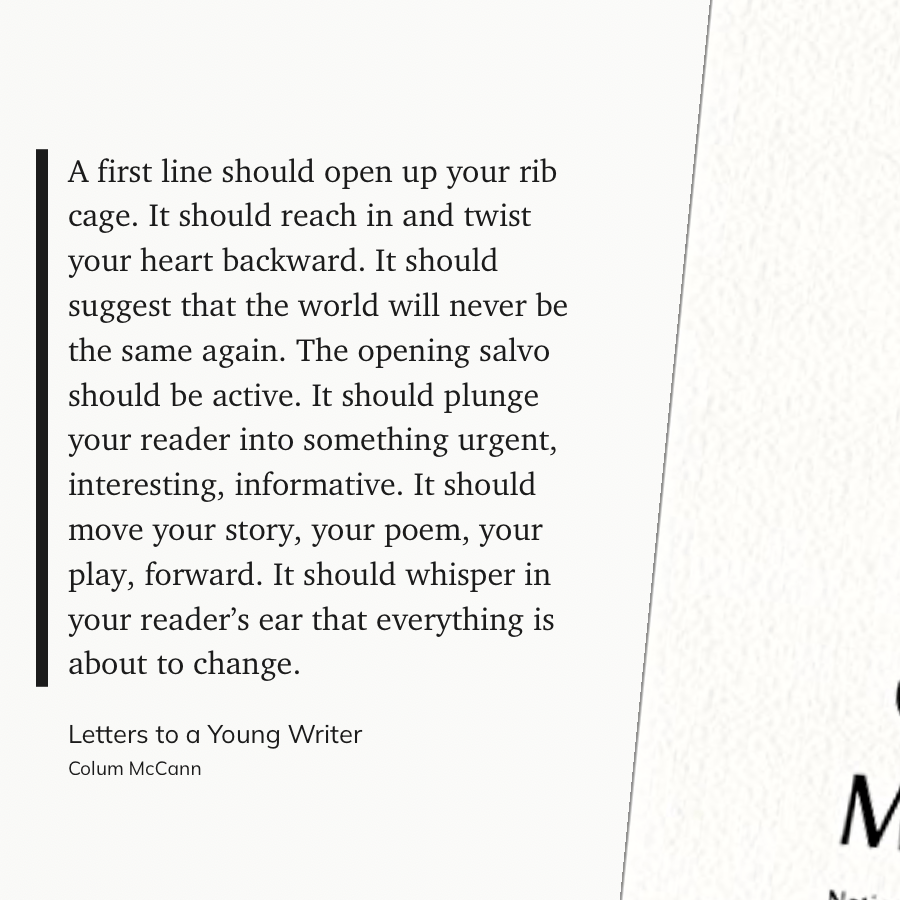
“A first line should open up your rib cage. It should reach in and twist your heart backward. It should suggest that the world will never be the same again. The opening salvo should be active. It should plunge your reader into something urgent, interesting, informative. It should move your story, your poem, your play, forward. It should whisper in your reader’s ear that everything is about to change.” (Colum McCann , Letters to a Young Writer)
Writing Exercise: The Shock of the First Line
Techniques Illustrated by the Quotation:
1. Emotional and Narrative Urgency – A strong opening line should immediately engage the reader with an emotional jolt, a compelling action, or an intriguing statement that demands attention.
2. Immediate Disruption of the Status Quo – The opening must imply that something has already shifted or is about to change irreversibly. This creates narrative propulsion from the very first sentence.
3. Implicit Promise of Story – The best openings contain an unstated contract with the reader: something is happening, and it matters. This can be done through tone, specificity, or an implied question that compels the reader forward.
Writing Prompt (500 words):
Write a scene that begins with an opening line designed to reach inside the reader and “twist their heart backward.” The line should establish tension, urgency, or an immediate emotional or narrative shift. Within the first paragraph, the world should feel different—whether through a revelation, an action, or an unsettling moment of quiet inevitability.
Example of a strong opening line: “The baby in the back seat wasn’t his, but the police officer tapping on the window didn’t know that yet.”
Example of a weak opening line: “It was a quiet morning, and he sipped his coffee slowly, thinking about what to do next.”
In the next 500 words, build upon this opening by deepening the stakes, complicating the character’s emotions or decisions, and ensuring that every subsequent sentence earns its place in the wake of that first line’s impact.
Evaluation Criteria:
• Power of the First Sentence: Does the opening line grip the reader emotionally, intellectually, or narratively? Does it contain tension, urgency, or an implicit question?
• Momentum and Stakes: Does the opening lead into a scene that continues the tension or intrigue? Is the world of the story altered in some way by the end of the passage?
• Character and Situation: Does the scene introduce a compelling character in a way that suggests depth and consequence rather than mere exposition?
• Precision and Control: Is the language sharp and purposeful, avoiding unnecessary setup or filler?
Follow-Up Questions for Workshopping/Revision:
• Does your first sentence force the reader to keep going? If not, why?
• Could your first line be made more urgent or emotionally immediate?
• Does the scene sustain the momentum created by the opening, or does the energy drop?
• Is there a clear sense that something has changed or is in the process of changing?
• Are the stakes clear without being over-explained?
Recommended Reading:
• “Bullet in the Brain” by Tobias Wolff – A masterclass in immediate disruption and momentum from the first line.
• Jesus’ Son by Denis Johnson – Striking, visceral opening sentences that transform a scene instantly.
• Beloved by Toni Morrison – A haunting first line (“124 was spiteful”) that reconfigures the reader’s expectations instantly.

Leave a comment