
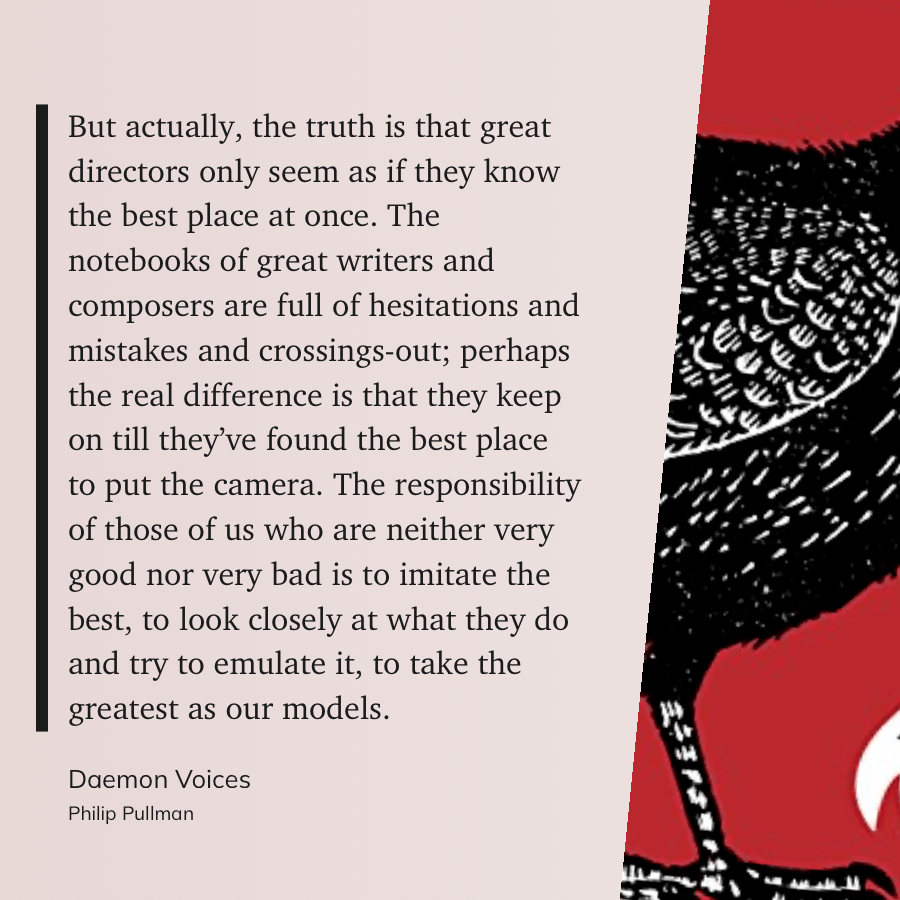
“But actually, the truth is that great directors only seem as if they know the best place at once. The notebooks of great writers and composers are full of hesitations and mistakes and crossings-out; perhaps the real difference is that they keep on till they’ve found the best place to put the camera. The responsibility of those of you us who are neither very good nor very bad is to imitate the best, to look closely at what they do and try to emulate it, to take the greatest as our models.” (Philip Pullman, Daemon Voices)
Writing Exercise: The Art of Relentless Refinement
Techniques to Develop:
1. Precision in Perspective: Finding the strongest vantage point for a scene—whether through POV, narrative distance, or structural placement—requires trial and error. Writers must experiment with shifts in focus and placement to discover the most impactful framing.
2. Revision as Discovery: Mastery is not about immediate perfection but about persistence. Great writing emerges from layering, reworking, and refining until every choice feels inevitable.
3. Studying and Emulating Mastery: Close analysis of great writers reveals deliberate craft choices. Writers grow by dissecting and imitating structural, tonal, and narrative decisions that elevate a story.
500-Word Writing Prompt:
Write a scene depicting a tense or emotionally charged moment between two characters. Begin by writing the scene three different ways, altering the “camera placement” each time:
1. Distant and observational: Use an omniscient or detached third-person narrator who does not enter the characters’ thoughts but describes the scene externally.
2. Close and immersive: Shift into deep third-person or first-person, embedding the reader in one character’s immediate perspective.
3. Unexpected vantage point: Rewrite from an unconventional perspective—a bystander, an object in the room, or even an animal.
After completing these three drafts, choose the version that feels strongest. Refine it with the goal of making every narrative choice—POV, detail selection, sentence rhythm—feel inevitable.
Evaluation Criteria for a Strong Response:
• Deliberate Perspective Choice: The final draft should demonstrate a clear reason for its chosen POV and vantage point, with every sentence reinforcing that perspective’s power.
• Immersive and Specific Detail: Sensory and emotional details should feel vivid and necessary, avoiding generic descriptions.
• Refinement through Revision: The strongest response will show evidence of deep refinement—word choices honed, unnecessary elements stripped away, and every sentence contributing to the scene’s effect.
Weak Response Characteristics:
• Lack of variation in drafts: Simply rewording the scene instead of reimagining perspective results in weak execution.
• Unintentional or arbitrary POV choices: If the final version does not feel like the most effective way to tell the scene, the exercise has not been fully explored.
• Surface-level revision: A weak response shows little evidence of refinement—sloppy phrasing, meandering sentences, or redundant details remain.
Workshopping & Revision Questions:
• What changed when the scene’s vantage point shifted? What was lost or gained?
• Which version felt most dynamic or emotionally resonant, and why?
• Where does the language still feel imprecise or unfocused? How can it be tightened?
• How do masterful writers handle perspective shifts? Can you find examples to guide your revision?
Recommended Reading:
• Runaway by Alice Munro (stories like “Passion” shift vantage points subtly, revealing how perspective shapes meaning).
• The Lover by Marguerite Duras (a masterclass in controlling narrative distance, shifting between personal and detached observation).

Leave a comment