
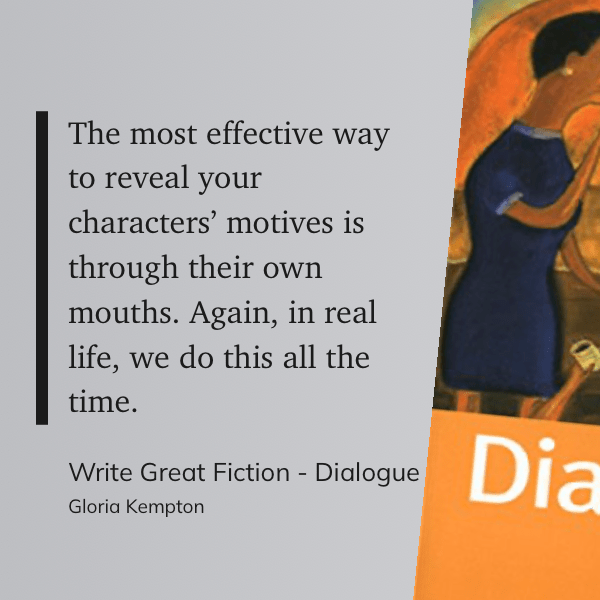
“The most effective way to reveal your characters’ motives is through their own mouths. Again, in real life, we do this all the time.” (Gloria Kempton, Write Great Fiction – Dialogue)
Writing Exercise: “What They Say, What They Mean”
Key Writing Techniques Illustrated by the Quotation:
1. Revealing Motive Through Dialogue – A character’s words should not simply state their intentions but should hint at their deeper desires, fears, and contradictions.
2. Subtext and Indirect Communication – People rarely say exactly what they mean. The strongest dialogue conveys a character’s true motives through what is left unsaid, how something is phrased, or what they avoid discussing.
3. Authenticity and Naturalism in Speech – Effective dialogue mirrors real-life conversation patterns, including digressions, evasions, and interruptions, rather than functioning as direct exposition.
Writing Prompt:
Write a 500-word scene in which two characters discuss an upcoming life-changing event—such as a wedding, a job opportunity, a move, or a major decision. One character has a strong but unspoken emotional investment in the decision, while the other has a more pragmatic or indifferent stance. Use dialogue to reveal each character’s true motive without explicitly stating it. Let the tension emerge not from what is said directly, but from how they say it, what they avoid, and the subtext behind their words.
The conversation should feel organic, with interruptions, misdirections, and shifting power dynamics. Consider how tone, pacing, and word choice influence the reader’s perception of what each character truly wants.
Strong vs. Weak Responses:
Strong Response:
• The dialogue feels natural, with realistic pacing, hesitation, and indirect phrasing.
• Each character’s true motive is evident but never explicitly stated.
• Subtext and emotional undercurrents add depth, making the reader feel the tension.
• The conversation reveals power shifts and character dynamics, keeping it engaging.
Example (Strong):
SARA: “You’ve been looking at flights?”
BEN: “Just checking prices. No harm in that.”
SARA: “Right. No harm.”
(Silence.)
BEN: “You know, the weather there is decent year-round. Not like here.”
SARA: “You always said you liked seasons.”
BEN: “I do. Just saying it’s… different.”
(Here, Ben avoids stating outright that he wants to leave, while Sara’s short responses show resistance. The tension builds through subtext.)
Weak Response:
• Dialogue is too direct and on-the-nose, leaving no room for reader interpretation.
• The characters’ motives are stated explicitly rather than hinted at.
• The conversation lacks tension or natural rhythm.
Example (Weak):
SARA: “You’re planning to move. That’s what this is about, isn’t it?”
BEN: “Yes, I want to move. I’ve been unhappy here for a long time.”
SARA: “That hurts. I thought you were happy with me.”
BEN: “It’s not about you. I just need a change.”
(Here, everything is stated outright, making the scene predictable and lifeless.)
Evaluation Criteria:
1. Subtext & Indirect Communication – Does the dialogue reveal character motives without stating them explicitly?
2. Authenticity & Natural Flow – Does the conversation sound natural, with interruptions, hesitations, and miscommunications?
3. Emotional Depth & Tension – Does the scene create an undercurrent of tension that keeps the reader engaged?
4. Characterization Through Speech – Do the characters’ speech patterns, word choices, and tone feel distinct and true to who they are?
Follow-Up Questions for Workshopping & Revision:
• What is each character’s true motive in this conversation? Does the dialogue reveal it effectively?
• Are there any moments where the dialogue is too direct? How can subtext be used instead?
• Does the conversation feel natural, or does it read like exposition?
• Are there places where the power dynamic shifts? Does the dialogue reflect those shifts?
• What does this dialogue reveal about each character beyond the immediate conflict?
Recommended Reading:
“Say Yes” by Tobias Wolff (a couple’s discussion about race and marriage exposes deeper tensions through subtext)
“The Third and Final Continent” by Jhumpa Lahiri (a restrained, indirect conversation between an immigrant and his new wife slowly reveals their emotional landscapes)
*Excerpt from Revolutionary Road by Richard Yates (Frank and April Wheeler’s conversations expose their inner conflicts through carefully layered dialogue)
This exercise should push you to explore how characters reveal themselves through speech—what they say, what they leave unsaid, and how their words betray their true motives.

Leave a comment