
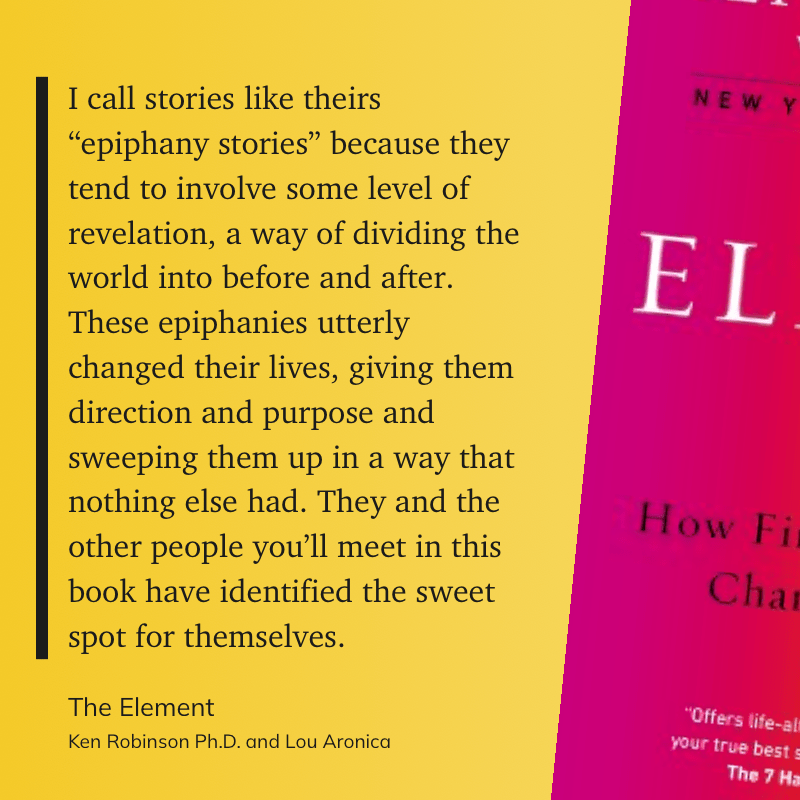
“I call stories like theirs “epiphany stories” because they tend to involve some level of revelation, a way of dividing the world into before and after. These epiphanies utterly changed their lives, giving them direction and purpose and sweeping them up in a way that nothing else had. They and the other people you’ll meet in this book have identified the sweet spot for themselves.” (Ken Robinson Ph.D. and Lou Aronica, The Element)
Writing Exercise: The Power of the Epiphany in Character Development
Key Writing Techniques Illustrated by the Quotation:
1. Epiphany as a Structural and Emotional Pivot – The quotation highlights how a moment of revelation divides a character’s life into “before” and “after,” serving as a turning point that shapes their direction.
2. Personal Stakes and Transformation – A strong epiphany is not just a realization but one that profoundly affects the character’s sense of purpose, forcing them to confront something essential about themselves.
3. Authenticity in Emotional Discovery – The most compelling epiphanies feel organic, arising naturally from the character’s internal or external conflicts, rather than being imposed for dramatic effect.
Writing Prompt (500 words):
Write a scene in which your protagonist experiences an epiphany that alters their sense of self or their path forward. The moment should be specific, tied to an immediate experience rather than an abstract realization. Consider what has led them to this point, what triggers the shift, and how it reshapes their perspective.
Set the scene in a place where the protagonist feels either deeply uncomfortable or unexpectedly at home—this contrast should amplify the revelation. Their realization should not be explicitly stated but should be conveyed through sensory details, actions, and subtle internal shifts.
For example, instead of writing, “She suddenly realized she had wasted her life,” show this realization through how she interacts with her environment. Maybe she watches a younger woman at a train station, carefree and laughing, and instinctively pulls out her phone to text someone she had long abandoned, finally acknowledging what she lost.
Evaluation Criteria for a Strong Response:
• Organic Development – The epiphany should arise naturally from the character’s experiences and not feel forced or overly dramatic.
• Subtlety in Revelation – Avoid heavy-handed explanations. Let the reader infer the shift in the character through their thoughts, actions, or setting interactions.
• Emotional Resonance – The moment should carry weight, making the reader feel the impact of the realization, even if it’s understated.
• Clear Before and After – The response should establish a distinction between the character’s mindset before and after the epiphany, even if the change is small.
Weak vs. Strong Execution Examples:
Weak:
“As John sat at the funeral, he realized he had never told his father he loved him. He felt overwhelmed with regret.”
(This tells the reader the character’s realization instead of showing it. There’s no depth to the emotional transformation.)
Strong:
John watched the minister’s mouth move, but the words blurred. A cough from the back of the chapel startled him, and he turned instinctively—half expecting to see his father, impatient as ever, checking his watch. The chair next to him was empty. It had been empty for years, really. His fingers twitched toward his phone, but there was no one left to call.
(This allows the reader to experience the character’s realization rather than being told outright.)
Follow-up Questions for Workshopping/Revision:
1. Does the epiphany feel earned, or does it seem sudden or contrived?
2. Is the moment rooted in the character’s specific experience, or could it happen to anyone?
3. Does the setting reinforce the emotional weight of the realization?
4. How does the shift in perspective manifest in action or internal thought, rather than direct explanation?
5. What lingers in the reader’s mind after the scene ends?
Recommended Reading Example:
“Araby” by James Joyce – This short story exemplifies a powerful, understated epiphany. The protagonist’s realization at the end is quiet yet devastating, transforming how he sees himself and the world. Joyce masterfully builds toward this moment, using setting and sensory detail to deepen the impact.
This exercise should challenge you to craft a meaningful shift in a character’s life without relying on exposition—let the reader feel the moment of transformation as it unfolds.

Leave a comment