
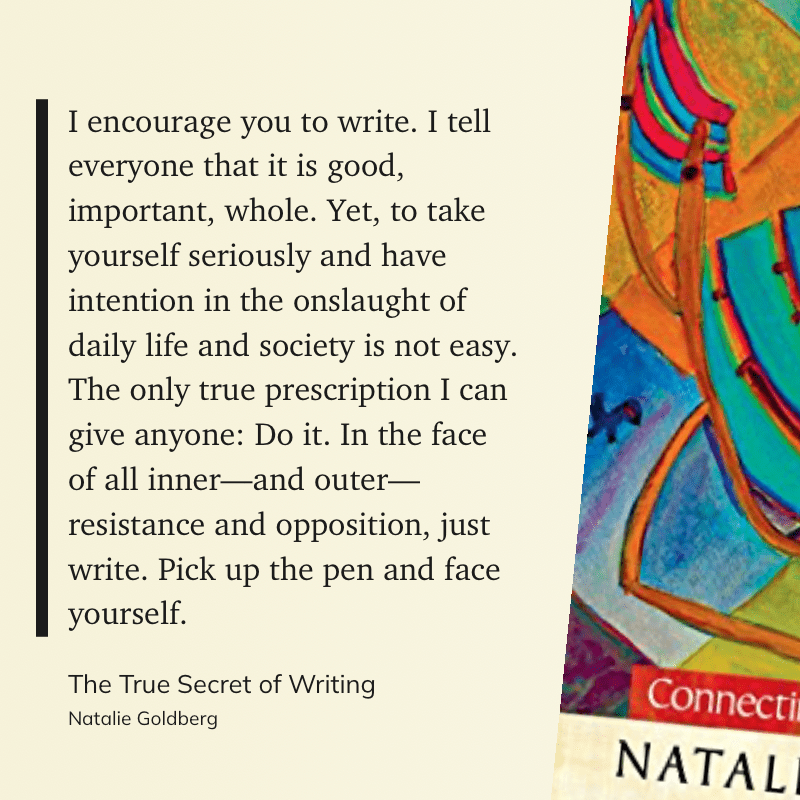
“I encourage you to write. I tell everyone that it is good, important, whole. Yet, to take yourself seriously and have intention in the onslaught of daily life and society is not easy. The only true prescription I can give anyone: Do it. In the face of all inner—and outer—resistance and opposition, just write. Pick up the pen and face yourself.” (Natalie Goldberg, The True Secret of Writing)
Writing Exercise: The Intentional Confrontation—Facing Resistance on the Page
Techniques Illustrated by the Quotation
1. Overcoming Resistance: Emphasizing the discipline of writing despite internal doubt or external challenges.
2. Writing with Purpose: Approaching writing as a deliberate act of self-reflection and emotional honesty.
3. Blending Internal and External Conflict: Crafting characters whose internal struggles echo or inform their external circumstances.
The Writing Prompt
Write a 500-word scene where a protagonist encounters a literal or metaphorical threshold they are reluctant to cross—e.g., a locked door, a confrontation, or a physical challenge. The scene must include:
• A clear depiction of the protagonist’s internal resistance, communicated through inner monologue and sensory details.
• An external obstacle or pressure that mirrors or amplifies the internal struggle.
• A decisive action—small or large—that shows whether they choose to cross the threshold or turn away.
In this exercise, prioritize honesty over polish: let the writing reflect the character’s raw, unfiltered experience.
Evaluation Criteria
Strong Responses:
• Internal monologue is vivid, layered, and reveals vulnerability or complexity.
• The external conflict meaningfully parallels or contrasts with the internal struggle.
• The character’s decisive moment feels emotionally authentic and inevitable.
• The writing embraces the tension and uncertainty of the moment without shying away.
Weak Responses:
• Generalized or vague internal monologue that lacks emotional weight.
• An unclear or disconnected relationship between the internal and external conflicts.
• A lack of a defined moment of decision, leaving the scene unresolved or unconvincing.
• Over-polished prose that prioritizes style over substance.
Follow-Up Questions for Workshopping/Revision
1. How effectively does the internal monologue reveal the character’s emotional stakes?
2. Does the external conflict resonate with the character’s inner struggle? How could it be strengthened?
3. Is the moment of action or inaction clear and impactful?
4. What specific details could deepen the emotional authenticity of the scene?
5. How does this moment contribute to a larger narrative about the character’s journey?
Recommended Reading
Excerpt: “Sonny’s Blues” by James Baldwin
This story exemplifies the interplay between internal resistance, external conflict, and emotional confrontation. Baldwin’s characters wrestle with deep personal struggles while navigating societal and relational tensions, providing a masterclass in intentional, emotionally rich writing.

Leave a comment