
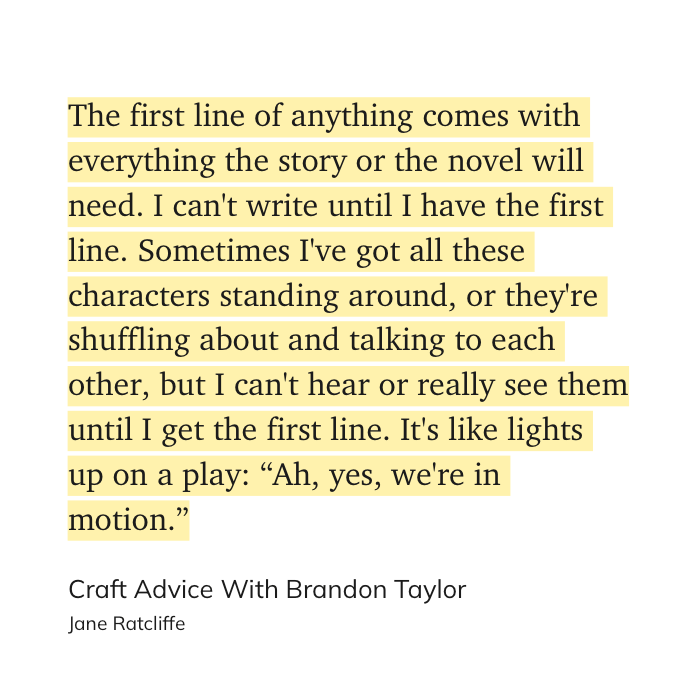
“The first line of anything comes with everything the story or the novel will need. I can’t write until I have the first line. Sometimes I’ve got all these characters standing around, or they’re shuffling about and talking to each other, but I can’t hear or really see them until I get the first line. It’s like lights up on a play: “Ah, yes, we’re in motion.”” (Jane Ratcliffe, Craft Advice With Brandon Taylor)
Writing Exercise: “The First Line: Setting the Stage for Character and Story”
This exercise explores the role of the first line in establishing tone, character, and narrative motion. Using the Brandon Taylor quotation shared by Jane Ratcliffe, we’ll focus on techniques to:
1. Set the tone and stakes immediately.
2. Introduce character dynamics subtly but distinctly.
3. Create forward momentum that invites the reader into the story.
Step 1: Writing Prompt (500 Words)
Write the first scene of a story (500 words max) using a single, compelling first line to establish the tone, hint at the central tension, and ground at least one character in a vivid situation. Imagine the first line as a spark that ignites the rest of the story. Build the scene with the following in mind:
• Tone: Is it ominous, whimsical, melancholy, or sharp? Reflect that in every word choice after the first line.
• Character: Introduce one or two characters through action, thought, or dialogue, but avoid dumping backstory. Allow the first line to suggest something fundamental about who they are.
• Forward Momentum: The first line should contain an implicit or explicit “why” that propels the reader to continue. Build on this to create tension or curiosity.
Evaluation Criteria
A strong response will:
1. Deliver a striking, precise first line that encapsulates the tone and stakes of the story. (e.g., “Marta hadn’t meant to leave the baby behind, but by the time she realized, it was too late.”)
2. Show, don’t tell. Use sensory details, dialogue, and character actions to make the world and characters tangible, rather than summarizing.
3. Maintain forward momentum. Every sentence should build on the first line, pushing the narrative toward a subtle or overt question that intrigues the reader.
Weak responses might:
• Offer a vague or generic first line without a distinct tone or stakes.
• Rely too heavily on exposition rather than immersing the reader in a scene.
• Lack narrative movement, stagnating in description or internal monologue.
Follow-Up Questions for Workshopping
• Does the first line establish tone, tension, or a central question? If not, how can it be sharpened?
• How does the rest of the scene reflect the tone or stakes set up by the first line?
• Are the characters’ motivations or emotional states clear without excessive exposition?
• Where does the scene feel like it’s moving toward? If unclear, how might the first line better anchor the narrative motion?
Recommended Reading
• The Secret History by Donna Tartt (opening line: “The snow in the mountains was melting and Bunny had been dead for several weeks before we came to understand the gravity of our situation.”)
• Exemplifies tone-setting, intrigue, and narrative momentum.
• Cathedral by Raymond Carver (opening line: “This blind man, an old friend of my wife’s, he was on his way to spend the night.”)
• Shows how a first line can reveal character relationships and tension while establishing voice.
Concluding Thoughts
This exercise forces you to hone in on the mechanics of storytelling through the first line, a deceptively small but powerful element of craft. Approach it as though the first line is the stage—everything that follows should reflect the light it casts.

Leave a comment