
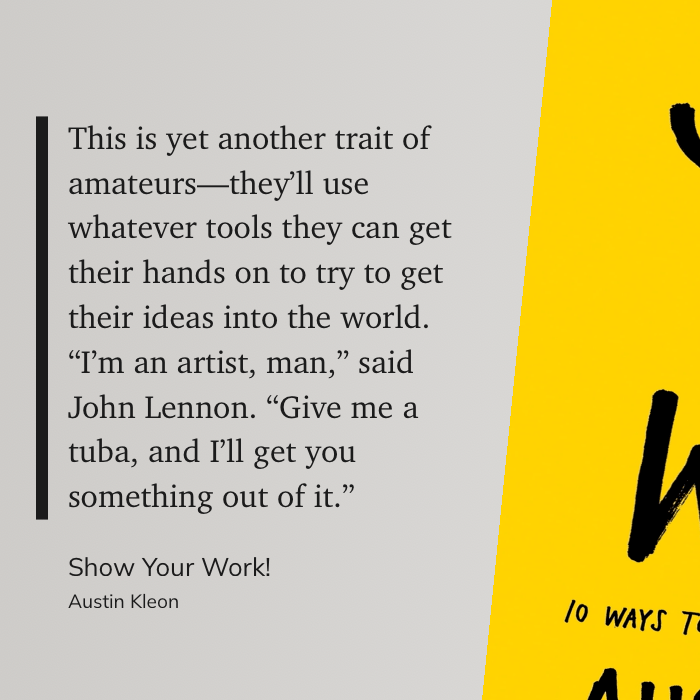
“This is yet another trait of amateurs—they’ll use whatever tools they can get their hands on to try to get their ideas into the world. “I’m an artist, man,” said John Lennon. “Give me a tuba, and I’ll get you something out of it.”” (Austin Kleon, Show Your Work!)
Writing Exercise: The Artist’s Toolbox
Context:
Austin Kleon’s quotation emphasizes the resourcefulness and adaptability of creative individuals. Great character-driven storytelling often hinges on showing how characters innovate and adapt to unexpected circumstances. This exercise invites you to challenge your characters, deepen their development, and use unexpected tools to reveal their essence.
Key Writing Practice Techniques:
1. Character Agency Through Improvisation
• Showcase how your character adapts to challenges when traditional tools or resources are unavailable.
2. Objects as Symbols
• Use an unconventional object to reflect the character’s inner world, relationships, or conflict.
3. Dynamic Problem-Solving in Plot
• Incorporate an immediate, high-stakes challenge that requires the character to reveal their deeper traits or flaws.
Writing Prompt:
Write a scene (500 words) in which your character is forced to use an unconventional object to solve a pressing problem. The stakes should be significant—this moment should reveal something profound about their personality, relationships, or values.
Guidelines:
• The object must be unexpected (e.g., a tuba, a broken umbrella, a sack of flour).
• The problem should demand immediate action (e.g., saving someone, covering up a mistake, repairing a relationship).
• Use sensory details and internal monologue to connect the character’s actions to their emotions and motivations.
Evaluation Criteria:
1. Creativity and Originality
• Is the object’s use inventive and meaningful within the context of the scene?
• Weak Example: The object is used in a way that feels convenient or unrelated to the character or plot.
• Strong Example: The object’s use reflects the character’s personality, struggles, or ingenuity.
2. Character Depth
• Does the scene deepen our understanding of the character?
• Weak Example: The object feels like a gimmick, and the character remains unchanged or unexplored.
• Strong Example: The object helps illuminate the character’s inner world or significant growth.
3. Conflict and Stakes
• Are the stakes high enough to create urgency and emotional tension?
• Weak Example: The problem feels minor, and the solution lacks impact.
• Strong Example: The problem creates meaningful conflict, and the solution reveals or challenges the character’s values.
Follow-Up Questions for Workshopping/Revision:
1. How does the object reflect or challenge the character’s personality or values?
2. Are the stakes high enough to sustain tension throughout the scene?
3. Does the resolution feel true to the character’s traits and decisions?
4. Would the scene benefit from more sensory details or symbolic resonance?
5. How does this moment contribute to the overall narrative or the character’s development?
Recommended Reading:
“The Lottery Ticket” by Anton Chekhov
• Chekhov demonstrates how an ordinary object—a lottery ticket—can become a catalyst for revealing a character’s inner world and the dynamics of their relationships. This short story is widely available and serves as an excellent example of using an object to drive both plot and character development.
This exercise is designed to challenge you to use everyday tools or unexpected objects to create rich, dynamic scenes that highlight character depth, creativity, and emotional stakes. By focusing on improvisation and symbolism, you’ll create compelling moments that resonate with readers.

Leave a comment