
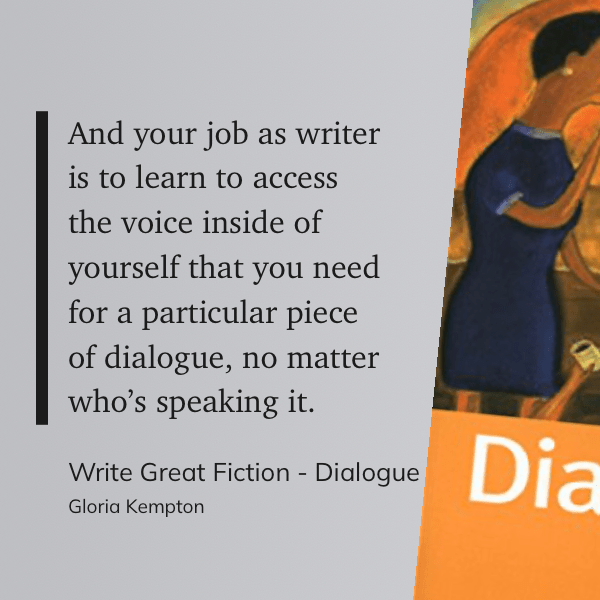
“And your job as writer is to learn to access the voice inside of yourself that you need for a particular piece of dialogue, no matter who’s speaking it.” (Gloria Kempton, Write Great Fiction – Dialogue)
Writing Exercise: Finding Voice in Dialogue
Based on the Gloria Kempton quote:
Key Writing Practice Development Techniques:
- Voice as Performance: This quote emphasizes that dialogue is not just about conveying information; it’s about embodying the character’s unique way of speaking. Writers must “access the voice” – imagine themselves performing the character’s speech, capturing their rhythm, tone, and idiosyncrasies.
- Empathy and Immersion: To truly access a character’s voice, writers must cultivate deep empathy. They must immerse themselves in the character’s perspective, understanding their motivations, history, and emotional state.
- Voice as a Tool for Characterization: Dialogue is a powerful tool for revealing character. By carefully crafting each line, writers can subtly convey a character’s age, social class, education, background, and even their inner conflicts.
Writing Prompt:
Write a 500-word scene featuring a conversation between two characters who are complete opposites in terms of their social background, education, and life experiences.
- Character 1: A renowned, world-weary art collector.
- Character 2: A young, idealistic art student struggling to make ends meet.
The scene should take place in the art collector’s opulent mansion. The conversation should revolve around the student’s art portfolio, but it should also reveal deeper truths about both characters.
Evaluation Criteria:
- Authenticity of Voice:
- Strong: Each character speaks with a distinct voice that reflects their background, personality, and social position. The collector’s speech may be refined and dismissive, while the student’s may be passionate and uncertain.
- Weak: Both characters sound alike, or their voices are generic and lack individuality.
- Voice as Characterization:
- Strong: Dialogue reveals crucial details about each character: the collector’s cynicism, the student’s vulnerability, their conflicting values, and their hidden desires.
- Weak: Dialogue merely conveys plot points and lacks the depth to illuminate character.
- Voice as Performance:
- Strong: The dialogue feels alive and dynamic, with varying rhythms, pauses, and inflections. It’s easy to “hear” the characters speaking aloud.
- Weak: Dialogue is flat and predictable, lacking the nuances of natural conversation.
Workshopping/Revision Questions:
- How does each character’s voice contribute to the power dynamic of the scene?
- Are there any moments where the dialogue feels stilted or unnatural? How can you make it more authentic?
- What are the unspoken subtexts of the conversation? How can you use dialogue to reveal these subtexts more effectively?
- How can you further differentiate the characters’ voices through the use of dialect, slang, or other stylistic choices?
Example of a Published Work Exemplifying These Techniques:
- “Interpreter of Maladies” by Jhumpa Lahiri: Lahiri masterfully captures the distinct voices of her Indian characters, revealing their cultural backgrounds, social anxieties, and inner conflicts through their nuanced use of language.
Note: This exercise can be adapted to fit the specific needs and interests of the individual students. For example, instead of an art collector and student, the characters could be a seasoned politician and a young activist, a renowned chef and a struggling food truck owner, or a grandmother and her rebellious granddaughter.
This exercise aims to guide writers beyond simply writing dialogue and encourage them to truly inhabit their characters’ voices, using language as a powerful tool for characterization and storytelling.

Leave a comment